

52
3 Dopaquinone Conversion and Related Reactions
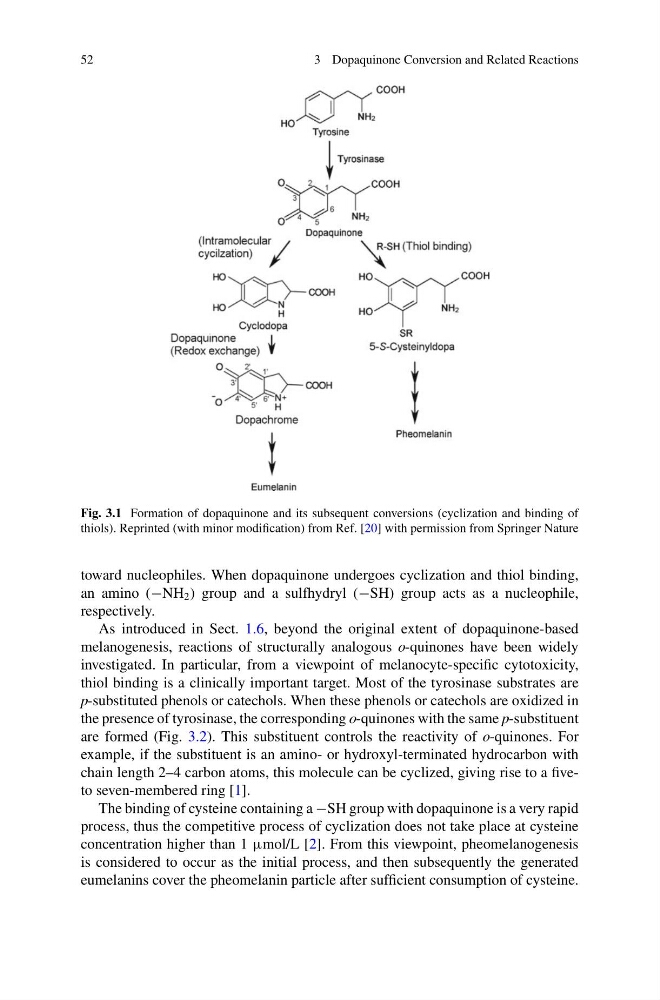
Fig. 3.1 Formation of dopaquinone and its subsequent conversions (cyclization and binding of
thiols). Reprinted (with minor modification) from Ref. [20] with permission from Springer Nature
toward nucleophiles. When dopaquinone undergoes cyclization and thiol binding,
an amino (−NH 2 ) group and a sulfhydryl (−SH) group acts as a nucleophile,
respectively.
As introduced in Sect. 1.6, beyond the original extent of dopaquinone-based
melanogenesis, reactions of structurally analogous o-quinones have been widely
investigated. In particular, from a viewpoint of melanocyte-specific cytotoxicity,
thiol binding is a clinically important target. Most of the tyrosinase substrates are
p-substituted phenols or catechols. When these phenols or catechols are oxidized in
the presence of tyrosinase, the corresponding o-quinones with the same p-substituent
are formed (Fig. 3.2). This substituent controls the reactivity of o-quinones. For
example, if the substituent is an amino- or hydroxyl-terminated hydrocarbon with
chain length 2–4 carbon atoms, this molecule can be cyclized, giving rise to a fiveto seven-membered ring [1].
The binding of cysteine containing a −SH group with dopaquinone is a very rapid
process, thus the competitive process of cyclization does not take place at cysteine
concentration higher than 1 μmol/L [2]. From this viewpoint, pheomelanogenesis
is considered to occur as the initial process, and then subsequently the generated
eumelanins cover the pheomelanin particle after sufficient consumption of cysteine.
3 Dopaquinone Conversion and Related Reactions
Fig. 3.1 Formation of dopaquinone and its subsequent conversions (cyclization and binding of
thiols). Reprinted (with minor modification) from Ref. [20] with permission from Springer Nature
toward nucleophiles. When dopaquinone undergoes cyclization and thiol binding,
an amino (−NH 2 ) group and a sulfhydryl (−SH) group acts as a nucleophile,
respectively.
As introduced in Sect. 1.6, beyond the original extent of dopaquinone-based
melanogenesis, reactions of structurally analogous o-quinones have been widely
investigated. In particular, from a viewpoint of melanocyte-specific cytotoxicity,
thiol binding is a clinically important target. Most of the tyrosinase substrates are
p-substituted phenols or catechols. When these phenols or catechols are oxidized in
the presence of tyrosinase, the corresponding o-quinones with the same p-substituent
are formed (Fig. 3.2). This substituent controls the reactivity of o-quinones. For
example, if the substituent is an amino- or hydroxyl-terminated hydrocarbon with
chain length 2–4 carbon atoms, this molecule can be cyclized, giving rise to a fiveto seven-membered ring [1].
The binding of cysteine containing a −SH group with dopaquinone is a very rapid
process, thus the competitive process of cyclization does not take place at cysteine
concentration higher than 1 μmol/L [2]. From this viewpoint, pheomelanogenesis
is considered to occur as the initial process, and then subsequently the generated
eumelanins cover the pheomelanin particle after sufficient consumption of cysteine.