

2.3 Dopachrome Conversion Mechanism Without Cu(II) Coordination
41
Table 2.1 Energetic stability of dopachrome prototropic tautomers at the initial step
Tautomer a
Protonation sites b
Energy (kcal/mol) c
Gibbs free energy
(kcal/mol) d
Equilibrium
composition e
A (vac.)
Carboxyl, N1
0.0
0.0
4.4 × 10 −4
B (vac.)
N1, O6
11.3
11.7
2.3 × 10 −12
C (vac.)
Carboxyl, O6
−5.5
−4.8
1.0
D (vac.)
N1, O5
28.0
27.5
1.7 × 10 −23
E (vac.)
Carboxyl, O5
Unstable f
Unstable f
0.0
A (aq.)
Carboxyl, N1
−18.5
−18.6
1.0
B (aq.)
N1, O6
−11.8
−11.4
8.4 × 10 −6
C (aq.)
Carboxyl, O6
−15.4
−15.4
6.1 × 10 −3
D (aq.)
N1, O5
0.7
0.7
2.6 × 10 −14
E (aq.)
Carboxyl, O5
0.3
−0.5
1.8 × 10 −13
a Symbols of dopachrome prototropic tautomers. Calculation without and with PCM is, respectively,
denoted as (vac.) and (aq.)
b Numbers in this column correspond to the labels in Fig. 2.1
c The energy origin was set to the value of A (vac.)
d The energy origin was set to the value of A (vac.). Temperature was set to 309.5 K as a condition
of human body
e Equilibrium composition is defined as the mole fraction of each tautomer in equilibrium state,
normalized by amount of all tautomers in vacuo or in aqueous solution. These compositions were
calculated based on the values of the Gibbs free energies. 1.0 of the activity coefficient was used as
an approximate value
f Spontaneous proton transfer to O6 occurred
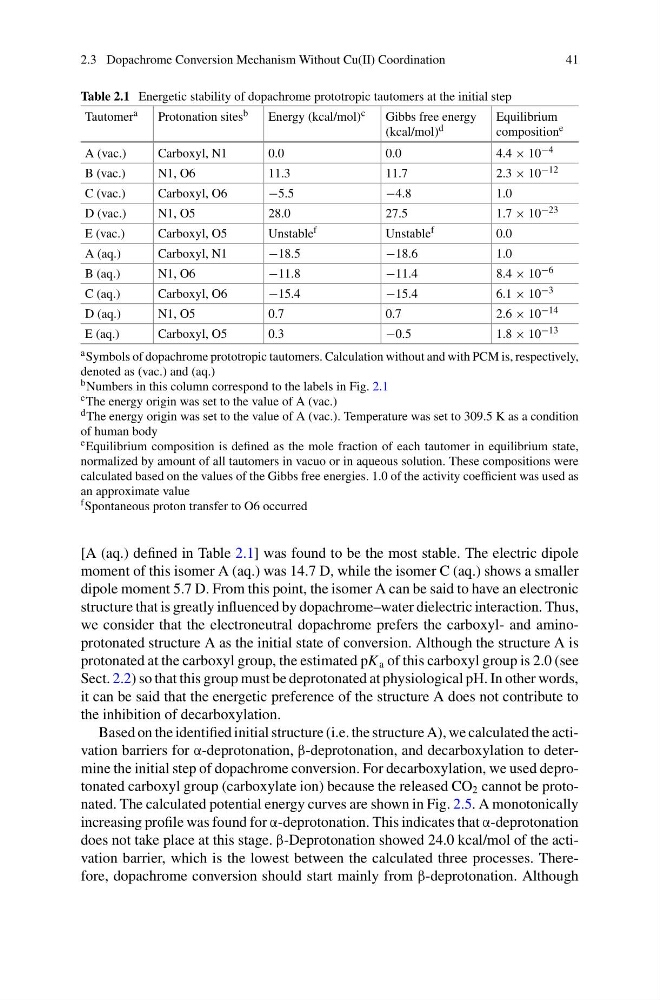
[A (aq.) defined in Table 2.1] was found to be the most stable. The electric dipole
moment of this isomer A (aq.) was 14.7 D, while the isomer C (aq.) shows a smaller
dipole moment 5.7 D. From this point, the isomer A can be said to have an electronic
structure that is greatly influenced by dopachrome–water dielectric interaction. Thus,
we consider that the electroneutral dopachrome prefers the carboxyl- and aminoprotonated structure A as the initial state of conversion. Although the structure A is
protonated at the carboxyl group, the estimated pK a of this carboxyl group is 2.0 (see
Sect. 2.2) so that this group must be deprotonated at physiological pH. In other words,
it can be said that the energetic preference of the structure A does not contribute to
the inhibition of decarboxylation.
Based on the identified initial structure (i.e. the structure A), we calculated the activation barriers for α-deprotonation, β-deprotonation, and decarboxylation to determine the initial step of dopachrome conversion. For decarboxylation, we used deprotonated carboxyl group (carboxylate ion) because the released CO 2 cannot be protonated. The calculated potential energy curves are shown in Fig. 2.5. A monotonically
increasing profile was found for α-deprotonation. This indicates that α-deprotonation
does not take place at this stage. β-Deprotonation showed 24.0 kcal/mol of the activation barrier, which is the lowest between the calculated three processes. Therefore, dopachrome conversion should start mainly from β-deprotonation. Although
41
Table 2.1 Energetic stability of dopachrome prototropic tautomers at the initial step
Tautomer a
Protonation sites b
Energy (kcal/mol) c
Gibbs free energy
(kcal/mol) d
Equilibrium
composition e
A (vac.)
Carboxyl, N1
0.0
0.0
4.4 × 10 −4
B (vac.)
N1, O6
11.3
11.7
2.3 × 10 −12
C (vac.)
Carboxyl, O6
−5.5
−4.8
1.0
D (vac.)
N1, O5
28.0
27.5
1.7 × 10 −23
E (vac.)
Carboxyl, O5
Unstable f
Unstable f
0.0
A (aq.)
Carboxyl, N1
−18.5
−18.6
1.0
B (aq.)
N1, O6
−11.8
−11.4
8.4 × 10 −6
C (aq.)
Carboxyl, O6
−15.4
−15.4
6.1 × 10 −3
D (aq.)
N1, O5
0.7
0.7
2.6 × 10 −14
E (aq.)
Carboxyl, O5
0.3
−0.5
1.8 × 10 −13
a Symbols of dopachrome prototropic tautomers. Calculation without and with PCM is, respectively,
denoted as (vac.) and (aq.)
b Numbers in this column correspond to the labels in Fig. 2.1
c The energy origin was set to the value of A (vac.)
d The energy origin was set to the value of A (vac.). Temperature was set to 309.5 K as a condition
of human body
e Equilibrium composition is defined as the mole fraction of each tautomer in equilibrium state,
normalized by amount of all tautomers in vacuo or in aqueous solution. These compositions were
calculated based on the values of the Gibbs free energies. 1.0 of the activity coefficient was used as
an approximate value
f Spontaneous proton transfer to O6 occurred
[A (aq.) defined in Table 2.1] was found to be the most stable. The electric dipole
moment of this isomer A (aq.) was 14.7 D, while the isomer C (aq.) shows a smaller
dipole moment 5.7 D. From this point, the isomer A can be said to have an electronic
structure that is greatly influenced by dopachrome–water dielectric interaction. Thus,
we consider that the electroneutral dopachrome prefers the carboxyl- and aminoprotonated structure A as the initial state of conversion. Although the structure A is
protonated at the carboxyl group, the estimated pK a of this carboxyl group is 2.0 (see
Sect. 2.2) so that this group must be deprotonated at physiological pH. In other words,
it can be said that the energetic preference of the structure A does not contribute to
the inhibition of decarboxylation.
Based on the identified initial structure (i.e. the structure A), we calculated the activation barriers for α-deprotonation, β-deprotonation, and decarboxylation to determine the initial step of dopachrome conversion. For decarboxylation, we used deprotonated carboxyl group (carboxylate ion) because the released CO 2 cannot be protonated. The calculated potential energy curves are shown in Fig. 2.5. A monotonically
increasing profile was found for α-deprotonation. This indicates that α-deprotonation
does not take place at this stage. β-Deprotonation showed 24.0 kcal/mol of the activation barrier, which is the lowest between the calculated three processes. Therefore, dopachrome conversion should start mainly from β-deprotonation. Although