

40
2 Dopachrome Conversion
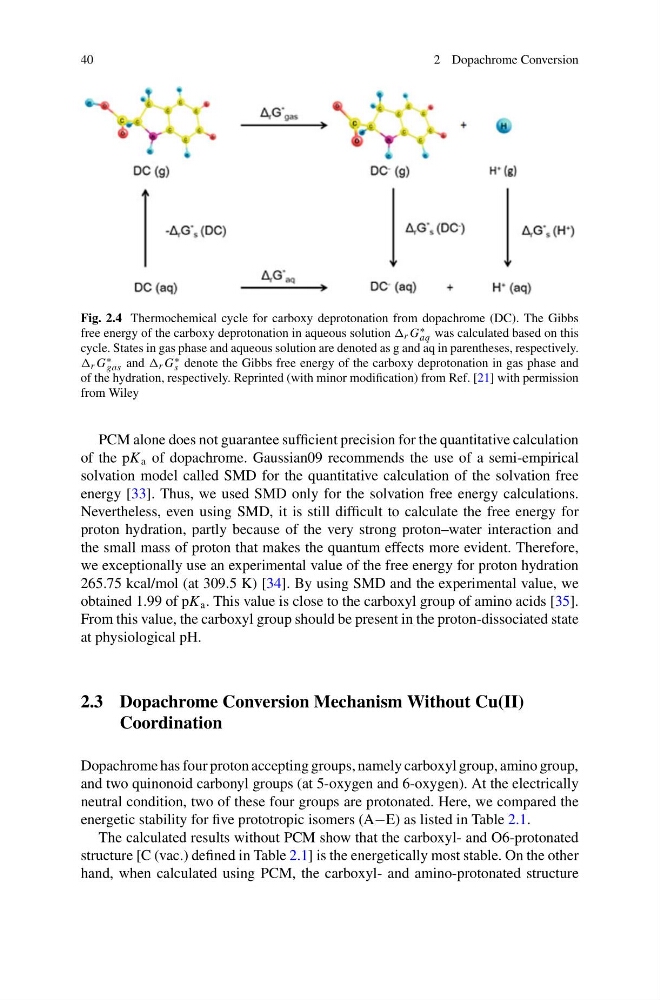
Fig. 2.4 Thermochemical cycle for carboxy deprotonation from dopachrome (DC). The Gibbs
free energy of the carboxy deprotonation in aqueous solution r G ∗
aq was calculated based on this
cycle. States in gas phase and aqueous solution are denoted as g and aq in parentheses, respectively.
r G ∗
gas and r G ∗
s denote the Gibbs free energy of the carboxy deprotonation in gas phase and
of the hydration, respectively. Reprinted (with minor modification) from Ref. [21] with permission
from Wiley
PCM alone does not guarantee sufficient precision for the quantitative calculation
of the pK a of dopachrome. Gaussian09 recommends the use of a semi-empirical
solvation model called SMD for the quantitative calculation of the solvation free
energy [33]. Thus, we used SMD only for the solvation free energy calculations.
Nevertheless, even using SMD, it is still difficult to calculate the free energy for
proton hydration, partly because of the very strong proton–water interaction and
the small mass of proton that makes the quantum effects more evident. Therefore,
we exceptionally use an experimental value of the free energy for proton hydration
265.75 kcal/mol (at 309.5 K) [34]. By using SMD and the experimental value, we
obtained 1.99 of pK a . This value is close to the carboxyl group of amino acids [35].
From this value, the carboxyl group should be present in the proton-dissociated state
at physiological pH.
2.3 Dopachrome Conversion Mechanism Without Cu(II)
Coordination
Dopachrome has four proton accepting groups, namely carboxyl group, amino group,
and two quinonoid carbonyl groups (at 5-oxygen and 6-oxygen). At the electrically
neutral condition, two of these four groups are protonated. Here, we compared the
energetic stability for five prototropic isomers (A−E) as listed in Table 2.1.
The calculated results without PCM show that the carboxyl- and O6-protonated
structure [C (vac.) defined in Table 2.1] is the energetically most stable. On the other
hand, when calculated using PCM, the carboxyl- and amino-protonated structure
2 Dopachrome Conversion
Fig. 2.4 Thermochemical cycle for carboxy deprotonation from dopachrome (DC). The Gibbs
free energy of the carboxy deprotonation in aqueous solution r G ∗
aq was calculated based on this
cycle. States in gas phase and aqueous solution are denoted as g and aq in parentheses, respectively.
r G ∗
gas and r G ∗
s denote the Gibbs free energy of the carboxy deprotonation in gas phase and
of the hydration, respectively. Reprinted (with minor modification) from Ref. [21] with permission
from Wiley
PCM alone does not guarantee sufficient precision for the quantitative calculation
of the pK a of dopachrome. Gaussian09 recommends the use of a semi-empirical
solvation model called SMD for the quantitative calculation of the solvation free
energy [33]. Thus, we used SMD only for the solvation free energy calculations.
Nevertheless, even using SMD, it is still difficult to calculate the free energy for
proton hydration, partly because of the very strong proton–water interaction and
the small mass of proton that makes the quantum effects more evident. Therefore,
we exceptionally use an experimental value of the free energy for proton hydration
265.75 kcal/mol (at 309.5 K) [34]. By using SMD and the experimental value, we
obtained 1.99 of pK a . This value is close to the carboxyl group of amino acids [35].
From this value, the carboxyl group should be present in the proton-dissociated state
at physiological pH.
2.3 Dopachrome Conversion Mechanism Without Cu(II)
Coordination
Dopachrome has four proton accepting groups, namely carboxyl group, amino group,
and two quinonoid carbonyl groups (at 5-oxygen and 6-oxygen). At the electrically
neutral condition, two of these four groups are protonated. Here, we compared the
energetic stability for five prototropic isomers (A−E) as listed in Table 2.1.
The calculated results without PCM show that the carboxyl- and O6-protonated
structure [C (vac.) defined in Table 2.1] is the energetically most stable. On the other
hand, when calculated using PCM, the carboxyl- and amino-protonated structure