

1.3 Biosynthesis of Eumelanin—Formation of Dopaquinone and Dopachrome
15
formation. Melanin biosynthesis begins with tyrosine. Tyrosinase expressed in
melanocytes catalyzes the oxidation of tyrosine to produce dopaquinone. When
dopaquinone undergoes intramolecular cyclization, eumelanin production (eumelanogenesis) will take place. Cyclodopa formed by dopaquinone cyclization reacts
with uncyclized dopaquinone to form dopachrome and dopa by means of redox
exchange. Dopachrome can be spontaneously converted to DHI, but the presence
of factors such as DCT promotes the conversion to DHICA. DHI and DHICA are
crosslinked to each other via IQ and its 2-carboxyl derivative by a further oxidation reaction to form eumelanin. Figure 1.4 summarizes the melanogenesis route
described here (and also the pheomelanin synthesis pathway).
1.4 Biosynthesis of Eumelanin—Oxidative Polymerization
to Form Eumelanin
1.4.1 Identification of Oligomeric Molecules
by Inter-Monomer Coupling
This section reviews the major findings that have been obtained so far regarding
the processes of eumelanin formation by oxidative polymerization of DHI and
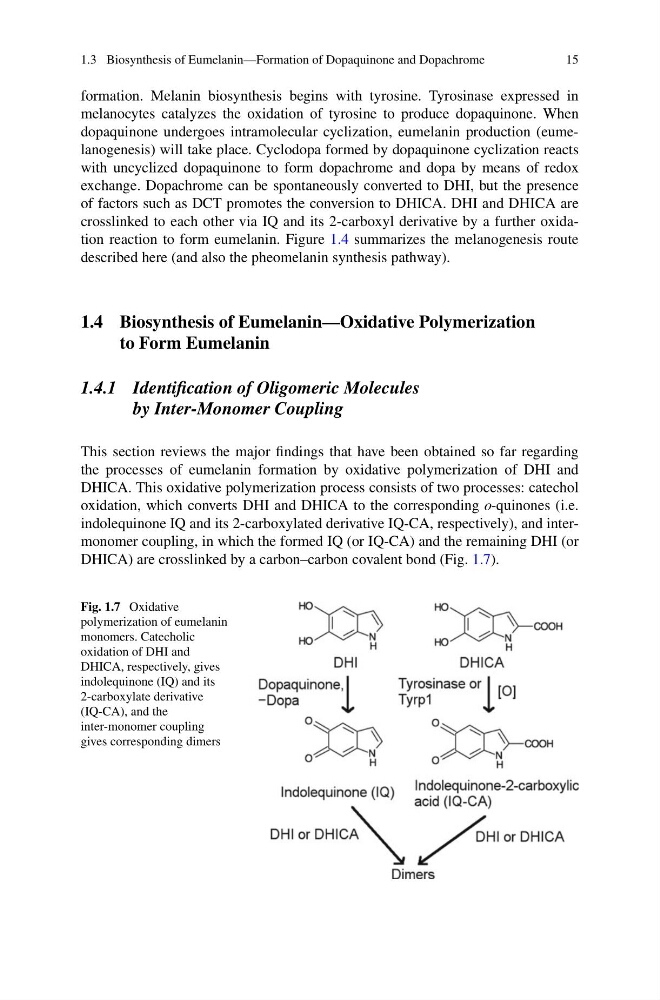
DHICA. This oxidative polymerization process consists of two processes: catechol
oxidation, which converts DHI and DHICA to the corresponding o-quinones (i.e.
indolequinone IQ and its 2-carboxylated derivative IQ-CA, respectively), and intermonomer coupling, in which the formed IQ (or IQ-CA) and the remaining DHI (or
DHICA) are crosslinked by a carbon–carbon covalent bond (Fig. 1.7).
Fig. 1.7 Oxidative
polymerization of eumelanin
monomers. Catecholic
oxidation of DHI and
DHICA, respectively, gives
indolequinone (IQ) and its
2-carboxylate derivative
(IQ-CA), and the
inter-monomer coupling
gives corresponding dimers
15
formation. Melanin biosynthesis begins with tyrosine. Tyrosinase expressed in
melanocytes catalyzes the oxidation of tyrosine to produce dopaquinone. When
dopaquinone undergoes intramolecular cyclization, eumelanin production (eumelanogenesis) will take place. Cyclodopa formed by dopaquinone cyclization reacts
with uncyclized dopaquinone to form dopachrome and dopa by means of redox
exchange. Dopachrome can be spontaneously converted to DHI, but the presence
of factors such as DCT promotes the conversion to DHICA. DHI and DHICA are
crosslinked to each other via IQ and its 2-carboxyl derivative by a further oxidation reaction to form eumelanin. Figure 1.4 summarizes the melanogenesis route
described here (and also the pheomelanin synthesis pathway).
1.4 Biosynthesis of Eumelanin—Oxidative Polymerization
to Form Eumelanin
1.4.1 Identification of Oligomeric Molecules
by Inter-Monomer Coupling
This section reviews the major findings that have been obtained so far regarding
the processes of eumelanin formation by oxidative polymerization of DHI and
DHICA. This oxidative polymerization process consists of two processes: catechol
oxidation, which converts DHI and DHICA to the corresponding o-quinones (i.e.
indolequinone IQ and its 2-carboxylated derivative IQ-CA, respectively), and intermonomer coupling, in which the formed IQ (or IQ-CA) and the remaining DHI (or
DHICA) are crosslinked by a carbon–carbon covalent bond (Fig. 1.7).
Fig. 1.7 Oxidative
polymerization of eumelanin
monomers. Catecholic
oxidation of DHI and
DHICA, respectively, gives
indolequinone (IQ) and its
2-carboxylate derivative
(IQ-CA), and the
inter-monomer coupling
gives corresponding dimers