

14
1 Melanin Chemistry
with respect to the substrate were observed, indicating that dopa-like catechol was
not generated. The reason for choosing these molecules is to prevent the amino
N from intramolecular cyclization by introducing protecting groups. Accordingly,
if cyclization does not occur, the extra O 2 consumption (0.5-fold amount of the
substrate) also does not occur. As described above, oxidation at O 2 /substrate = 1.5
would correspond to the formation of catechol such as dopa. Therefore, it should
be interpreted that dopa was indirectly formed after the formation of dopaquinone.
This indirect formation is likely to take place by reduction between uncyclized and
cyclized dopaquinone (i.e. dopaquinone and cyclodopa), namely the redox exchange
reaction, together with the formation of dopachrome.
Dopaquinone has a UV absorption at a wavelength maximum around 380 nm
[51, 52]. Although chemical properties of dopaquinone and similar o-quinones had
been discussed for a long time as mentioned above, direct observations had not been
reported because of the too short lifetime. Tyrosinase-catalyzed oxidation was too
slow as compared to cyclization of dopaquinone and the redox exchange. Therefore, it
was not possible to spectroscopically identify dopaquinone because the production
rate was lower than the consumption rate. This problem has become resolved by
pulse radiolysis techniques, which were employed to track the production and the
consumption of dopaquinone.
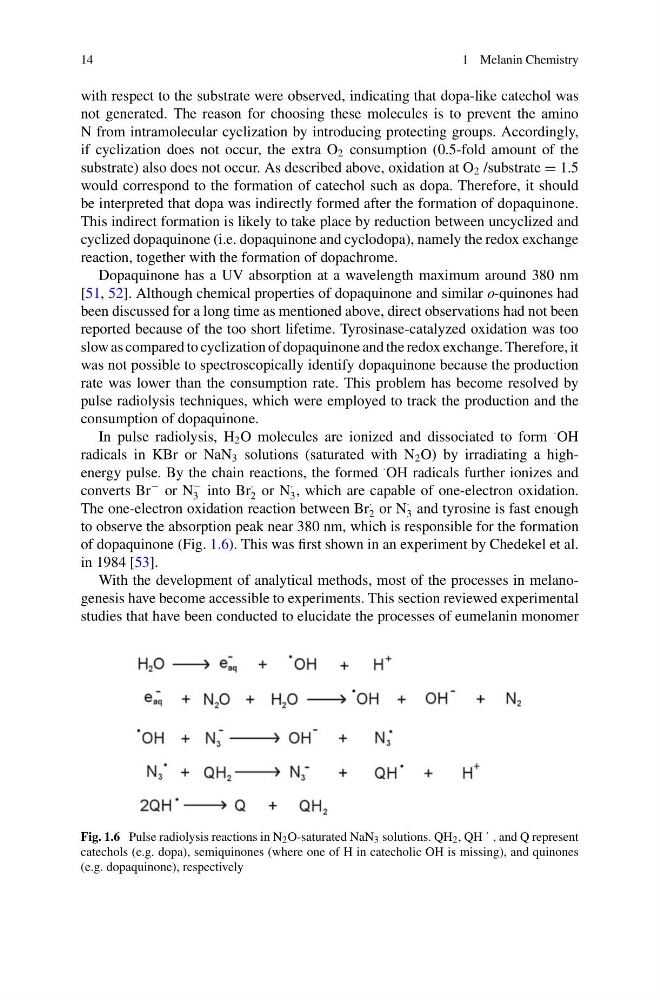
In pulse radiolysis, H 2 O molecules are ionized and dissociated to form
· OH
radicals in KBr or NaN 3 solutions (saturated with N 2 O) by irradiating a highenergy pulse. By the chain reactions, the formed
· OH radicals further ionizes and
converts Br
− or N
−
3 into Br
·
2 or N
·
3 , which are capable of one-electron oxidation.
The one-electron oxidation reaction between Br
·
2 or N
·
3 and tyrosine is fast enough
to observe the absorption peak near 380 nm, which is responsible for the formation
of dopaquinone (Fig. 1.6). This was first shown in an experiment by Chedekel et al.
in 1984 [53].
With the development of analytical methods, most of the processes in melanogenesis have become accessible to experiments. This section reviewed experimental
studies that have been conducted to elucidate the processes of eumelanin monomer
Fig. 1.6 Pulse radiolysis reactions in N 2 O-saturated NaN 3 solutions. QH 2 , QH ・ , and Q represent
catechols (e.g. dopa), semiquinones (where one of H in catecholic OH is missing), and quinones
(e.g. dopaquinone), respectively
1 Melanin Chemistry
with respect to the substrate were observed, indicating that dopa-like catechol was
not generated. The reason for choosing these molecules is to prevent the amino
N from intramolecular cyclization by introducing protecting groups. Accordingly,
if cyclization does not occur, the extra O 2 consumption (0.5-fold amount of the
substrate) also does not occur. As described above, oxidation at O 2 /substrate = 1.5
would correspond to the formation of catechol such as dopa. Therefore, it should
be interpreted that dopa was indirectly formed after the formation of dopaquinone.
This indirect formation is likely to take place by reduction between uncyclized and
cyclized dopaquinone (i.e. dopaquinone and cyclodopa), namely the redox exchange
reaction, together with the formation of dopachrome.
Dopaquinone has a UV absorption at a wavelength maximum around 380 nm
[51, 52]. Although chemical properties of dopaquinone and similar o-quinones had
been discussed for a long time as mentioned above, direct observations had not been
reported because of the too short lifetime. Tyrosinase-catalyzed oxidation was too
slow as compared to cyclization of dopaquinone and the redox exchange. Therefore, it
was not possible to spectroscopically identify dopaquinone because the production
rate was lower than the consumption rate. This problem has become resolved by
pulse radiolysis techniques, which were employed to track the production and the
consumption of dopaquinone.
In pulse radiolysis, H 2 O molecules are ionized and dissociated to form
· OH
radicals in KBr or NaN 3 solutions (saturated with N 2 O) by irradiating a highenergy pulse. By the chain reactions, the formed
· OH radicals further ionizes and
converts Br
− or N
−
3 into Br
·
2 or N
·
3 , which are capable of one-electron oxidation.
The one-electron oxidation reaction between Br
·
2 or N
·
3 and tyrosine is fast enough
to observe the absorption peak near 380 nm, which is responsible for the formation
of dopaquinone (Fig. 1.6). This was first shown in an experiment by Chedekel et al.
in 1984 [53].
With the development of analytical methods, most of the processes in melanogenesis have become accessible to experiments. This section reviewed experimental
studies that have been conducted to elucidate the processes of eumelanin monomer
Fig. 1.6 Pulse radiolysis reactions in N 2 O-saturated NaN 3 solutions. QH 2 , QH ・ , and Q represent
catechols (e.g. dopa), semiquinones (where one of H in catecholic OH is missing), and quinones
(e.g. dopaquinone), respectively