

1.3 Biosynthesis of Eumelanin—Formation of Dopaquinone and Dopachrome
13
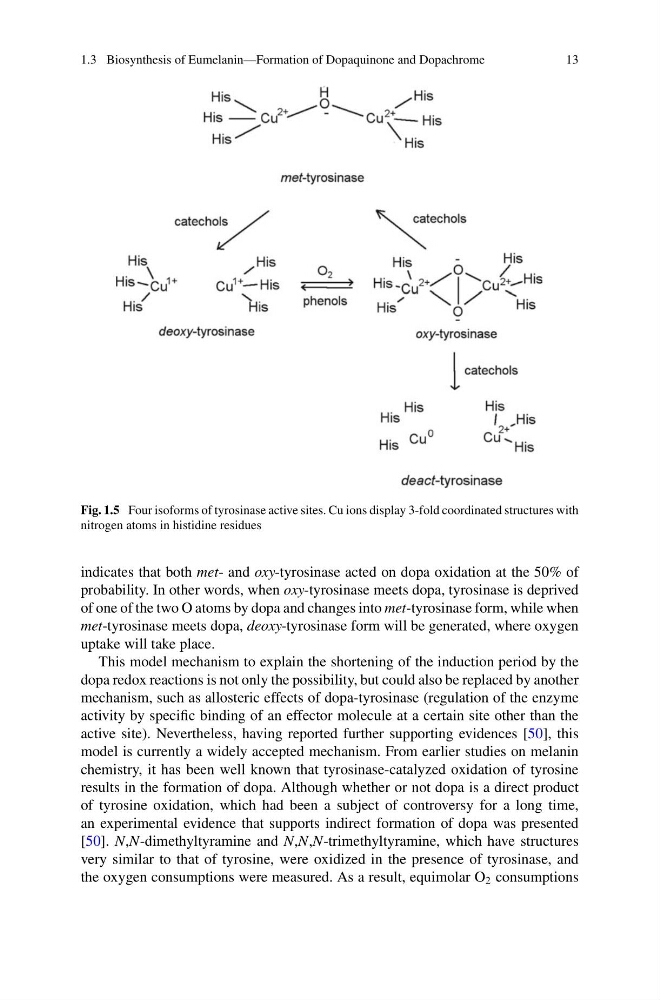
Fig. 1.5 Four isoforms of tyrosinase active sites. Cu ions display 3-fold coordinated structures with
nitrogen atoms in histidine residues
indicates that both met- and oxy-tyrosinase acted on dopa oxidation at the 50% of
probability. In other words, when oxy-tyrosinase meets dopa, tyrosinase is deprived
of one of the two O atoms by dopa and changes into met-tyrosinase form, while when
met-tyrosinase meets dopa, deoxy-tyrosinase form will be generated, where oxygen
uptake will take place.
This model mechanism to explain the shortening of the induction period by the
dopa redox reactions is not only the possibility, but could also be replaced by another
mechanism, such as allosteric effects of dopa-tyrosinase (regulation of the enzyme
activity by specific binding of an effector molecule at a certain site other than the
active site). Nevertheless, having reported further supporting evidences [50], this
model is currently a widely accepted mechanism. From earlier studies on melanin
chemistry, it has been well known that tyrosinase-catalyzed oxidation of tyrosine
results in the formation of dopa. Although whether or not dopa is a direct product
of tyrosine oxidation, which had been a subject of controversy for a long time,
an experimental evidence that supports indirect formation of dopa was presented
[50]. N,N-dimethyltyramine and N,N,N-trimethyltyramine, which have structures
very similar to that of tyrosine, were oxidized in the presence of tyrosinase, and
the oxygen consumptions were measured. As a result, equimolar O 2 consumptions
13
Fig. 1.5 Four isoforms of tyrosinase active sites. Cu ions display 3-fold coordinated structures with
nitrogen atoms in histidine residues
indicates that both met- and oxy-tyrosinase acted on dopa oxidation at the 50% of
probability. In other words, when oxy-tyrosinase meets dopa, tyrosinase is deprived
of one of the two O atoms by dopa and changes into met-tyrosinase form, while when
met-tyrosinase meets dopa, deoxy-tyrosinase form will be generated, where oxygen
uptake will take place.
This model mechanism to explain the shortening of the induction period by the
dopa redox reactions is not only the possibility, but could also be replaced by another
mechanism, such as allosteric effects of dopa-tyrosinase (regulation of the enzyme
activity by specific binding of an effector molecule at a certain site other than the
active site). Nevertheless, having reported further supporting evidences [50], this
model is currently a widely accepted mechanism. From earlier studies on melanin
chemistry, it has been well known that tyrosinase-catalyzed oxidation of tyrosine
results in the formation of dopa. Although whether or not dopa is a direct product
of tyrosine oxidation, which had been a subject of controversy for a long time,
an experimental evidence that supports indirect formation of dopa was presented
[50]. N,N-dimethyltyramine and N,N,N-trimethyltyramine, which have structures
very similar to that of tyrosine, were oxidized in the presence of tyrosinase, and
the oxygen consumptions were measured. As a result, equimolar O 2 consumptions