

16
1 Melanin Chemistry
As introduced above, it has been reported that dopaquinone produced upstream
of melanogenesis can be an oxidizing agent for cyclic catechols, as a result of
redox exchange between dopaquinone and dopa [54]. Then, dopaquinone, which
is generated by the oxidation of tyrosine, can also oxidize catechols like DHI and
DHICA, as well as cyclodopa. However, in the case of DHICA, catechol oxidation
by dopaquinone is very slow. Thus, it has been pointed out that it is unlikely to be
a process involved in actual melanogenesis [54]. At least in the case of mice, Trp1
(see Sect. 1.3.3; note that, unlike human proteins, only the first letter is capitalized
for non-human-derived proteins) is able to catalyze the DHICA oxidation [55, 56].
Furthermore, human tyrosinase was shown to catalyze DHICA oxidation [57]. More
recently, Cu (II) was reported to promote catechol oxidation of DHI and DHICA [58].
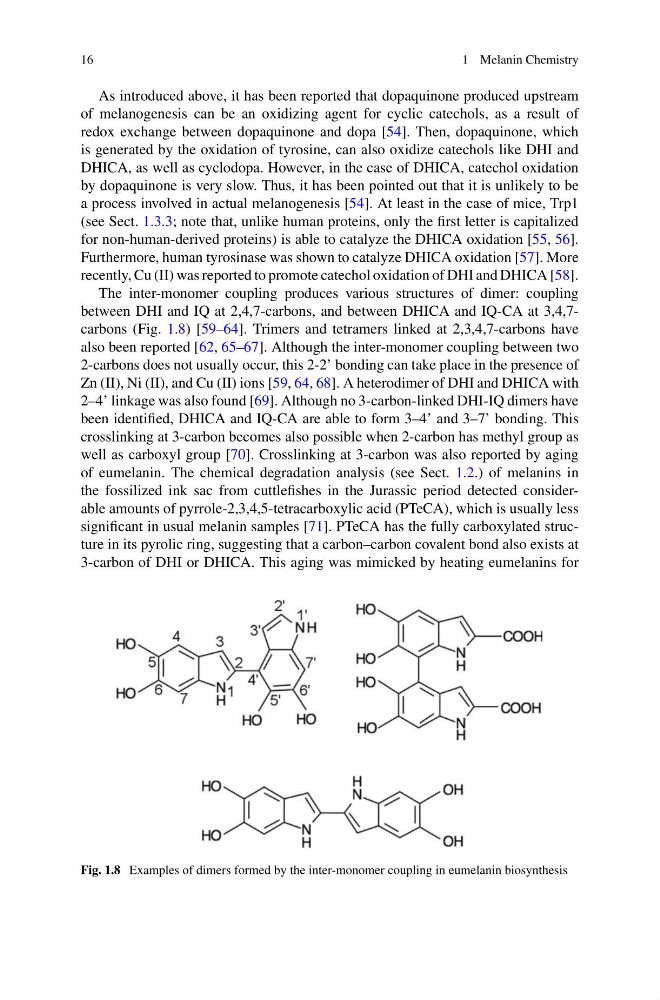
The inter-monomer coupling produces various structures of dimer: coupling
between DHI and IQ at 2,4,7-carbons, and between DHICA and IQ-CA at 3,4,7carbons (Fig. 1.8) [59–64]. Trimers and tetramers linked at 2,3,4,7-carbons have
also been reported [62, 65–67]. Although the inter-monomer coupling between two
2-carbons does not usually occur, this 2-2’ bonding can take place in the presence of
Zn (II), Ni (II), and Cu (II) ions [59, 64, 68]. A heterodimer of DHI and DHICA with
2–4’ linkage was also found [69]. Although no 3-carbon-linked DHI-IQ dimers have
been identified, DHICA and IQ-CA are able to form 3–4’ and 3–7’ bonding. This
crosslinking at 3-carbon becomes also possible when 2-carbon has methyl group as
well as carboxyl group [70]. Crosslinking at 3-carbon was also reported by aging
of eumelanin. The chemical degradation analysis (see Sect. 1.2.) of melanins in
the fossilized ink sac from cuttlefishes in the Jurassic period detected considerable amounts of pyrrole-2,3,4,5-tetracarboxylic acid (PTeCA), which is usually less
significant in usual melanin samples [71]. PTeCA has the fully carboxylated structure in its pyrolic ring, suggesting that a carbon–carbon covalent bond also exists at
3-carbon of DHI or DHICA. This aging was mimicked by heating eumelanins for
Fig. 1.8 Examples of dimers formed by the inter-monomer coupling in eumelanin biosynthesis
1 Melanin Chemistry
As introduced above, it has been reported that dopaquinone produced upstream
of melanogenesis can be an oxidizing agent for cyclic catechols, as a result of
redox exchange between dopaquinone and dopa [54]. Then, dopaquinone, which
is generated by the oxidation of tyrosine, can also oxidize catechols like DHI and
DHICA, as well as cyclodopa. However, in the case of DHICA, catechol oxidation
by dopaquinone is very slow. Thus, it has been pointed out that it is unlikely to be
a process involved in actual melanogenesis [54]. At least in the case of mice, Trp1
(see Sect. 1.3.3; note that, unlike human proteins, only the first letter is capitalized
for non-human-derived proteins) is able to catalyze the DHICA oxidation [55, 56].
Furthermore, human tyrosinase was shown to catalyze DHICA oxidation [57]. More
recently, Cu (II) was reported to promote catechol oxidation of DHI and DHICA [58].
The inter-monomer coupling produces various structures of dimer: coupling
between DHI and IQ at 2,4,7-carbons, and between DHICA and IQ-CA at 3,4,7carbons (Fig. 1.8) [59–64]. Trimers and tetramers linked at 2,3,4,7-carbons have
also been reported [62, 65–67]. Although the inter-monomer coupling between two
2-carbons does not usually occur, this 2-2’ bonding can take place in the presence of
Zn (II), Ni (II), and Cu (II) ions [59, 64, 68]. A heterodimer of DHI and DHICA with
2–4’ linkage was also found [69]. Although no 3-carbon-linked DHI-IQ dimers have
been identified, DHICA and IQ-CA are able to form 3–4’ and 3–7’ bonding. This
crosslinking at 3-carbon becomes also possible when 2-carbon has methyl group as
well as carboxyl group [70]. Crosslinking at 3-carbon was also reported by aging
of eumelanin. The chemical degradation analysis (see Sect. 1.2.) of melanins in
the fossilized ink sac from cuttlefishes in the Jurassic period detected considerable amounts of pyrrole-2,3,4,5-tetracarboxylic acid (PTeCA), which is usually less
significant in usual melanin samples [71]. PTeCA has the fully carboxylated structure in its pyrolic ring, suggesting that a carbon–carbon covalent bond also exists at
3-carbon of DHI or DHICA. This aging was mimicked by heating eumelanins for
Fig. 1.8 Examples of dimers formed by the inter-monomer coupling in eumelanin biosynthesis