

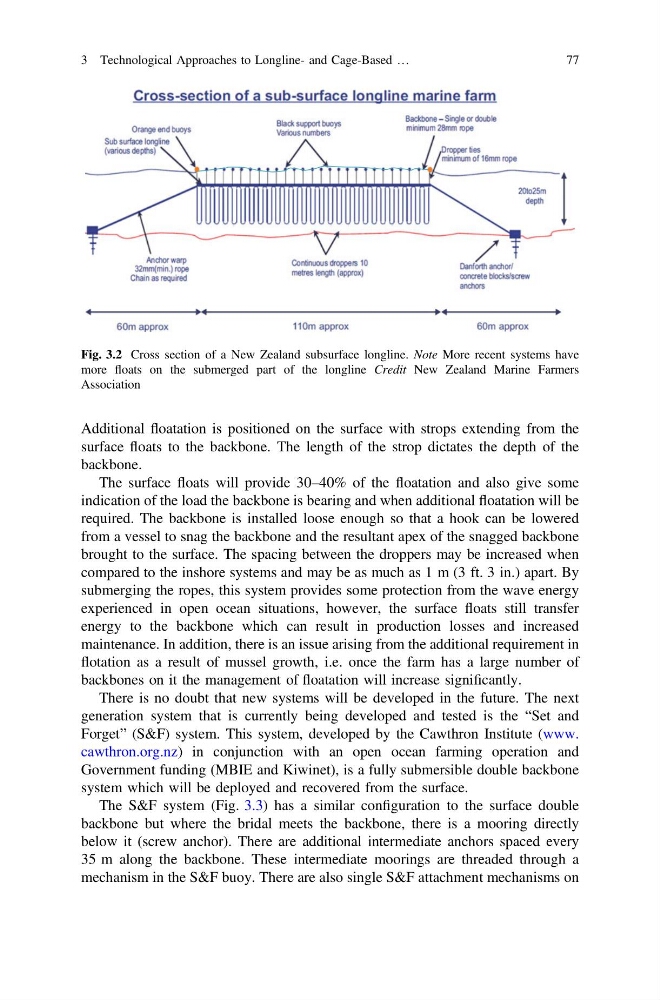
Additional floatation is positioned on the surface with strops extending from the
surface floats to the backbone. The length of the strop dictates the depth of the
backbone.
The surface floats will provide 30–40% of the floatation and also give some
indication of the load the backbone is bearing and when additional floatation will be
required. The backbone is installed loose enough so that a hook can be lowered
from a vessel to snag the backbone and the resultant apex of the snagged backbone
brought to the surface. The spacing between the droppers may be increased when
compared to the inshore systems and may be as much as 1 m (3 ft. 3 in.) apart. By
submerging the ropes, this system provides some protection from the wave energy
experienced in open ocean situations, however, the surface floats still transfer
energy to the backbone which can result in production losses and increased
maintenance. In addition, there is an issue arising from the additional requirement in
flotation as a result of mussel growth, i.e. once the farm has a large number of
backbones on it the management of floatation will increase significantly.
There is no doubt that new systems will be developed in the future. The next
generation system that is currently being developed and tested is the “Set and
Forget” (S&F) system. This system, developed by the Cawthron Institute (www.
cawthron.org.nz) in conjunction with an open ocean farming operation and
Government funding (MBIE and Kiwinet), is a fully submersible double backbone
system which will be deployed and recovered from the surface.
The S&F system (Fig. 3.3) has a similar configuration to the surface double
backbone but where the bridal meets the backbone, there is a mooring directly
below it (screw anchor). There are additional intermediate anchors spaced every
35 m along the backbone. These intermediate moorings are threaded through a
mechanism in the S&F buoy. There are also single S&F attachment mechanisms on
Fig. 3.2 Cross section of a New Zealand subsurface longline. Note More recent systems have
more floats on the submerged part of the longline Credit New Zealand Marine Farmers
Association
3 Technological Approaches to Longline- and Cage-Based …
77
surface floats to the backbone. The length of the strop dictates the depth of the
backbone.
The surface floats will provide 30–40% of the floatation and also give some
indication of the load the backbone is bearing and when additional floatation will be
required. The backbone is installed loose enough so that a hook can be lowered
from a vessel to snag the backbone and the resultant apex of the snagged backbone
brought to the surface. The spacing between the droppers may be increased when
compared to the inshore systems and may be as much as 1 m (3 ft. 3 in.) apart. By
submerging the ropes, this system provides some protection from the wave energy
experienced in open ocean situations, however, the surface floats still transfer
energy to the backbone which can result in production losses and increased
maintenance. In addition, there is an issue arising from the additional requirement in
flotation as a result of mussel growth, i.e. once the farm has a large number of
backbones on it the management of floatation will increase significantly.
There is no doubt that new systems will be developed in the future. The next
generation system that is currently being developed and tested is the “Set and
Forget” (S&F) system. This system, developed by the Cawthron Institute (www.
cawthron.org.nz) in conjunction with an open ocean farming operation and
Government funding (MBIE and Kiwinet), is a fully submersible double backbone
system which will be deployed and recovered from the surface.
The S&F system (Fig. 3.3) has a similar configuration to the surface double
backbone but where the bridal meets the backbone, there is a mooring directly
below it (screw anchor). There are additional intermediate anchors spaced every
35 m along the backbone. These intermediate moorings are threaded through a
mechanism in the S&F buoy. There are also single S&F attachment mechanisms on
Fig. 3.2 Cross section of a New Zealand subsurface longline. Note More recent systems have
more floats on the submerged part of the longline Credit New Zealand Marine Farmers
Association
3 Technological Approaches to Longline- and Cage-Based …
77