

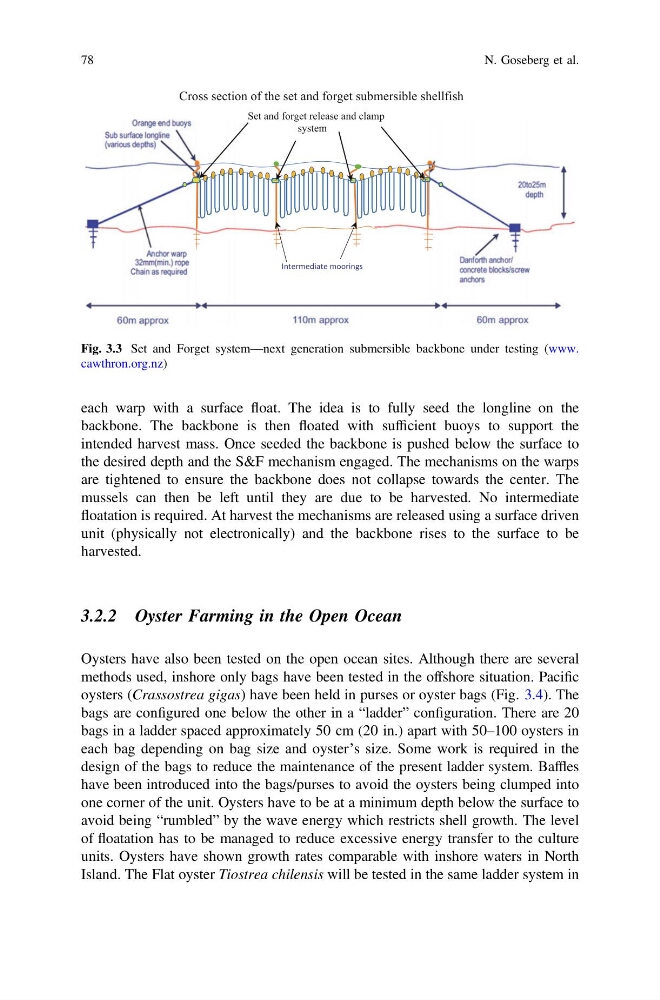
each warp with a surface float. The idea is to fully seed the longline on the
backbone. The backbone is then floated with sufficient buoys to support the
intended harvest mass. Once seeded the backbone is pushed below the surface to
the desired depth and the S&F mechanism engaged. The mechanisms on the warps
are tightened to ensure the backbone does not collapse towards the center. The
mussels can then be left until they are due to be harvested. No intermediate
floatation is required. At harvest the mechanisms are released using a surface driven
unit (physically not electronically) and the backbone rises to the surface to be
harvested.
3.2.2 Oyster Farming in the Open Ocean
Oysters have also been tested on the open ocean sites. Although there are several
methods used, inshore only bags have been tested in the offshore situation. Pacific
oysters (Crassostrea gigas) have been held in purses or oyster bags (Fig. 3.4). The
bags are configured one below the other in a “ladder” configuration. There are 20
bags in a ladder spaced approximately 50 cm (20 in.) apart with 50–100 oysters in
each bag depending on bag size and oyster’s size. Some work is required in the
design of the bags to reduce the maintenance of the present ladder system. Baffles
have been introduced into the bags/purses to avoid the oysters being clumped into
one corner of the unit. Oysters have to be at a minimum depth below the surface to
avoid being “rumbled” by the wave energy which restricts shell growth. The level
of floatation has to be managed to reduce excessive energy transfer to the culture
units. Oysters have shown growth rates comparable with inshore waters in North
Island. The Flat oyster Tiostrea chilensis will be tested in the same ladder system in
Intermediate moorings
Set and forget release and clamp
system
Cross section of the set and forget submersible shellfish
Fig. 3.3 Set and Forget system—next generation submersible backbone under testing (www.
cawthron.org.nz)
78
N. Goseberg et al.
backbone. The backbone is then floated with sufficient buoys to support the
intended harvest mass. Once seeded the backbone is pushed below the surface to
the desired depth and the S&F mechanism engaged. The mechanisms on the warps
are tightened to ensure the backbone does not collapse towards the center. The
mussels can then be left until they are due to be harvested. No intermediate
floatation is required. At harvest the mechanisms are released using a surface driven
unit (physically not electronically) and the backbone rises to the surface to be
harvested.
3.2.2 Oyster Farming in the Open Ocean
Oysters have also been tested on the open ocean sites. Although there are several
methods used, inshore only bags have been tested in the offshore situation. Pacific
oysters (Crassostrea gigas) have been held in purses or oyster bags (Fig. 3.4). The
bags are configured one below the other in a “ladder” configuration. There are 20
bags in a ladder spaced approximately 50 cm (20 in.) apart with 50–100 oysters in
each bag depending on bag size and oyster’s size. Some work is required in the
design of the bags to reduce the maintenance of the present ladder system. Baffles
have been introduced into the bags/purses to avoid the oysters being clumped into
one corner of the unit. Oysters have to be at a minimum depth below the surface to
avoid being “rumbled” by the wave energy which restricts shell growth. The level
of floatation has to be managed to reduce excessive energy transfer to the culture
units. Oysters have shown growth rates comparable with inshore waters in North
Island. The Flat oyster Tiostrea chilensis will be tested in the same ladder system in
Intermediate moorings
Set and forget release and clamp
system
Cross section of the set and forget submersible shellfish
Fig. 3.3 Set and Forget system—next generation submersible backbone under testing (www.
cawthron.org.nz)
78
N. Goseberg et al.