

concrete shaped moorings of up to 10 metric tons (22,200 lb.) in mass. Where
possible concrete mooring are being superseded by screw anchors when new ropes
are being installed and the substrate is suitable.
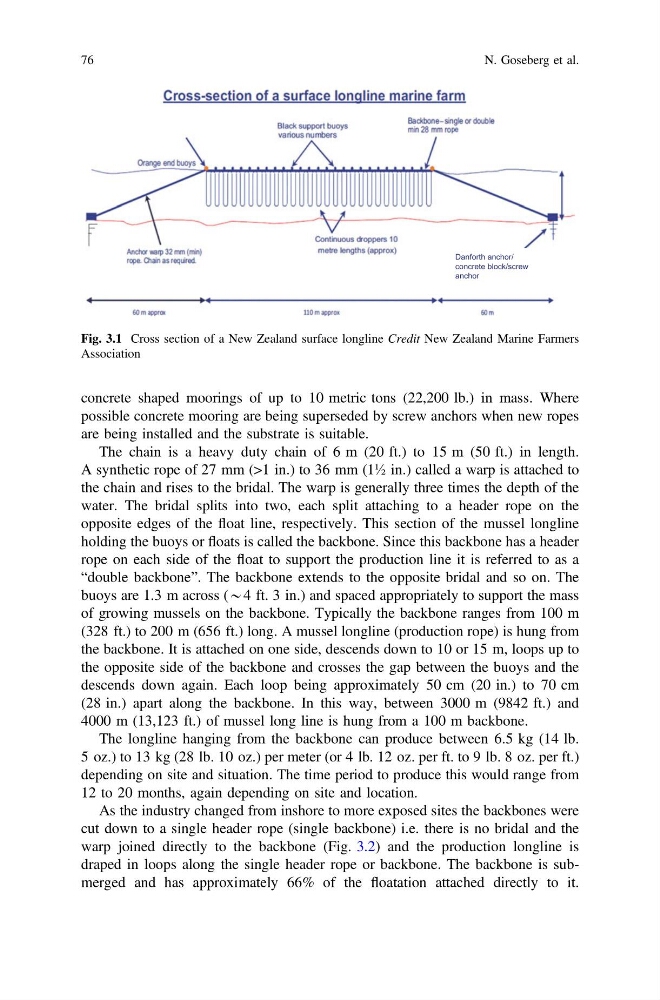
The chain is a heavy duty chain of 6 m (20 ft.) to 15 m (50 ft.) in length.
A synthetic rope of 27 mm (>1 in.) to 36 mm (1½ in.) called a warp is attached to
the chain and rises to the bridal. The warp is generally three times the depth of the
water. The bridal splits into two, each split attaching to a header rope on the
opposite edges of the float line, respectively. This section of the mussel longline
holding the buoys or floats is called the backbone. Since this backbone has a header
rope on each side of the float to support the production line it is referred to as a
“double backbone”. The backbone extends to the opposite bridal and so on. The
buoys are 1.3 m across (*4 ft. 3 in.) and spaced appropriately to support the mass
of growing mussels on the backbone. Typically the backbone ranges from 100 m
(328 ft.) to 200 m (656 ft.) long. A mussel longline (production rope) is hung from
the backbone. It is attached on one side, descends down to 10 or 15 m, loops up to
the opposite side of the backbone and crosses the gap between the buoys and the
descends down again. Each loop being approximately 50 cm (20 in.) to 70 cm
(28 in.) apart along the backbone. In this way, between 3000 m (9842 ft.) and
4000 m (13,123 ft.) of mussel long line is hung from a 100 m backbone.
The longline hanging from the backbone can produce between 6.5 kg (14 lb.
5 oz.) to 13 kg (28 lb. 10 oz.) per meter (or 4 lb. 12 oz. per ft. to 9 lb. 8 oz. per ft.)
depending on site and situation. The time period to produce this would range from
12 to 20 months, again depending on site and location.
As the industry changed from inshore to more exposed sites the backbones were
cut down to a single header rope (single backbone) i.e. there is no bridal and the
warp joined directly to the backbone (Fig. 3.2) and the production longline is
draped in loops along the single header rope or backbone. The backbone is submerged and has approximately 66% of the floatation attached directly to it.
Danforth anchor/
concrete block/screw
anchor
Fig. 3.1 Cross section of a New Zealand surface longline Credit New Zealand Marine Farmers
Association
76
N. Goseberg et al.
possible concrete mooring are being superseded by screw anchors when new ropes
are being installed and the substrate is suitable.
The chain is a heavy duty chain of 6 m (20 ft.) to 15 m (50 ft.) in length.
A synthetic rope of 27 mm (>1 in.) to 36 mm (1½ in.) called a warp is attached to
the chain and rises to the bridal. The warp is generally three times the depth of the
water. The bridal splits into two, each split attaching to a header rope on the
opposite edges of the float line, respectively. This section of the mussel longline
holding the buoys or floats is called the backbone. Since this backbone has a header
rope on each side of the float to support the production line it is referred to as a
“double backbone”. The backbone extends to the opposite bridal and so on. The
buoys are 1.3 m across (*4 ft. 3 in.) and spaced appropriately to support the mass
of growing mussels on the backbone. Typically the backbone ranges from 100 m
(328 ft.) to 200 m (656 ft.) long. A mussel longline (production rope) is hung from
the backbone. It is attached on one side, descends down to 10 or 15 m, loops up to
the opposite side of the backbone and crosses the gap between the buoys and the
descends down again. Each loop being approximately 50 cm (20 in.) to 70 cm
(28 in.) apart along the backbone. In this way, between 3000 m (9842 ft.) and
4000 m (13,123 ft.) of mussel long line is hung from a 100 m backbone.
The longline hanging from the backbone can produce between 6.5 kg (14 lb.
5 oz.) to 13 kg (28 lb. 10 oz.) per meter (or 4 lb. 12 oz. per ft. to 9 lb. 8 oz. per ft.)
depending on site and situation. The time period to produce this would range from
12 to 20 months, again depending on site and location.
As the industry changed from inshore to more exposed sites the backbones were
cut down to a single header rope (single backbone) i.e. there is no bridal and the
warp joined directly to the backbone (Fig. 3.2) and the production longline is
draped in loops along the single header rope or backbone. The backbone is submerged and has approximately 66% of the floatation attached directly to it.
Danforth anchor/
concrete block/screw
anchor
Fig. 3.1 Cross section of a New Zealand surface longline Credit New Zealand Marine Farmers
Association
76
N. Goseberg et al.