

This creates product diversification, improves farm output, helps maintain a clean
environment and is more socially acceptable. IMTA promotes economic and
environmental sustainability by converting byproducts and uneaten feed from fed
organisms into harvestable crops, thereby reducing eutrophication, and increasing
economic diversification (Neori et al. 2004; Troell et al. 2003). IMTA has been
investigated extensively in Atlantic Canada with salmon, blue mussels and kelps
(Chopin et al. 2004, 2013; Ridler et al. 2006, 2007; Robinson et al. 2007).
The University has been engaging commercial fishermen on small-scale, IMTA
as a means to diversify their income. By integrating the production of steelhead
trout (Oncorhynchus mykiss), blue mussels (Mytilus edulis) and sugar kelp
(Saccharina latissima) on a floating platform, fishermen have been able to grow and
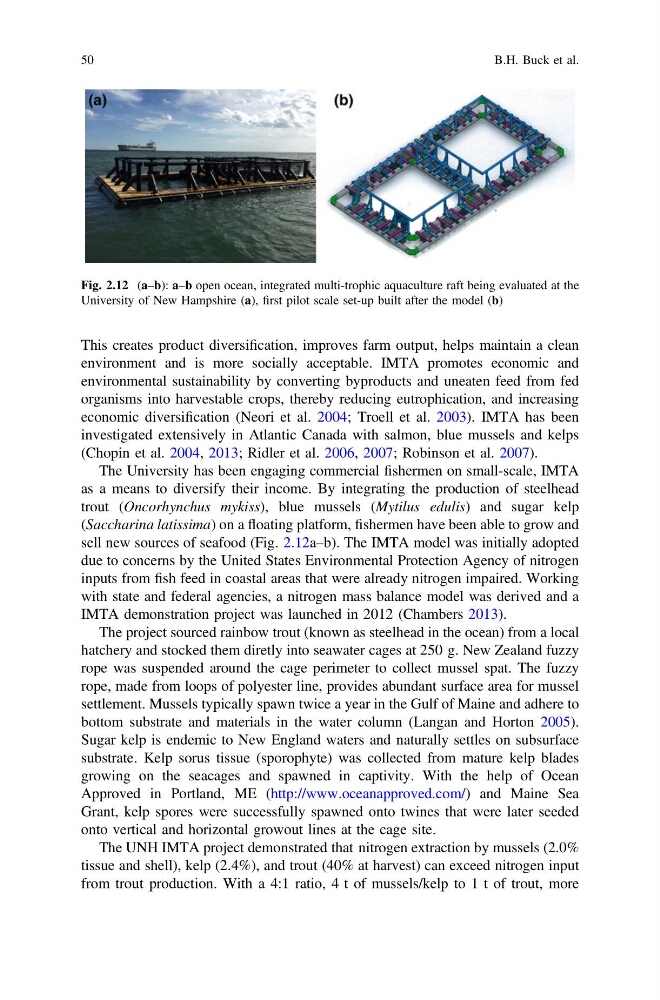
sell new sources of seafood (Fig. 2.12a–b). The IMTA model was initially adopted
due to concerns by the United States Environmental Protection Agency of nitrogen
inputs from fish feed in coastal areas that were already nitrogen impaired. Working
with state and federal agencies, a nitrogen mass balance model was derived and a
IMTA demonstration project was launched in 2012 (Chambers 2013).
The project sourced rainbow trout (known as steelhead in the ocean) from a local
hatchery and stocked them diretly into seawater cages at 250 g. New Zealand fuzzy
rope was suspended around the cage perimeter to collect mussel spat. The fuzzy
rope, made from loops of polyester line, provides abundant surface area for mussel
settlement. Mussels typically spawn twice a year in the Gulf of Maine and adhere to
bottom substrate and materials in the water column (Langan and Horton 2005).
Sugar kelp is endemic to New England waters and naturally settles on subsurface
substrate. Kelp sorus tissue (sporophyte) was collected from mature kelp blades
growing on the seacages and spawned in captivity. With the help of Ocean
Approved in Portland, ME (http://www.oceanapproved.com/) and Maine Sea
Grant, kelp spores were successfully spawned onto twines that were later seeded
onto vertical and horizontal growout lines at the cage site.
The UNH IMTA project demonstrated that nitrogen extraction by mussels (2.0%
tissue and shell), kelp (2.4%), and trout (40% at harvest) can exceed nitrogen input
from trout production. With a 4:1 ratio, 4 t of mussels/kelp to 1 t of trout, more
Fig. 2.12 (a–b): a–b open ocean, integrated multi-trophic aquaculture raft being evaluated at the
University of New Hampshire (a), first pilot scale set-up built after the model (b)
50
B.H. Buck et al.
environment and is more socially acceptable. IMTA promotes economic and
environmental sustainability by converting byproducts and uneaten feed from fed
organisms into harvestable crops, thereby reducing eutrophication, and increasing
economic diversification (Neori et al. 2004; Troell et al. 2003). IMTA has been
investigated extensively in Atlantic Canada with salmon, blue mussels and kelps
(Chopin et al. 2004, 2013; Ridler et al. 2006, 2007; Robinson et al. 2007).
The University has been engaging commercial fishermen on small-scale, IMTA
as a means to diversify their income. By integrating the production of steelhead
trout (Oncorhynchus mykiss), blue mussels (Mytilus edulis) and sugar kelp
(Saccharina latissima) on a floating platform, fishermen have been able to grow and
sell new sources of seafood (Fig. 2.12a–b). The IMTA model was initially adopted
due to concerns by the United States Environmental Protection Agency of nitrogen
inputs from fish feed in coastal areas that were already nitrogen impaired. Working
with state and federal agencies, a nitrogen mass balance model was derived and a
IMTA demonstration project was launched in 2012 (Chambers 2013).
The project sourced rainbow trout (known as steelhead in the ocean) from a local
hatchery and stocked them diretly into seawater cages at 250 g. New Zealand fuzzy
rope was suspended around the cage perimeter to collect mussel spat. The fuzzy
rope, made from loops of polyester line, provides abundant surface area for mussel
settlement. Mussels typically spawn twice a year in the Gulf of Maine and adhere to
bottom substrate and materials in the water column (Langan and Horton 2005).
Sugar kelp is endemic to New England waters and naturally settles on subsurface
substrate. Kelp sorus tissue (sporophyte) was collected from mature kelp blades
growing on the seacages and spawned in captivity. With the help of Ocean
Approved in Portland, ME (http://www.oceanapproved.com/) and Maine Sea
Grant, kelp spores were successfully spawned onto twines that were later seeded
onto vertical and horizontal growout lines at the cage site.
The UNH IMTA project demonstrated that nitrogen extraction by mussels (2.0%
tissue and shell), kelp (2.4%), and trout (40% at harvest) can exceed nitrogen input
from trout production. With a 4:1 ratio, 4 t of mussels/kelp to 1 t of trout, more
Fig. 2.12 (a–b): a–b open ocean, integrated multi-trophic aquaculture raft being evaluated at the
University of New Hampshire (a), first pilot scale set-up built after the model (b)
50
B.H. Buck et al.