

prices, will likely have a significant dampening effect on the development of
operational offshore wind energy projects or sites, which in turn would decrease the
chance for multi-use aspects.
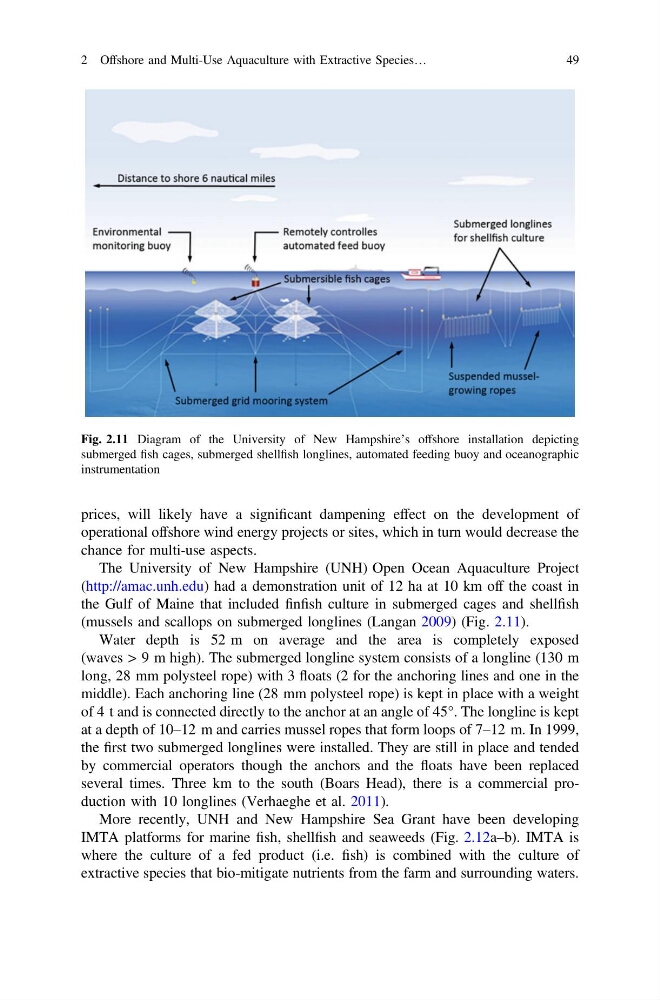
The University of New Hampshire (UNH) Open Ocean Aquaculture Project
(http://amac.unh.edu) had a demonstration unit of 12 ha at 10 km off the coast in
the Gulf of Maine that included finfish culture in submerged cages and shellfish
(mussels and scallops on submerged longlines (Langan 2009) (Fig. 2.11).
Water depth is 52 m on average and the area is completely exposed
(waves > 9 m high). The submerged longline system consists of a longline (130 m
long, 28 mm polysteel rope) with 3 floats (2 for the anchoring lines and one in the
middle). Each anchoring line (28 mm polysteel rope) is kept in place with a weight
of 4 t and is connected directly to the anchor at an angle of 45°. The longline is kept
at a depth of 10–12 m and carries mussel ropes that form loops of 7–12 m. In 1999,
the first two submerged longlines were installed. They are still in place and tended
by commercial operators though the anchors and the floats have been replaced
several times. Three km to the south (Boars Head), there is a commercial production with 10 longlines (Verhaeghe et al. 2011).
More recently, UNH and New Hampshire Sea Grant have been developing
IMTA platforms for marine fish, shellfish and seaweeds (Fig. 2.12a–b). IMTA is
where the culture of a fed product (i.e. fish) is combined with the culture of
extractive species that bio-mitigate nutrients from the farm and surrounding waters.
Fig. 2.11 Diagram of the University of New Hampshire’s offshore installation depicting
submerged fish cages, submerged shellfish longlines, automated feeding buoy and oceanographic
instrumentation
2 Offshore and Multi-Use Aquaculture with Extractive Species…
49
operational offshore wind energy projects or sites, which in turn would decrease the
chance for multi-use aspects.
The University of New Hampshire (UNH) Open Ocean Aquaculture Project
(http://amac.unh.edu) had a demonstration unit of 12 ha at 10 km off the coast in
the Gulf of Maine that included finfish culture in submerged cages and shellfish
(mussels and scallops on submerged longlines (Langan 2009) (Fig. 2.11).
Water depth is 52 m on average and the area is completely exposed
(waves > 9 m high). The submerged longline system consists of a longline (130 m
long, 28 mm polysteel rope) with 3 floats (2 for the anchoring lines and one in the
middle). Each anchoring line (28 mm polysteel rope) is kept in place with a weight
of 4 t and is connected directly to the anchor at an angle of 45°. The longline is kept
at a depth of 10–12 m and carries mussel ropes that form loops of 7–12 m. In 1999,
the first two submerged longlines were installed. They are still in place and tended
by commercial operators though the anchors and the floats have been replaced
several times. Three km to the south (Boars Head), there is a commercial production with 10 longlines (Verhaeghe et al. 2011).
More recently, UNH and New Hampshire Sea Grant have been developing
IMTA platforms for marine fish, shellfish and seaweeds (Fig. 2.12a–b). IMTA is
where the culture of a fed product (i.e. fish) is combined with the culture of
extractive species that bio-mitigate nutrients from the farm and surrounding waters.
Fig. 2.11 Diagram of the University of New Hampshire’s offshore installation depicting
submerged fish cages, submerged shellfish longlines, automated feeding buoy and oceanographic
instrumentation
2 Offshore and Multi-Use Aquaculture with Extractive Species…
49