

challenge and it was not uncommon to experience losses of 25% or more during the
transport depending on a number of factors. Once in the cage and after commencing
feeding however, the fish exhibited very good overall health and no incidence of
disease or parasitic outbreaks were observed. Grow out of red drum for 6–
12 months to a market size of 0.7–1.0 kg at final harvest densities of 7–40 kg/m
3
was successful on three occasions totaling approximately 7300 kg (Chambers
1998). Though not a significant amount of production in terms of commercial
volumes, this project stands alone as the only example of fish successfully stocked,
fed, and harvested offshore in the Gulf of Mexico to date (Fig. 13.6).
The cages that survived the extreme GoM conditions during the course of the
project were smaller, submerged designs whose cost per cubic meter would make
them uneconomical for a large scale operation. Results of the MNE project
demonstrated that the fish growth and acclimation to the cage system were very
good and maintaining them from a biological standpoint was not particularly difficult. The maintenance of cage system components on the other hand, combined
with the logistics of supplying feed and the production costs of simply operating
offshore resulted in the shutdown of the project in 1995.
The next project along the Texas coast was a joint venture with Shell Oil
company called Seafish Mariculture which took place from 1997–1999 (Kaiser
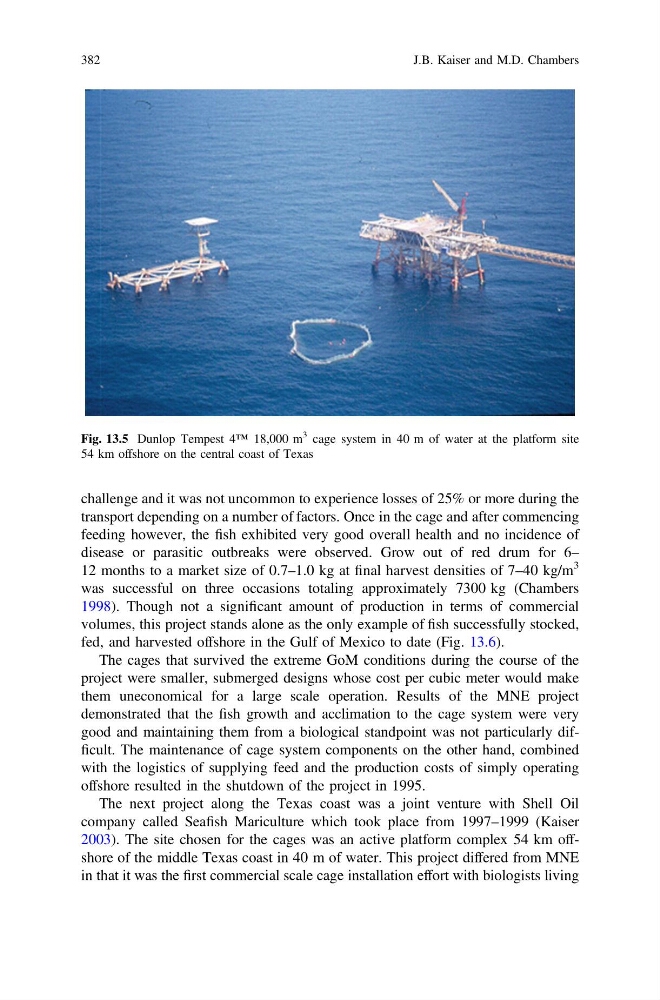
2003). The site chosen for the cages was an active platform complex 54 km offshore of the middle Texas coast in 40 m of water. This project differed from MNE
in that it was the first commercial scale cage installation effort with biologists living
Fig. 13.5 Dunlop Tempest 4™ 18,000 m
3 cage system in 40 m of water at the platform site
54 km offshore on the central coast of Texas
382
J.B. Kaiser and M.D. Chambers
transport depending on a number of factors. Once in the cage and after commencing
feeding however, the fish exhibited very good overall health and no incidence of
disease or parasitic outbreaks were observed. Grow out of red drum for 6–
12 months to a market size of 0.7–1.0 kg at final harvest densities of 7–40 kg/m
3
was successful on three occasions totaling approximately 7300 kg (Chambers
1998). Though not a significant amount of production in terms of commercial
volumes, this project stands alone as the only example of fish successfully stocked,
fed, and harvested offshore in the Gulf of Mexico to date (Fig. 13.6).
The cages that survived the extreme GoM conditions during the course of the
project were smaller, submerged designs whose cost per cubic meter would make
them uneconomical for a large scale operation. Results of the MNE project
demonstrated that the fish growth and acclimation to the cage system were very
good and maintaining them from a biological standpoint was not particularly difficult. The maintenance of cage system components on the other hand, combined
with the logistics of supplying feed and the production costs of simply operating
offshore resulted in the shutdown of the project in 1995.
The next project along the Texas coast was a joint venture with Shell Oil
company called Seafish Mariculture which took place from 1997–1999 (Kaiser
2003). The site chosen for the cages was an active platform complex 54 km offshore of the middle Texas coast in 40 m of water. This project differed from MNE
in that it was the first commercial scale cage installation effort with biologists living
Fig. 13.5 Dunlop Tempest 4™ 18,000 m
3 cage system in 40 m of water at the platform site
54 km offshore on the central coast of Texas
382
J.B. Kaiser and M.D. Chambers