

13.3 Past Projects
The history of mariculture utilizing offshore platforms in US waters begins in 1990
off the coast of Texas (Chambers 1998; Kaiser 2003). During the next five years
MNE, a wholly owned subsidiary of Occidental Petroleum, embarked on a project
to assess the feasibility of using oil and gas platforms as a base of operations for fish
production. These included both manned and unmanned structures located 11–
54 km offshore at depths of 20–80 m in both state and federal waters. Several cage
designs were deployed, including both surface and submerged systems all of which
were connected at some point to the platform itself. Various types of feed units were
designed and placed on the platforms and company biologists would visit the
projects sites every 1–2 weeks to inspect the cages and fish, re-supply the feeders,
and perform general maintenance wherever required.
Red drum Sciaenops ocellatus was the primary species used during the project
although on one occasion a smaller prototype cage was stocked with Florida
pompano Trachinotus carolinus. Red drum from 30–85 g were acquired and
transported to the project sites utilizing offshore crew boats in a fiberglass holding
tank with supplemental pure oxygen. Stress and subsequent mortality was a
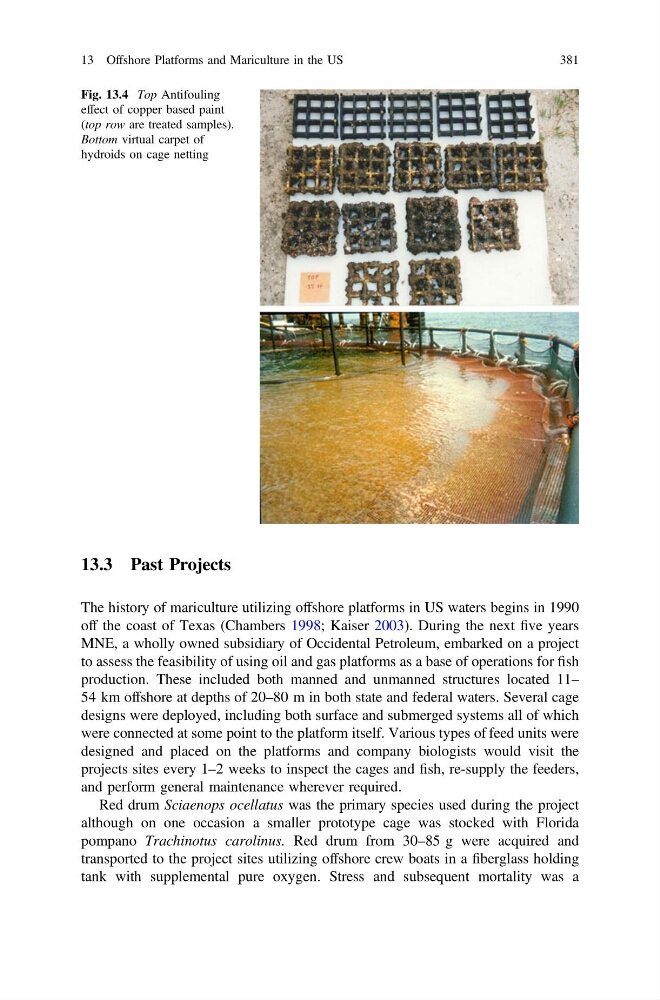
Fig. 13.4 Top Antifouling
effect of copper based paint
(top row are treated samples).
Bottom virtual carpet of
hydroids on cage netting
13 Offshore Platforms and Mariculture in the US
381
The history of mariculture utilizing offshore platforms in US waters begins in 1990
off the coast of Texas (Chambers 1998; Kaiser 2003). During the next five years
MNE, a wholly owned subsidiary of Occidental Petroleum, embarked on a project
to assess the feasibility of using oil and gas platforms as a base of operations for fish
production. These included both manned and unmanned structures located 11–
54 km offshore at depths of 20–80 m in both state and federal waters. Several cage
designs were deployed, including both surface and submerged systems all of which
were connected at some point to the platform itself. Various types of feed units were
designed and placed on the platforms and company biologists would visit the
projects sites every 1–2 weeks to inspect the cages and fish, re-supply the feeders,
and perform general maintenance wherever required.
Red drum Sciaenops ocellatus was the primary species used during the project
although on one occasion a smaller prototype cage was stocked with Florida
pompano Trachinotus carolinus. Red drum from 30–85 g were acquired and
transported to the project sites utilizing offshore crew boats in a fiberglass holding
tank with supplemental pure oxygen. Stress and subsequent mortality was a
Fig. 13.4 Top Antifouling
effect of copper based paint
(top row are treated samples).
Bottom virtual carpet of
hydroids on cage netting
13 Offshore Platforms and Mariculture in the US
381