

11.3.2.2 Candidates: Crassostrea gigas and Ostrea edulis
Health conditions: In contrast to Blue mussel cultivation, which can rely on natural
spatfall in offshore areas of the German Bight, offshore oyster cultivation depends
on purchasing seed oysters and caging of animals. The biological performance of
Pacific and European oysters was investigated at three different offshore sites in the
German Bight during the first multi-use aquaculture project “Open Ocean
Aquaculture” as well as in the project “Offshore Oyster Physiology” (OysterPhys)
(Project No. 2 and No. 7, Fig. 11.1). Young oysters were cultivated in the open
ocean 10–40 nautical miles off the coast in 2001–2003 and from April to October
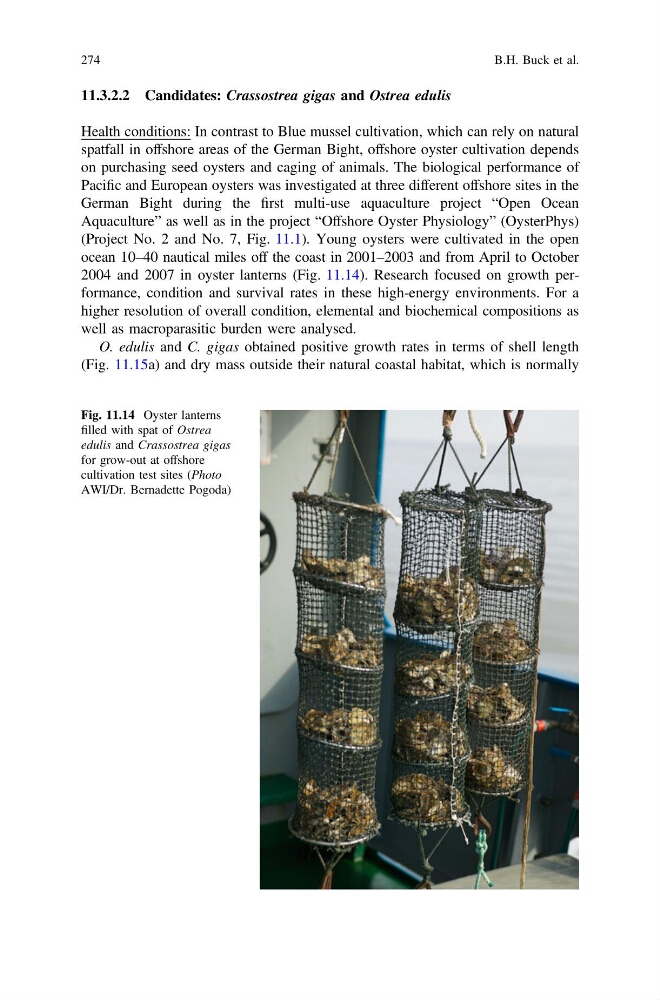
2004 and 2007 in oyster lanterns (Fig. 11.14). Research focused on growth performance, condition and survival rates in these high-energy environments. For a
higher resolution of overall condition, elemental and biochemical compositions as
well as macroparasitic burden were analysed.
O. edulis and C. gigas obtained positive growth rates in terms of shell length
(Fig. 11.15a) and dry mass outside their natural coastal habitat, which is normally
Fig. 11.14 Oyster lanterns
filled with spat of Ostrea
edulis and Crassostrea gigas
for grow-out at offshore
cultivation test sites (Photo
AWI/Dr. Bernadette Pogoda)
274
B.H. Buck et al.
Health conditions: In contrast to Blue mussel cultivation, which can rely on natural
spatfall in offshore areas of the German Bight, offshore oyster cultivation depends
on purchasing seed oysters and caging of animals. The biological performance of
Pacific and European oysters was investigated at three different offshore sites in the
German Bight during the first multi-use aquaculture project “Open Ocean
Aquaculture” as well as in the project “Offshore Oyster Physiology” (OysterPhys)
(Project No. 2 and No. 7, Fig. 11.1). Young oysters were cultivated in the open
ocean 10–40 nautical miles off the coast in 2001–2003 and from April to October
2004 and 2007 in oyster lanterns (Fig. 11.14). Research focused on growth performance, condition and survival rates in these high-energy environments. For a
higher resolution of overall condition, elemental and biochemical compositions as
well as macroparasitic burden were analysed.
O. edulis and C. gigas obtained positive growth rates in terms of shell length
(Fig. 11.15a) and dry mass outside their natural coastal habitat, which is normally
Fig. 11.14 Oyster lanterns
filled with spat of Ostrea
edulis and Crassostrea gigas
for grow-out at offshore
cultivation test sites (Photo
AWI/Dr. Bernadette Pogoda)
274
B.H. Buck et al.