

located on the seabed of coastal seas. In general, growth rates were similar to those
of oysters from nearshore coastal areas (Pogoda et al. 2011). This documents that
offshore-cultivated oysters are able to achieve a “normal” or “natural” growth
performance.
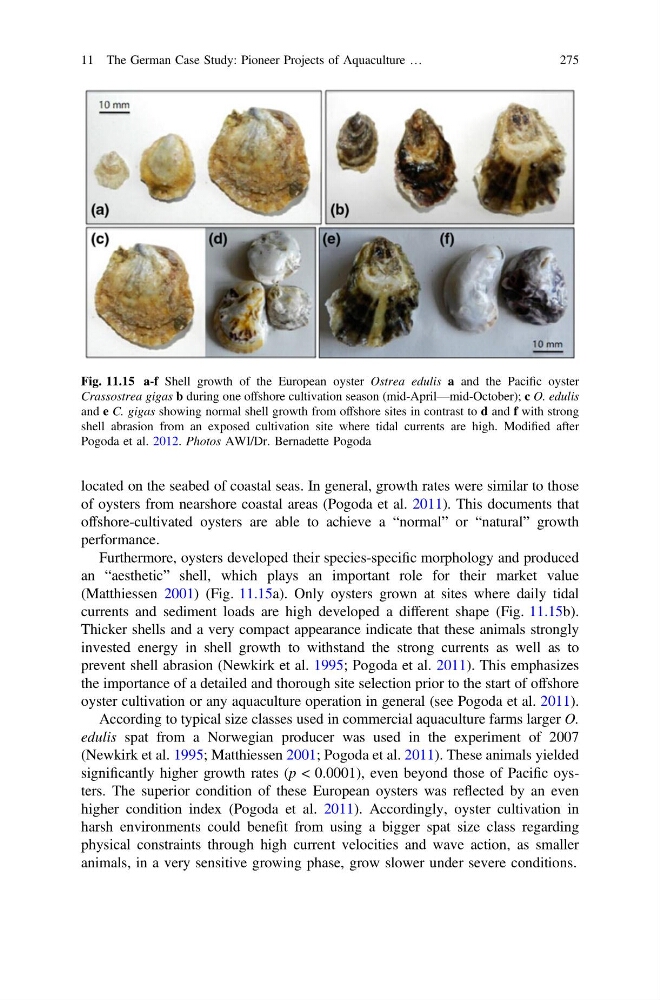
Furthermore, oysters developed their species-specific morphology and produced
an “aesthetic” shell, which plays an important role for their market value
(Matthiessen 2001) (Fig. 11.15a). Only oysters grown at sites where daily tidal
currents and sediment loads are high developed a different shape (Fig. 11.15b).
Thicker shells and a very compact appearance indicate that these animals strongly
invested energy in shell growth to withstand the strong currents as well as to
prevent shell abrasion (Newkirk et al. 1995; Pogoda et al. 2011). This emphasizes
the importance of a detailed and thorough site selection prior to the start of offshore
oyster cultivation or any aquaculture operation in general (see Pogoda et al. 2011).
According to typical size classes used in commercial aquaculture farms larger O.
edulis spat from a Norwegian producer was used in the experiment of 2007
(Newkirk et al. 1995; Matthiessen 2001; Pogoda et al. 2011). These animals yielded
significantly higher growth rates (p < 0.0001), even beyond those of Pacific oysters. The superior condition of these European oysters was reflected by an even
higher condition index (Pogoda et al. 2011). Accordingly, oyster cultivation in
harsh environments could benefit from using a bigger spat size class regarding
physical constraints through high current velocities and wave action, as smaller
animals, in a very sensitive growing phase, grow slower under severe conditions.
Fig. 11.15 a-f Shell growth of the European oyster Ostrea edulis a and the Pacific oyster
Crassostrea gigas b during one offshore cultivation season (mid-April—mid-October); c O. edulis
and e C. gigas showing normal shell growth from offshore sites in contrast to d and f with strong
shell abrasion from an exposed cultivation site where tidal currents are high. Modified after
Pogoda et al. 2012. Photos AWI/Dr. Bernadette Pogoda
11 The German Case Study: Pioneer Projects of Aquaculture …
275
of oysters from nearshore coastal areas (Pogoda et al. 2011). This documents that
offshore-cultivated oysters are able to achieve a “normal” or “natural” growth
performance.
Furthermore, oysters developed their species-specific morphology and produced
an “aesthetic” shell, which plays an important role for their market value
(Matthiessen 2001) (Fig. 11.15a). Only oysters grown at sites where daily tidal
currents and sediment loads are high developed a different shape (Fig. 11.15b).
Thicker shells and a very compact appearance indicate that these animals strongly
invested energy in shell growth to withstand the strong currents as well as to
prevent shell abrasion (Newkirk et al. 1995; Pogoda et al. 2011). This emphasizes
the importance of a detailed and thorough site selection prior to the start of offshore
oyster cultivation or any aquaculture operation in general (see Pogoda et al. 2011).
According to typical size classes used in commercial aquaculture farms larger O.
edulis spat from a Norwegian producer was used in the experiment of 2007
(Newkirk et al. 1995; Matthiessen 2001; Pogoda et al. 2011). These animals yielded
significantly higher growth rates (p < 0.0001), even beyond those of Pacific oysters. The superior condition of these European oysters was reflected by an even
higher condition index (Pogoda et al. 2011). Accordingly, oyster cultivation in
harsh environments could benefit from using a bigger spat size class regarding
physical constraints through high current velocities and wave action, as smaller
animals, in a very sensitive growing phase, grow slower under severe conditions.
Fig. 11.15 a-f Shell growth of the European oyster Ostrea edulis a and the Pacific oyster
Crassostrea gigas b during one offshore cultivation season (mid-April—mid-October); c O. edulis
and e C. gigas showing normal shell growth from offshore sites in contrast to d and f with strong
shell abrasion from an exposed cultivation site where tidal currents are high. Modified after
Pogoda et al. 2012. Photos AWI/Dr. Bernadette Pogoda
11 The German Case Study: Pioneer Projects of Aquaculture …
275