

28
2 Front-End Electronics
Time
Time
Continuous mode
Triggered mode
1
2
3
4
5
1
2
3
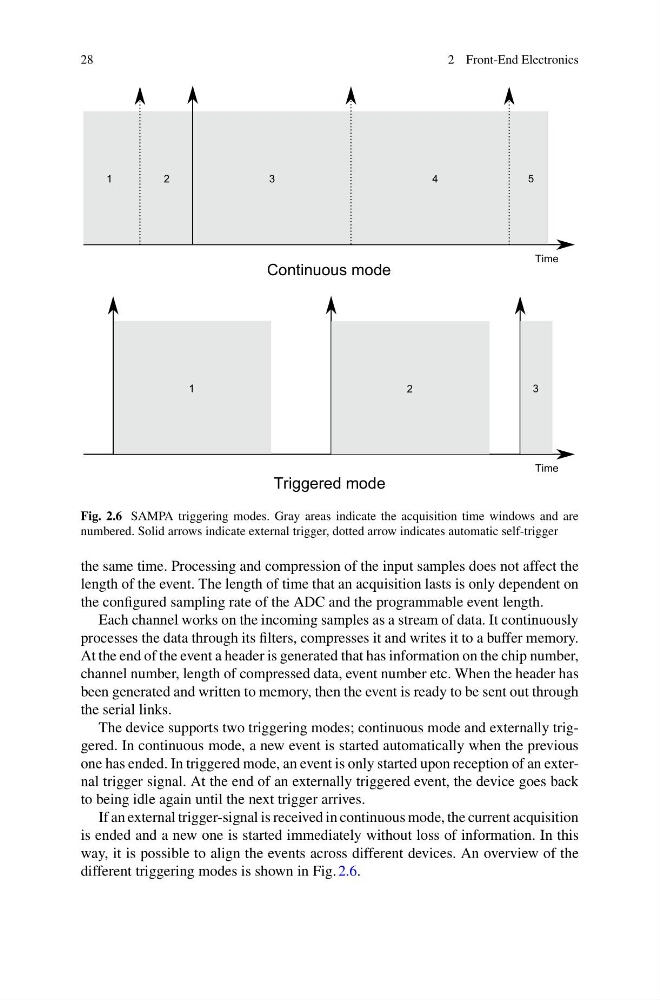
Fig. 2.6 SAMPA triggering modes. Gray areas indicate the acquisition time windows and are
numbered. Solid arrows indicate external trigger, dotted arrow indicates automatic self-trigger
the same time. Processing and compression of the input samples does not affect the
length of the event. The length of time that an acquisition lasts is only dependent on
the configured sampling rate of the ADC and the programmable event length.
Each channel works on the incoming samples as a stream of data. It continuously
processes the data through its filters, compresses it and writes it to a buffer memory.
At the end of the event a header is generated that has information on the chip number,
channel number, length of compressed data, event number etc. When the header has
been generated and written to memory, then the event is ready to be sent out through
the serial links.
The device supports two triggering modes; continuous mode and externally triggered. In continuous mode, a new event is started automatically when the previous
one has ended. In triggered mode, an event is only started upon reception of an external trigger signal. At the end of an externally triggered event, the device goes back
to being idle again until the next trigger arrives.
If an external trigger-signal is received in continuous mode, the current acquisition
is ended and a new one is started immediately without loss of information. In this
way, it is possible to align the events across different devices. An overview of the
different triggering modes is shown in Fig. 2.6.
2 Front-End Electronics
Time
Time
Continuous mode
Triggered mode
1
2
3
4
5
1
2
3
Fig. 2.6 SAMPA triggering modes. Gray areas indicate the acquisition time windows and are
numbered. Solid arrows indicate external trigger, dotted arrow indicates automatic self-trigger
the same time. Processing and compression of the input samples does not affect the
length of the event. The length of time that an acquisition lasts is only dependent on
the configured sampling rate of the ADC and the programmable event length.
Each channel works on the incoming samples as a stream of data. It continuously
processes the data through its filters, compresses it and writes it to a buffer memory.
At the end of the event a header is generated that has information on the chip number,
channel number, length of compressed data, event number etc. When the header has
been generated and written to memory, then the event is ready to be sent out through
the serial links.
The device supports two triggering modes; continuous mode and externally triggered. In continuous mode, a new event is started automatically when the previous
one has ended. In triggered mode, an event is only started upon reception of an external trigger signal. At the end of an externally triggered event, the device goes back
to being idle again until the next trigger arrives.
If an external trigger-signal is received in continuous mode, the current acquisition
is ended and a new one is started immediately without loss of information. In this
way, it is possible to align the events across different devices. An overview of the
different triggering modes is shown in Fig. 2.6.