

3.7 Zero Goos–Hänchen Shift
77
where λ 1 = λ 0 /n 1 is the wavelength in medium 1, n 1 is the refractive index of
medium 1, n 2 is the refractive index of medium 2, n = n 1 /n 2 , θ i is the angle of
incidence, and θ c = sin
−1
(n 2 /n 1 ) is the critical angle. This is the microscopic view of
total internal reflection with natural materials. The phenomenon takes an interesting
modification when the second medium is replaced by an epsilon-near-zero (ENZ)
medium.
3.7.1 Inside the Epsilon-Near-Zero Medium
According to Snell’s law, the critical θ c = sin
−1
(n 2 /n 1 ) = sin
−1
( 2 / 1 ), if μ 2 =
μ 1 = μ = 1. When the second medium is of near-zero permittivity, i.e., 2 ≈ 0, then
θ c ≈ 0. This means that at any angle of incidence except zero, the light will be total
internally reflected when it travels from a positive-epsilon medium (glass in this case)
to an ENZ medium. For such an arrangement, Xu et al. expressed the equations of
Goos–Hänchen shift in terms of epsilon [169] as
d s =
λ
π
sin θ i
√
sin θ i − 2
(3.16)
for s-polarization and
d p =
λ
π
2 (1 − 2 )sin θ i
(
2
2 cos 2 θ i + sin 2 θ i − 2 )
sin 2 θ i − 2
(3.17)
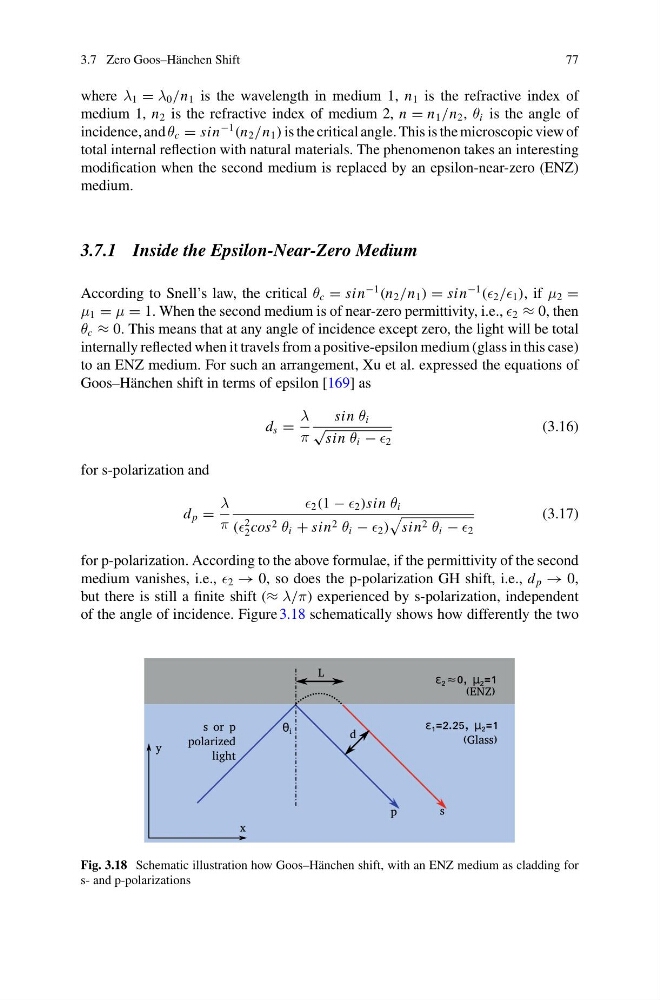
for p-polarization. According to the above formulae, if the permittivity of the second
medium vanishes, i.e., 2 → 0, so does the p-polarization GH shift, i.e., d p → 0,
but there is still a finite shift (≈ λ/π) experienced by s-polarization, independent
of the angle of incidence. Figure 3.18 schematically shows how differently the two
Fig. 3.18 Schematic illustration how Goos–Hänchen shift, with an ENZ medium as cladding for
s- and p-polarizations
77
where λ 1 = λ 0 /n 1 is the wavelength in medium 1, n 1 is the refractive index of
medium 1, n 2 is the refractive index of medium 2, n = n 1 /n 2 , θ i is the angle of
incidence, and θ c = sin
−1
(n 2 /n 1 ) is the critical angle. This is the microscopic view of
total internal reflection with natural materials. The phenomenon takes an interesting
modification when the second medium is replaced by an epsilon-near-zero (ENZ)
medium.
3.7.1 Inside the Epsilon-Near-Zero Medium
According to Snell’s law, the critical θ c = sin
−1
(n 2 /n 1 ) = sin
−1
( 2 / 1 ), if μ 2 =
μ 1 = μ = 1. When the second medium is of near-zero permittivity, i.e., 2 ≈ 0, then
θ c ≈ 0. This means that at any angle of incidence except zero, the light will be total
internally reflected when it travels from a positive-epsilon medium (glass in this case)
to an ENZ medium. For such an arrangement, Xu et al. expressed the equations of
Goos–Hänchen shift in terms of epsilon [169] as
d s =
λ
π
sin θ i
√
sin θ i − 2
(3.16)
for s-polarization and
d p =
λ
π
2 (1 − 2 )sin θ i
(
2
2 cos 2 θ i + sin 2 θ i − 2 )
sin 2 θ i − 2
(3.17)
for p-polarization. According to the above formulae, if the permittivity of the second
medium vanishes, i.e., 2 → 0, so does the p-polarization GH shift, i.e., d p → 0,
but there is still a finite shift (≈ λ/π) experienced by s-polarization, independent
of the angle of incidence. Figure 3.18 schematically shows how differently the two
Fig. 3.18 Schematic illustration how Goos–Hänchen shift, with an ENZ medium as cladding for
s- and p-polarizations