

76
3 Applications of Zero-Index Metamaterials
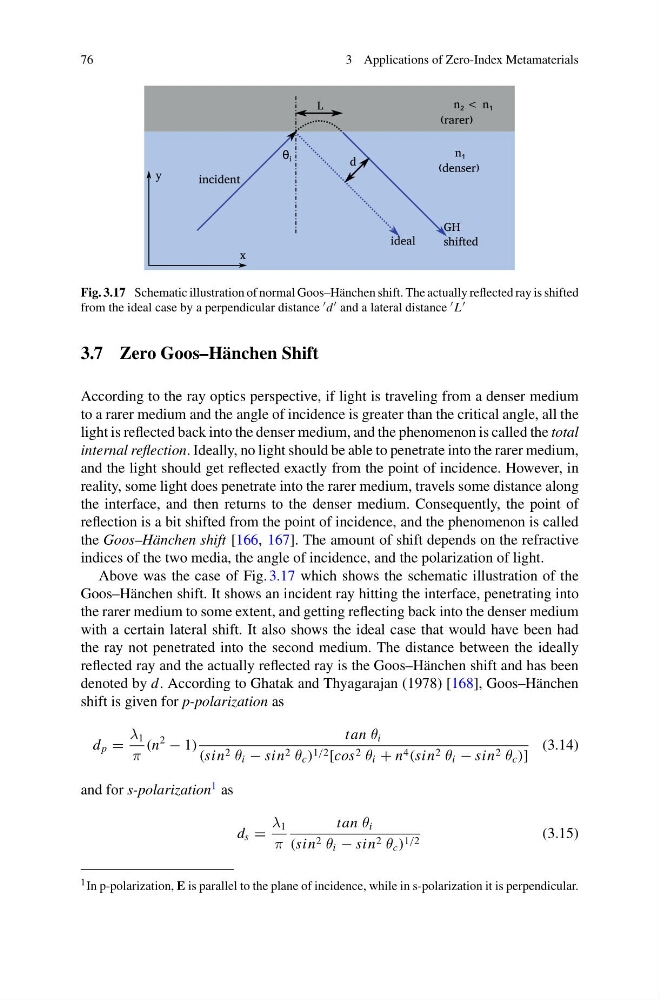
Fig. 3.17 Schematic illustration of normal Goos–Hänchen shift. The actually reflected ray is shifted
from the ideal case by a perpendicular distance d and a lateral distance L
3.7 Zero Goos–Hänchen Shift
According to the ray optics perspective, if light is traveling from a denser medium
to a rarer medium and the angle of incidence is greater than the critical angle, all the
light is reflected back into the denser medium, and the phenomenon is called the total
internal reflection. Ideally, no light should be able to penetrate into the rarer medium,
and the light should get reflected exactly from the point of incidence. However, in
reality, some light does penetrate into the rarer medium, travels some distance along
the interface, and then returns to the denser medium. Consequently, the point of
reflection is a bit shifted from the point of incidence, and the phenomenon is called
the Goos–Hänchen shift [166, 167]. The amount of shift depends on the refractive
indices of the two media, the angle of incidence, and the polarization of light.
Above was the case of Fig. 3.17 which shows the schematic illustration of the
Goos–Hänchen shift. It shows an incident ray hitting the interface, penetrating into
the rarer medium to some extent, and getting reflecting back into the denser medium
with a certain lateral shift. It also shows the ideal case that would have been had
the ray not penetrated into the second medium. The distance between the ideally
reflected ray and the actually reflected ray is the Goos–Hänchen shift and has been
denoted by d. According to Ghatak and Thyagarajan (1978) [168], Goos–Hänchen
shift is given for p-polarization as
d p =
λ 1
π
(n
2
− 1)
tan θ i
(sin 2 θ i − sin 2 θ c ) 1/2 [cos 2 θ i + n 4 (sin 2 θ i − sin 2 θ c )]
(3.14)
and for s-polarization
1 as
d s =
λ 1
π
tan θ i
(sin 2 θ i − sin 2 θ c ) 1/2
(3.15)
1 In p-polarization, E is parallel to the plane of incidence, while in s-polarization it is perpendicular.
3 Applications of Zero-Index Metamaterials
Fig. 3.17 Schematic illustration of normal Goos–Hänchen shift. The actually reflected ray is shifted
from the ideal case by a perpendicular distance d and a lateral distance L
3.7 Zero Goos–Hänchen Shift
According to the ray optics perspective, if light is traveling from a denser medium
to a rarer medium and the angle of incidence is greater than the critical angle, all the
light is reflected back into the denser medium, and the phenomenon is called the total
internal reflection. Ideally, no light should be able to penetrate into the rarer medium,
and the light should get reflected exactly from the point of incidence. However, in
reality, some light does penetrate into the rarer medium, travels some distance along
the interface, and then returns to the denser medium. Consequently, the point of
reflection is a bit shifted from the point of incidence, and the phenomenon is called
the Goos–Hänchen shift [166, 167]. The amount of shift depends on the refractive
indices of the two media, the angle of incidence, and the polarization of light.
Above was the case of Fig. 3.17 which shows the schematic illustration of the
Goos–Hänchen shift. It shows an incident ray hitting the interface, penetrating into
the rarer medium to some extent, and getting reflecting back into the denser medium
with a certain lateral shift. It also shows the ideal case that would have been had
the ray not penetrated into the second medium. The distance between the ideally
reflected ray and the actually reflected ray is the Goos–Hänchen shift and has been
denoted by d. According to Ghatak and Thyagarajan (1978) [168], Goos–Hänchen
shift is given for p-polarization as
d p =
λ 1
π
(n
2
− 1)
tan θ i
(sin 2 θ i − sin 2 θ c ) 1/2 [cos 2 θ i + n 4 (sin 2 θ i − sin 2 θ c )]
(3.14)
and for s-polarization
1 as
d s =
λ 1
π
tan θ i
(sin 2 θ i − sin 2 θ c ) 1/2
(3.15)
1 In p-polarization, E is parallel to the plane of incidence, while in s-polarization it is perpendicular.