

3.4 Wavefront Engineering
69
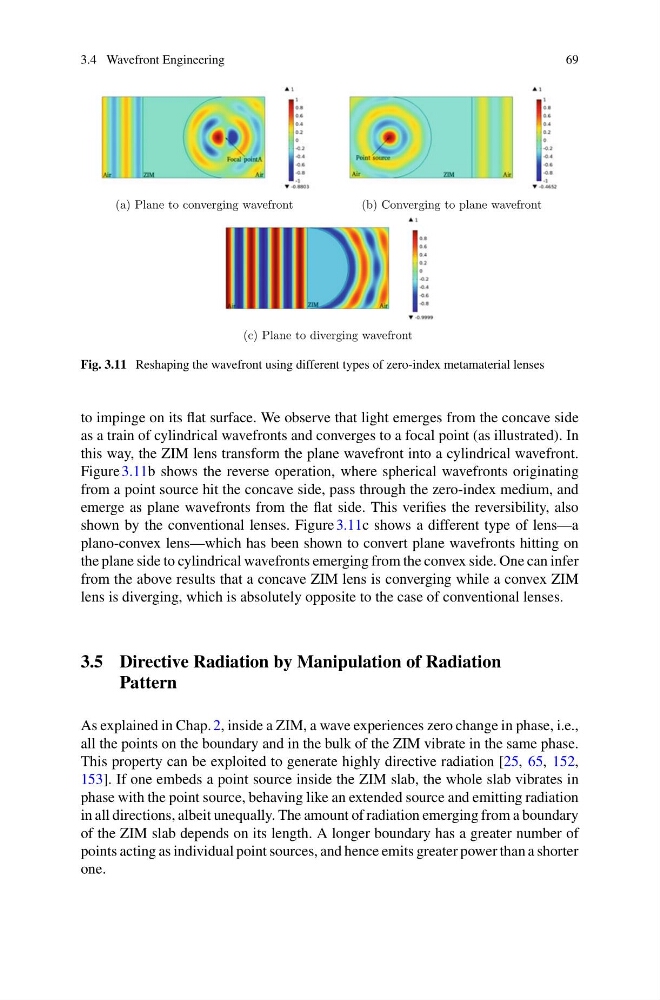
(a) Plane to converging wavefront
(b) Converging to plane wavefront
(c) Plane to diverging wavefront
Fig. 3.11 Reshaping the wavefront using different types of zero-index metamaterial lenses
to impinge on its flat surface. We observe that light emerges from the concave side
as a train of cylindrical wavefronts and converges to a focal point (as illustrated). In
this way, the ZIM lens transform the plane wavefront into a cylindrical wavefront.
Figure 3.11b shows the reverse operation, where spherical wavefronts originating
from a point source hit the concave side, pass through the zero-index medium, and
emerge as plane wavefronts from the flat side. This verifies the reversibility, also
shown by the conventional lenses. Figure 3.11c shows a different type of lens—a
plano-convex lens—which has been shown to convert plane wavefronts hitting on
the plane side to cylindrical wavefronts emerging from the convex side. One can infer
from the above results that a concave ZIM lens is converging while a convex ZIM
lens is diverging, which is absolutely opposite to the case of conventional lenses.
3.5 Directive Radiation by Manipulation of Radiation
Pattern
As explained in Chap. 2, inside a ZIM, a wave experiences zero change in phase, i.e.,
all the points on the boundary and in the bulk of the ZIM vibrate in the same phase.
This property can be exploited to generate highly directive radiation [25, 65, 152,
153]. If one embeds a point source inside the ZIM slab, the whole slab vibrates in
phase with the point source, behaving like an extended source and emitting radiation
in all directions, albeit unequally. The amount of radiation emerging from a boundary
of the ZIM slab depends on its length. A longer boundary has a greater number of
points acting as individual point sources, and hence emits greater power than a shorter
one.
69
(a) Plane to converging wavefront
(b) Converging to plane wavefront
(c) Plane to diverging wavefront
Fig. 3.11 Reshaping the wavefront using different types of zero-index metamaterial lenses
to impinge on its flat surface. We observe that light emerges from the concave side
as a train of cylindrical wavefronts and converges to a focal point (as illustrated). In
this way, the ZIM lens transform the plane wavefront into a cylindrical wavefront.
Figure 3.11b shows the reverse operation, where spherical wavefronts originating
from a point source hit the concave side, pass through the zero-index medium, and
emerge as plane wavefronts from the flat side. This verifies the reversibility, also
shown by the conventional lenses. Figure 3.11c shows a different type of lens—a
plano-convex lens—which has been shown to convert plane wavefronts hitting on
the plane side to cylindrical wavefronts emerging from the convex side. One can infer
from the above results that a concave ZIM lens is converging while a convex ZIM
lens is diverging, which is absolutely opposite to the case of conventional lenses.
3.5 Directive Radiation by Manipulation of Radiation
Pattern
As explained in Chap. 2, inside a ZIM, a wave experiences zero change in phase, i.e.,
all the points on the boundary and in the bulk of the ZIM vibrate in the same phase.
This property can be exploited to generate highly directive radiation [25, 65, 152,
153]. If one embeds a point source inside the ZIM slab, the whole slab vibrates in
phase with the point source, behaving like an extended source and emitting radiation
in all directions, albeit unequally. The amount of radiation emerging from a boundary
of the ZIM slab depends on its length. A longer boundary has a greater number of
points acting as individual point sources, and hence emits greater power than a shorter
one.