

68
3 Applications of Zero-Index Metamaterials
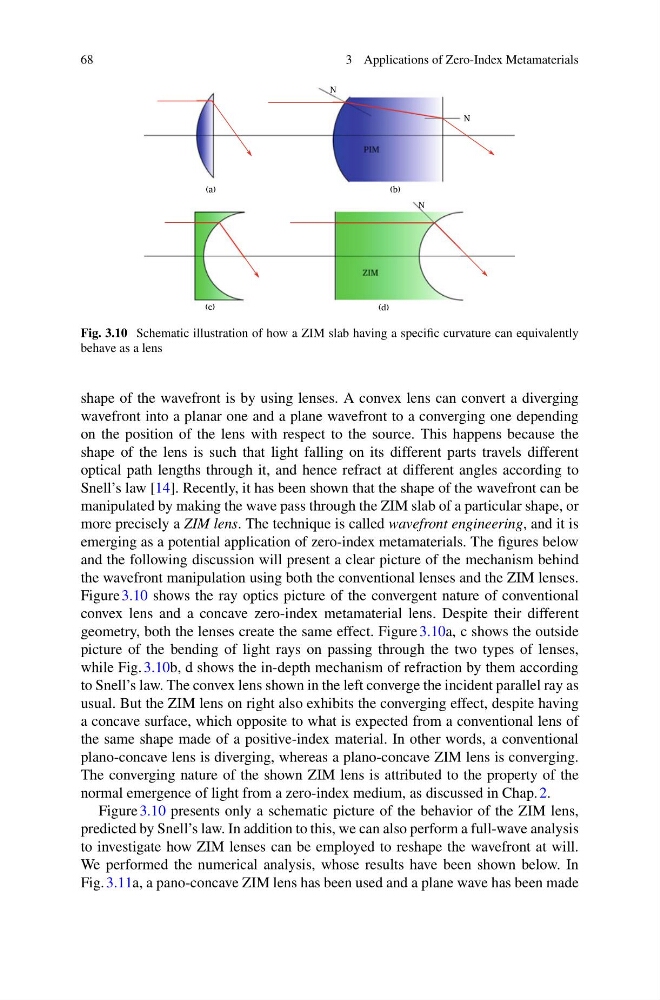
Fig. 3.10 Schematic illustration of how a ZIM slab having a specific curvature can equivalently
behave as a lens
shape of the wavefront is by using lenses. A convex lens can convert a diverging
wavefront into a planar one and a plane wavefront to a converging one depending
on the position of the lens with respect to the source. This happens because the
shape of the lens is such that light falling on its different parts travels different
optical path lengths through it, and hence refract at different angles according to
Snell’s law [14]. Recently, it has been shown that the shape of the wavefront can be
manipulated by making the wave pass through the ZIM slab of a particular shape, or
more precisely a ZIM lens. The technique is called wavefront engineering, and it is
emerging as a potential application of zero-index metamaterials. The figures below
and the following discussion will present a clear picture of the mechanism behind
the wavefront manipulation using both the conventional lenses and the ZIM lenses.
Figure 3.10 shows the ray optics picture of the convergent nature of conventional
convex lens and a concave zero-index metamaterial lens. Despite their different
geometry, both the lenses create the same effect. Figure 3.10a, c shows the outside
picture of the bending of light rays on passing through the two types of lenses,
while Fig. 3.10b, d shows the in-depth mechanism of refraction by them according
to Snell’s law. The convex lens shown in the left converge the incident parallel ray as
usual. But the ZIM lens on right also exhibits the converging effect, despite having
a concave surface, which opposite to what is expected from a conventional lens of
the same shape made of a positive-index material. In other words, a conventional
plano-concave lens is diverging, whereas a plano-concave ZIM lens is converging.
The converging nature of the shown ZIM lens is attributed to the property of the
normal emergence of light from a zero-index medium, as discussed in Chap. 2.
Figure 3.10 presents only a schematic picture of the behavior of the ZIM lens,
predicted by Snell’s law. In addition to this, we can also perform a full-wave analysis
to investigate how ZIM lenses can be employed to reshape the wavefront at will.
We performed the numerical analysis, whose results have been shown below. In
Fig. 3.11a, a pano-concave ZIM lens has been used and a plane wave has been made
3 Applications of Zero-Index Metamaterials
Fig. 3.10 Schematic illustration of how a ZIM slab having a specific curvature can equivalently
behave as a lens
shape of the wavefront is by using lenses. A convex lens can convert a diverging
wavefront into a planar one and a plane wavefront to a converging one depending
on the position of the lens with respect to the source. This happens because the
shape of the lens is such that light falling on its different parts travels different
optical path lengths through it, and hence refract at different angles according to
Snell’s law [14]. Recently, it has been shown that the shape of the wavefront can be
manipulated by making the wave pass through the ZIM slab of a particular shape, or
more precisely a ZIM lens. The technique is called wavefront engineering, and it is
emerging as a potential application of zero-index metamaterials. The figures below
and the following discussion will present a clear picture of the mechanism behind
the wavefront manipulation using both the conventional lenses and the ZIM lenses.
Figure 3.10 shows the ray optics picture of the convergent nature of conventional
convex lens and a concave zero-index metamaterial lens. Despite their different
geometry, both the lenses create the same effect. Figure 3.10a, c shows the outside
picture of the bending of light rays on passing through the two types of lenses,
while Fig. 3.10b, d shows the in-depth mechanism of refraction by them according
to Snell’s law. The convex lens shown in the left converge the incident parallel ray as
usual. But the ZIM lens on right also exhibits the converging effect, despite having
a concave surface, which opposite to what is expected from a conventional lens of
the same shape made of a positive-index material. In other words, a conventional
plano-concave lens is diverging, whereas a plano-concave ZIM lens is converging.
The converging nature of the shown ZIM lens is attributed to the property of the
normal emergence of light from a zero-index medium, as discussed in Chap. 2.
Figure 3.10 presents only a schematic picture of the behavior of the ZIM lens,
predicted by Snell’s law. In addition to this, we can also perform a full-wave analysis
to investigate how ZIM lenses can be employed to reshape the wavefront at will.
We performed the numerical analysis, whose results have been shown below. In
Fig. 3.11a, a pano-concave ZIM lens has been used and a plane wave has been made