

3.3 Electromagnetic Cloaking
67
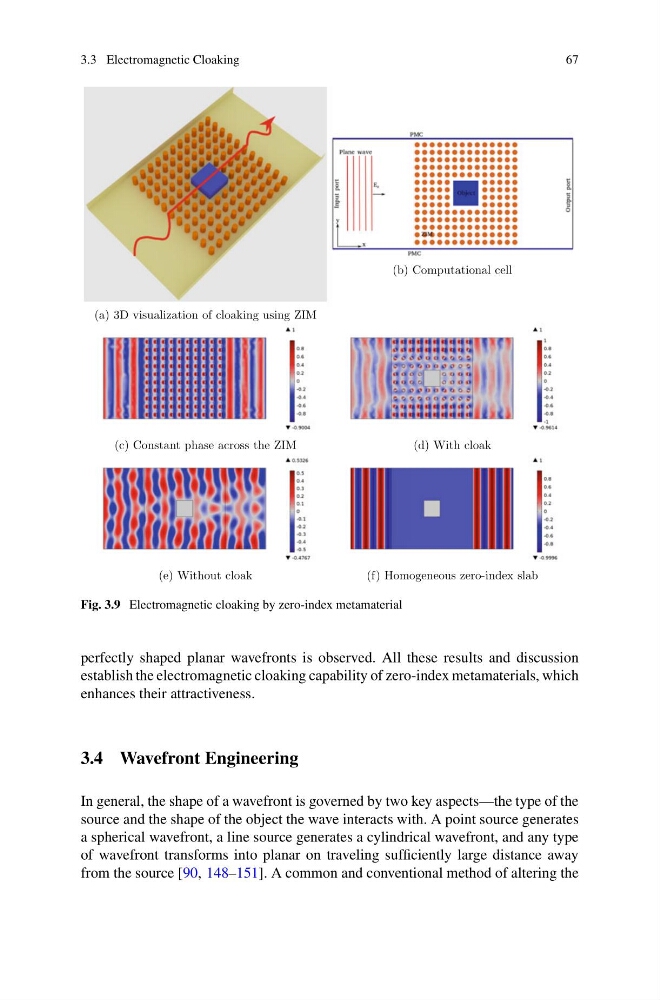
(a) 3D visualization of cloaking using ZIM
(b) Computational cell
(c) Constant phase across the ZIM
(d) With cloak
(e) Without cloak
(f) Homogeneous zero-index slab
Fig. 3.9 Electromagnetic cloaking by zero-index metamaterial
perfectly shaped planar wavefronts is observed. All these results and discussion
establish the electromagnetic cloaking capability of zero-index metamaterials, which
enhances their attractiveness.
3.4 Wavefront Engineering
In general, the shape of a wavefront is governed by two key aspects—the type of the
source and the shape of the object the wave interacts with. A point source generates
a spherical wavefront, a line source generates a cylindrical wavefront, and any type
of wavefront transforms into planar on traveling sufficiently large distance away
from the source [90, 148–151]. A common and conventional method of altering the
67
(a) 3D visualization of cloaking using ZIM
(b) Computational cell
(c) Constant phase across the ZIM
(d) With cloak
(e) Without cloak
(f) Homogeneous zero-index slab
Fig. 3.9 Electromagnetic cloaking by zero-index metamaterial
perfectly shaped planar wavefronts is observed. All these results and discussion
establish the electromagnetic cloaking capability of zero-index metamaterials, which
enhances their attractiveness.
3.4 Wavefront Engineering
In general, the shape of a wavefront is governed by two key aspects—the type of the
source and the shape of the object the wave interacts with. A point source generates
a spherical wavefront, a line source generates a cylindrical wavefront, and any type
of wavefront transforms into planar on traveling sufficiently large distance away
from the source [90, 148–151]. A common and conventional method of altering the