

70
3 Applications of Zero-Index Metamaterials
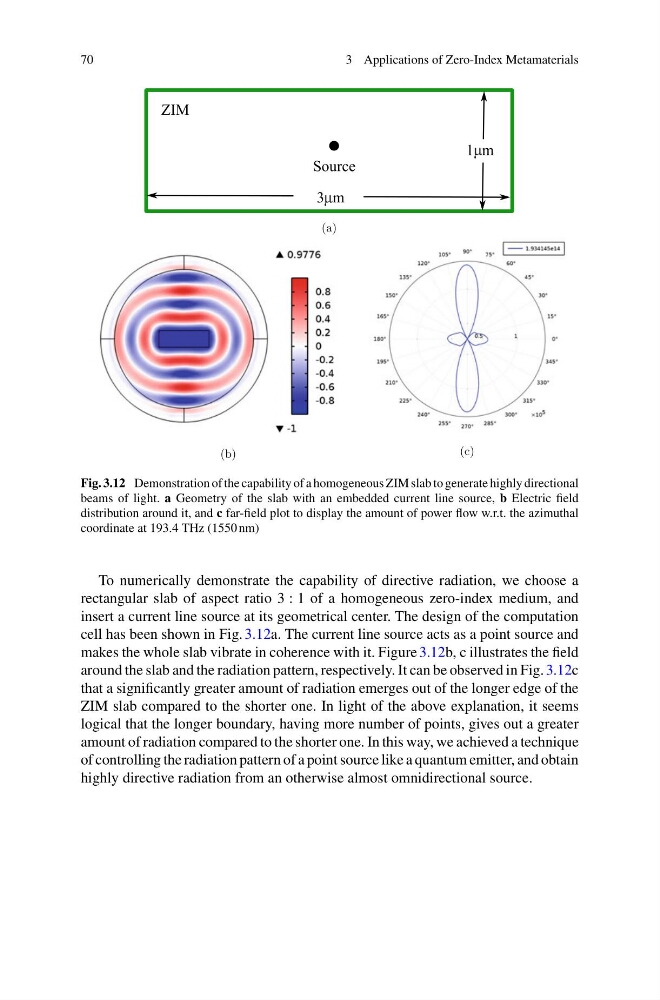
Fig. 3.12 Demonstration of the capability of a homogeneous ZIM slab to generate highly directional
beams of light. a Geometry of the slab with an embedded current line source, b Electric field
distribution around it, and c far-field plot to display the amount of power flow w.r.t. the azimuthal
coordinate at 193.4 THz (1550 nm)
To numerically demonstrate the capability of directive radiation, we choose a
rectangular slab of aspect ratio 3 : 1 of a homogeneous zero-index medium, and
insert a current line source at its geometrical center. The design of the computation
cell has been shown in Fig. 3.12a. The current line source acts as a point source and
makes the whole slab vibrate in coherence with it. Figure 3.12b, c illustrates the field
around the slab and the radiation pattern, respectively. It can be observed in Fig. 3.12c
that a significantly greater amount of radiation emerges out of the longer edge of the
ZIM slab compared to the shorter one. In light of the above explanation, it seems
logical that the longer boundary, having more number of points, gives out a greater
amount of radiation compared to the shorter one. In this way, we achieved a technique
of controlling the radiation pattern of a point source like a quantum emitter, and obtain
highly directive radiation from an otherwise almost omnidirectional source.
3 Applications of Zero-Index Metamaterials
Fig. 3.12 Demonstration of the capability of a homogeneous ZIM slab to generate highly directional
beams of light. a Geometry of the slab with an embedded current line source, b Electric field
distribution around it, and c far-field plot to display the amount of power flow w.r.t. the azimuthal
coordinate at 193.4 THz (1550 nm)
To numerically demonstrate the capability of directive radiation, we choose a
rectangular slab of aspect ratio 3 : 1 of a homogeneous zero-index medium, and
insert a current line source at its geometrical center. The design of the computation
cell has been shown in Fig. 3.12a. The current line source acts as a point source and
makes the whole slab vibrate in coherence with it. Figure 3.12b, c illustrates the field
around the slab and the radiation pattern, respectively. It can be observed in Fig. 3.12c
that a significantly greater amount of radiation emerges out of the longer edge of the
ZIM slab compared to the shorter one. In light of the above explanation, it seems
logical that the longer boundary, having more number of points, gives out a greater
amount of radiation compared to the shorter one. In this way, we achieved a technique
of controlling the radiation pattern of a point source like a quantum emitter, and obtain
highly directive radiation from an otherwise almost omnidirectional source.