

1.8 Transition from a Photonic Crystal to a Dielectric Metamaterial
21
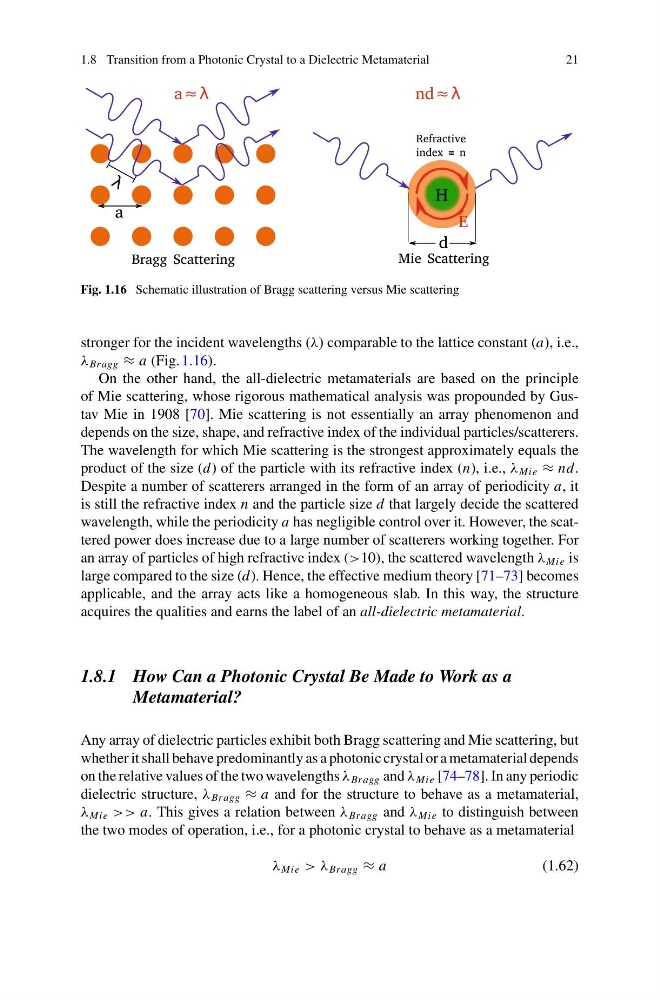
Fig. 1.16 Schematic illustration of Bragg scattering versus Mie scattering
stronger for the incident wavelengths (λ) comparable to the lattice constant (a), i.e.,
λ Bragg ≈ a (Fig. 1.16).
On the other hand, the all-dielectric metamaterials are based on the principle
of Mie scattering, whose rigorous mathematical analysis was propounded by Gustav Mie in 1908 [70]. Mie scattering is not essentially an array phenomenon and
depends on the size, shape, and refractive index of the individual particles/scatterers.
The wavelength for which Mie scattering is the strongest approximately equals the
product of the size (d) of the particle with its refractive index (n), i.e., λ Mie ≈ nd.
Despite a number of scatterers arranged in the form of an array of periodicity a, it
is still the refractive index n and the particle size d that largely decide the scattered
wavelength, while the periodicity a has negligible control over it. However, the scattered power does increase due to a large number of scatterers working together. For
an array of particles of high refractive index (>10), the scattered wavelength λ Mie is
large compared to the size (d). Hence, the effective medium theory [71–73] becomes
applicable, and the array acts like a homogeneous slab. In this way, the structure
acquires the qualities and earns the label of an all-dielectric metamaterial.
1.8.1 How Can a Photonic Crystal Be Made to Work as a
Metamaterial?
Any array of dielectric particles exhibit both Bragg scattering and Mie scattering, but
whether it shall behave predominantly as a photonic crystal or a metamaterial depends
on the relative values of the two wavelengths λ Bragg and λ Mie [74–78]. In any periodic
dielectric structure, λ Bragg ≈ a and for the structure to behave as a metamaterial,
λ Mie >> a. This gives a relation between λ Bragg and λ Mie to distinguish between
the two modes of operation, i.e., for a photonic crystal to behave as a metamaterial
λ Mie > λ Bragg ≈ a
(1.62)
21
Fig. 1.16 Schematic illustration of Bragg scattering versus Mie scattering
stronger for the incident wavelengths (λ) comparable to the lattice constant (a), i.e.,
λ Bragg ≈ a (Fig. 1.16).
On the other hand, the all-dielectric metamaterials are based on the principle
of Mie scattering, whose rigorous mathematical analysis was propounded by Gustav Mie in 1908 [70]. Mie scattering is not essentially an array phenomenon and
depends on the size, shape, and refractive index of the individual particles/scatterers.
The wavelength for which Mie scattering is the strongest approximately equals the
product of the size (d) of the particle with its refractive index (n), i.e., λ Mie ≈ nd.
Despite a number of scatterers arranged in the form of an array of periodicity a, it
is still the refractive index n and the particle size d that largely decide the scattered
wavelength, while the periodicity a has negligible control over it. However, the scattered power does increase due to a large number of scatterers working together. For
an array of particles of high refractive index (>10), the scattered wavelength λ Mie is
large compared to the size (d). Hence, the effective medium theory [71–73] becomes
applicable, and the array acts like a homogeneous slab. In this way, the structure
acquires the qualities and earns the label of an all-dielectric metamaterial.
1.8.1 How Can a Photonic Crystal Be Made to Work as a
Metamaterial?
Any array of dielectric particles exhibit both Bragg scattering and Mie scattering, but
whether it shall behave predominantly as a photonic crystal or a metamaterial depends
on the relative values of the two wavelengths λ Bragg and λ Mie [74–78]. In any periodic
dielectric structure, λ Bragg ≈ a and for the structure to behave as a metamaterial,
λ Mie >> a. This gives a relation between λ Bragg and λ Mie to distinguish between
the two modes of operation, i.e., for a photonic crystal to behave as a metamaterial
λ Mie > λ Bragg ≈ a
(1.62)