

6
1 Electromagnetics for Zero-Index Metamaterials
scenario, the force on the two paddles will be the same, but along opposite directions.
Consequently, the wheel will experience no net force but only a net torque, and will
exhibit rotation but no translatory motion. It should be noted that in this case, the curl
of the vector field will be relatively greater than that in case (b), since the direction of
water flow is opposite in the two halves of the stream. Now, if the velocity is replaced
by any other vector quantity such as electric field or magnetic field, the meaning of
curl remains unchanged. In light of the above explanations, we believe that the
reader will develop a sufficient insight into the physical significance of gradient,
divergence, and curl, which will be invoked in context to Maxwell’s equations and
the electromagnetic waves.
1.3 Maxwell’s Equation
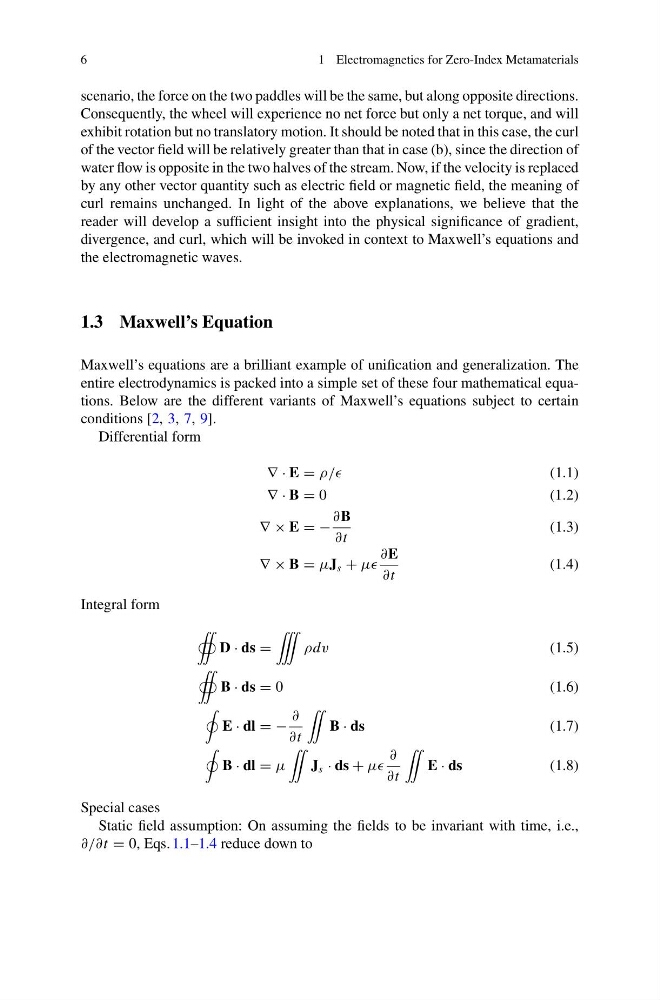
Maxwell’s equations are a brilliant example of unification and generalization. The
entire electrodynamics is packed into a simple set of these four mathematical equations. Below are the different variants of Maxwell’s equations subject to certain
conditions [2, 3, 7, 9].
Differential form
∇ · E = ρ/
(1.1)
∇ · B = 0
( 1 . 2 )
∇ × E = −
∂B
∂t
(1.3)
∇ × B = μJ s + μμ
∂E
∂t
(1.4)
Integral form
‹
D · ds =
˚
ρdv
(1.5)
‹
B · ds = 0
(1.6)
˛
E · dl = −
∂
∂t
¨
B · ds
(1.7)
˛
B · dl = μ
¨
J s · ds + μμ
∂
∂t
¨
E · ds
(1.8)
Special cases
Static field assumption: On assuming the fields to be invariant with time, i.e.,
∂/∂t = 0, Eqs. 1.1–1.4 reduce down to
1 Electromagnetics for Zero-Index Metamaterials
scenario, the force on the two paddles will be the same, but along opposite directions.
Consequently, the wheel will experience no net force but only a net torque, and will
exhibit rotation but no translatory motion. It should be noted that in this case, the curl
of the vector field will be relatively greater than that in case (b), since the direction of
water flow is opposite in the two halves of the stream. Now, if the velocity is replaced
by any other vector quantity such as electric field or magnetic field, the meaning of
curl remains unchanged. In light of the above explanations, we believe that the
reader will develop a sufficient insight into the physical significance of gradient,
divergence, and curl, which will be invoked in context to Maxwell’s equations and
the electromagnetic waves.
1.3 Maxwell’s Equation
Maxwell’s equations are a brilliant example of unification and generalization. The
entire electrodynamics is packed into a simple set of these four mathematical equations. Below are the different variants of Maxwell’s equations subject to certain
conditions [2, 3, 7, 9].
Differential form
∇ · E = ρ/
(1.1)
∇ · B = 0
( 1 . 2 )
∇ × E = −
∂B
∂t
(1.3)
∇ × B = μJ s + μμ
∂E
∂t
(1.4)
Integral form
‹
D · ds =
˚
ρdv
(1.5)
‹
B · ds = 0
(1.6)
˛
E · dl = −
∂
∂t
¨
B · ds
(1.7)
˛
B · dl = μ
¨
J s · ds + μμ
∂
∂t
¨
E · ds
(1.8)
Special cases
Static field assumption: On assuming the fields to be invariant with time, i.e.,
∂/∂t = 0, Eqs. 1.1–1.4 reduce down to