

1.2 Physical Meaning of Gradient, Divergence, and Curl
5
or sinking into the system. One may wonder, why divergence (and not convergence)
has been embraced as a property of the field? Answer to this is the fact that since
the advent of electrodynamics positive charge has conventionally been pivotal in
defining various quantities and parameters. It was not known back then that electron (a negatively charged particle) was the fundamental unit of charge, hence the
convention.
1.2.3 Curl
Curl, as the name suggests, is the measure of the twist or swirl of a vector field. To
understand the physical meaning of curl, let us think of a paddled wheel submerged
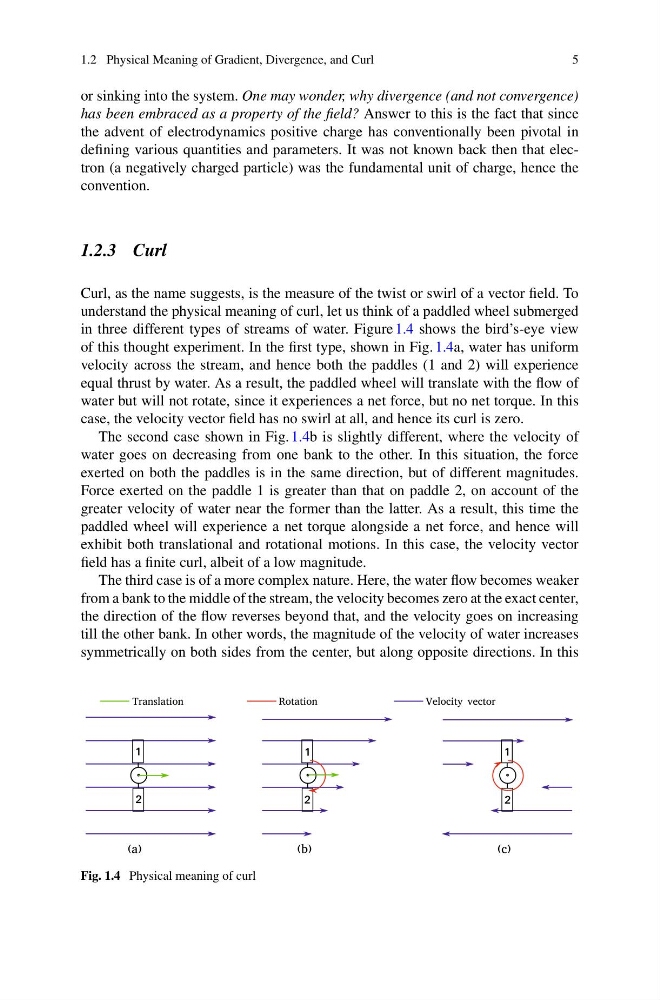
in three different types of streams of water. Figure 1.4 shows the bird’s-eye view
of this thought experiment. In the first type, shown in Fig. 1.4a, water has uniform
velocity across the stream, and hence both the paddles (1 and 2) will experience
equal thrust by water. As a result, the paddled wheel will translate with the flow of
water but will not rotate, since it experiences a net force, but no net torque. In this
case, the velocity vector field has no swirl at all, and hence its curl is zero.
The second case shown in Fig. 1.4b is slightly different, where the velocity of
water goes on decreasing from one bank to the other. In this situation, the force
exerted on both the paddles is in the same direction, but of different magnitudes.
Force exerted on the paddle 1 is greater than that on paddle 2, on account of the
greater velocity of water near the former than the latter. As a result, this time the
paddled wheel will experience a net torque alongside a net force, and hence will
exhibit both translational and rotational motions. In this case, the velocity vector
field has a finite curl, albeit of a low magnitude.
The third case is of a more complex nature. Here, the water flow becomes weaker
from a bank to the middle of the stream, the velocity becomes zero at the exact center,
the direction of the flow reverses beyond that, and the velocity goes on increasing
till the other bank. In other words, the magnitude of the velocity of water increases
symmetrically on both sides from the center, but along opposite directions. In this
Fig. 1.4 Physical meaning of curl
5
or sinking into the system. One may wonder, why divergence (and not convergence)
has been embraced as a property of the field? Answer to this is the fact that since
the advent of electrodynamics positive charge has conventionally been pivotal in
defining various quantities and parameters. It was not known back then that electron (a negatively charged particle) was the fundamental unit of charge, hence the
convention.
1.2.3 Curl
Curl, as the name suggests, is the measure of the twist or swirl of a vector field. To
understand the physical meaning of curl, let us think of a paddled wheel submerged
in three different types of streams of water. Figure 1.4 shows the bird’s-eye view
of this thought experiment. In the first type, shown in Fig. 1.4a, water has uniform
velocity across the stream, and hence both the paddles (1 and 2) will experience
equal thrust by water. As a result, the paddled wheel will translate with the flow of
water but will not rotate, since it experiences a net force, but no net torque. In this
case, the velocity vector field has no swirl at all, and hence its curl is zero.
The second case shown in Fig. 1.4b is slightly different, where the velocity of
water goes on decreasing from one bank to the other. In this situation, the force
exerted on both the paddles is in the same direction, but of different magnitudes.
Force exerted on the paddle 1 is greater than that on paddle 2, on account of the
greater velocity of water near the former than the latter. As a result, this time the
paddled wheel will experience a net torque alongside a net force, and hence will
exhibit both translational and rotational motions. In this case, the velocity vector
field has a finite curl, albeit of a low magnitude.
The third case is of a more complex nature. Here, the water flow becomes weaker
from a bank to the middle of the stream, the velocity becomes zero at the exact center,
the direction of the flow reverses beyond that, and the velocity goes on increasing
till the other bank. In other words, the magnitude of the velocity of water increases
symmetrically on both sides from the center, but along opposite directions. In this
Fig. 1.4 Physical meaning of curl