

4
1 Electromagnetics for Zero-Index Metamaterials
1.2.2 Divergence
According to dictionary, diverge means to separate and converge means to come
together. In electromagnetics, the divergence has special significance in relation to
the distribution and orientation of the electric field. The electric field, in simple terms,
is the influence of a charge felt in its surroundings. In close proximity to the charge,
the influence is strong and becomes gradually weaker as one moves away from it.
The term divergence describes the nature of the field around the charge. To visualize
the true nature of the electric field, let us think of an isolated fixed positive charge
+Q which influences a free small positive test charge +q present in its vicinity. How
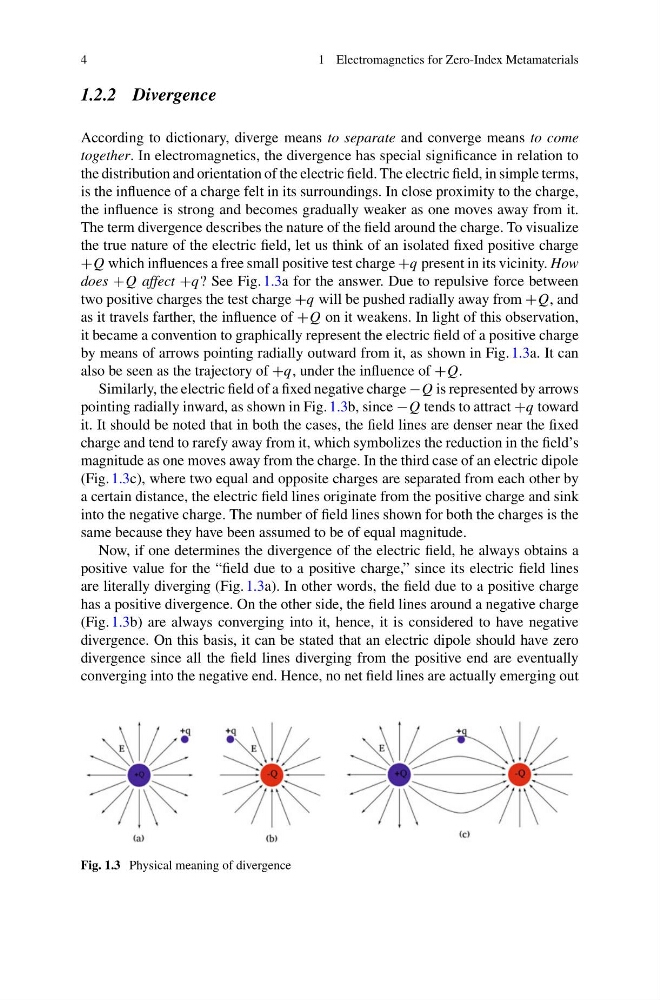
does +Q affect +q? See Fig. 1.3a for the answer. Due to repulsive force between
two positive charges the test charge +q will be pushed radially away from +Q, and
as it travels farther, the influence of +Q on it weakens. In light of this observation,
it became a convention to graphically represent the electric field of a positive charge
by means of arrows pointing radially outward from it, as shown in Fig. 1.3a. It can
also be seen as the trajectory of +q, under the influence of +Q.
Similarly, the electric field of a fixed negative charge −Q is represented by arrows
pointing radially inward, as shown in Fig. 1.3b, since −Q tends to attract +q toward
it. It should be noted that in both the cases, the field lines are denser near the fixed
charge and tend to rarefy away from it, which symbolizes the reduction in the field’s
magnitude as one moves away from the charge. In the third case of an electric dipole
(Fig. 1.3c), where two equal and opposite charges are separated from each other by
a certain distance, the electric field lines originate from the positive charge and sink
into the negative charge. The number of field lines shown for both the charges is the
same because they have been assumed to be of equal magnitude.
Now, if one determines the divergence of the electric field, he always obtains a
positive value for the “field due to a positive charge,” since its electric field lines
are literally diverging (Fig. 1.3a). In other words, the field due to a positive charge
has a positive divergence. On the other side, the field lines around a negative charge
(Fig. 1.3b) are always converging into it, hence, it is considered to have negative
divergence. On this basis, it can be stated that an electric dipole should have zero
divergence since all the field lines diverging from the positive end are eventually
converging into the negative end. Hence, no net field lines are actually emerging out
Fig. 1.3 Physical meaning of divergence
1 Electromagnetics for Zero-Index Metamaterials
1.2.2 Divergence
According to dictionary, diverge means to separate and converge means to come
together. In electromagnetics, the divergence has special significance in relation to
the distribution and orientation of the electric field. The electric field, in simple terms,
is the influence of a charge felt in its surroundings. In close proximity to the charge,
the influence is strong and becomes gradually weaker as one moves away from it.
The term divergence describes the nature of the field around the charge. To visualize
the true nature of the electric field, let us think of an isolated fixed positive charge
+Q which influences a free small positive test charge +q present in its vicinity. How
does +Q affect +q? See Fig. 1.3a for the answer. Due to repulsive force between
two positive charges the test charge +q will be pushed radially away from +Q, and
as it travels farther, the influence of +Q on it weakens. In light of this observation,
it became a convention to graphically represent the electric field of a positive charge
by means of arrows pointing radially outward from it, as shown in Fig. 1.3a. It can
also be seen as the trajectory of +q, under the influence of +Q.
Similarly, the electric field of a fixed negative charge −Q is represented by arrows
pointing radially inward, as shown in Fig. 1.3b, since −Q tends to attract +q toward
it. It should be noted that in both the cases, the field lines are denser near the fixed
charge and tend to rarefy away from it, which symbolizes the reduction in the field’s
magnitude as one moves away from the charge. In the third case of an electric dipole
(Fig. 1.3c), where two equal and opposite charges are separated from each other by
a certain distance, the electric field lines originate from the positive charge and sink
into the negative charge. The number of field lines shown for both the charges is the
same because they have been assumed to be of equal magnitude.
Now, if one determines the divergence of the electric field, he always obtains a
positive value for the “field due to a positive charge,” since its electric field lines
are literally diverging (Fig. 1.3a). In other words, the field due to a positive charge
has a positive divergence. On the other side, the field lines around a negative charge
(Fig. 1.3b) are always converging into it, hence, it is considered to have negative
divergence. On this basis, it can be stated that an electric dipole should have zero
divergence since all the field lines diverging from the positive end are eventually
converging into the negative end. Hence, no net field lines are actually emerging out
Fig. 1.3 Physical meaning of divergence