

116
4 Nonlinear Optics with Zero-Index Metamaterials
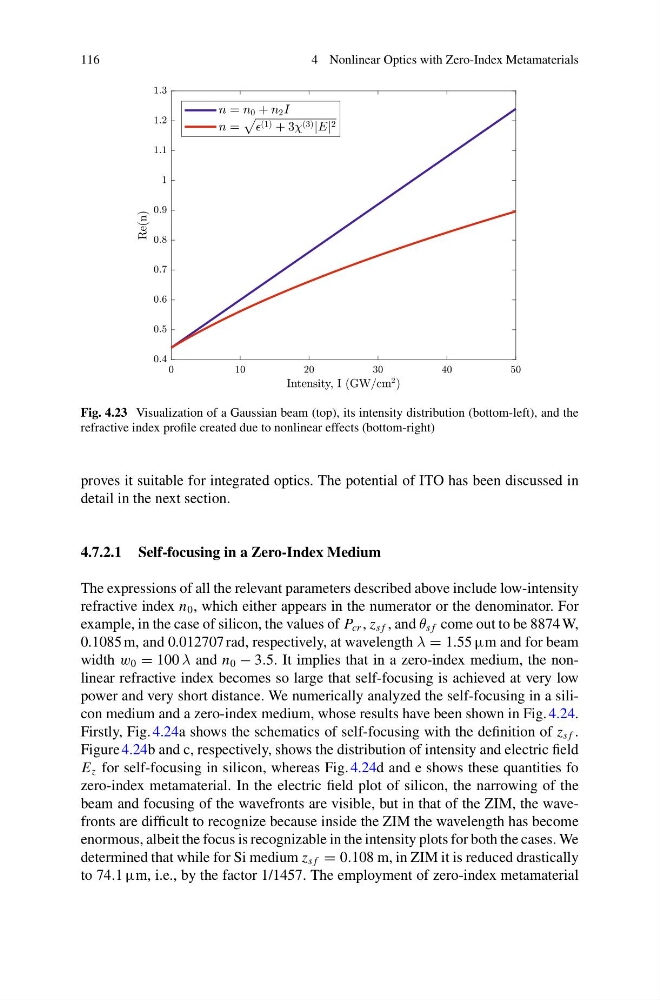
Fig. 4.23 Visualization of a Gaussian beam (top), its intensity distribution (bottom-left), and the
refractive index profile created due to nonlinear effects (bottom-right)
proves it suitable for integrated optics. The potential of ITO has been discussed in
detail in the next section.
4.7.2.1 Self-focusing in a Zero-Index Medium
The expressions of all the relevant parameters described above include low-intensity
refractive index n 0 , which either appears in the numerator or the denominator. For
example, in the case of silicon, the values of P cr , z s f , and θ s f come out to be 8874 W,
0.1085 m, and 0.012707 rad, respectively, at wavelength λ = 1.55 µm and for beam
width w 0 = 100 λ and n 0 − 3.5. It implies that in a zero-index medium, the nonlinear refractive index becomes so large that self-focusing is achieved at very low
power and very short distance. We numerically analyzed the self-focusing in a silicon medium and a zero-index medium, whose results have been shown in Fig. 4.24.
Firstly, Fig. 4.24a shows the schematics of self-focusing with the definition of z s f .
Figure 4.24b and c, respectively, shows the distribution of intensity and electric field
E z for self-focusing in silicon, whereas Fig. 4.24d and e shows these quantities fo
zero-index metamaterial. In the electric field plot of silicon, the narrowing of the
beam and focusing of the wavefronts are visible, but in that of the ZIM, the wavefronts are difficult to recognize because inside the ZIM the wavelength has become
enormous, albeit the focus is recognizable in the intensity plots for both the cases. We
determined that while for Si medium z s f = 0.108 m, in ZIM it is reduced drastically
to 74.1 µm, i.e., by the factor 1/1457. The employment of zero-index metamaterial
4 Nonlinear Optics with Zero-Index Metamaterials
Fig. 4.23 Visualization of a Gaussian beam (top), its intensity distribution (bottom-left), and the
refractive index profile created due to nonlinear effects (bottom-right)
proves it suitable for integrated optics. The potential of ITO has been discussed in
detail in the next section.
4.7.2.1 Self-focusing in a Zero-Index Medium
The expressions of all the relevant parameters described above include low-intensity
refractive index n 0 , which either appears in the numerator or the denominator. For
example, in the case of silicon, the values of P cr , z s f , and θ s f come out to be 8874 W,
0.1085 m, and 0.012707 rad, respectively, at wavelength λ = 1.55 µm and for beam
width w 0 = 100 λ and n 0 − 3.5. It implies that in a zero-index medium, the nonlinear refractive index becomes so large that self-focusing is achieved at very low
power and very short distance. We numerically analyzed the self-focusing in a silicon medium and a zero-index medium, whose results have been shown in Fig. 4.24.
Firstly, Fig. 4.24a shows the schematics of self-focusing with the definition of z s f .
Figure 4.24b and c, respectively, shows the distribution of intensity and electric field
E z for self-focusing in silicon, whereas Fig. 4.24d and e shows these quantities fo
zero-index metamaterial. In the electric field plot of silicon, the narrowing of the
beam and focusing of the wavefronts are visible, but in that of the ZIM, the wavefronts are difficult to recognize because inside the ZIM the wavelength has become
enormous, albeit the focus is recognizable in the intensity plots for both the cases. We
determined that while for Si medium z s f = 0.108 m, in ZIM it is reduced drastically
to 74.1 µm, i.e., by the factor 1/1457. The employment of zero-index metamaterial