

114
4 Nonlinear Optics with Zero-Index Metamaterials
0
0.1
0.2
0.3
0.4
0.5
0.6
0.7
0.8
-2
0
2
10
-4
-2
0
2
10
-4
0
0.5
1
1.5
2
2.5
10
4
-2
0
2
10
-4
3.5
3.5001
3.5002
3.5003
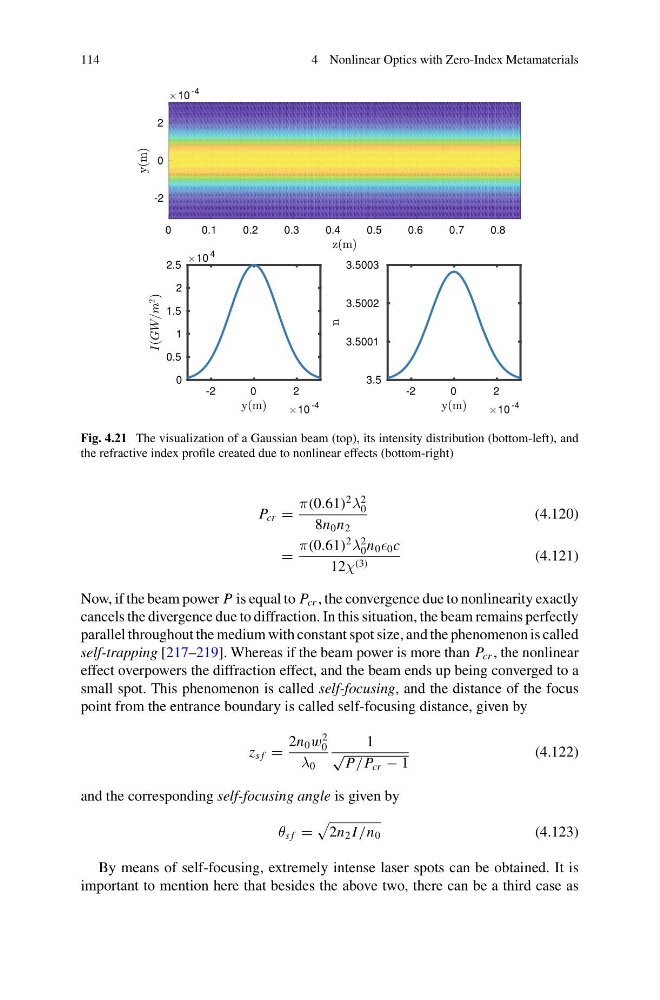
Fig. 4.21 The visualization of a Gaussian beam (top), its intensity distribution (bottom-left), and
the refractive index profile created due to nonlinear effects (bottom-right)
P cr =
π(0.61)
2
λ
2
0
8n 0 n 2
(4.120)
=
π(0.61)
2
λ
2
0 n 0 0 c
12χ (3)
(4.121)
Now, if the beam power P is equal to P cr , the convergence due to nonlinearity exactly
cancels the divergence due to diffraction. In this situation, the beam remains perfectly
parallel throughout the medium with constant spot size, and the phenomenon is called
self-trapping [217–219]. Whereas if the beam power is more than P cr , the nonlinear
effect overpowers the diffraction effect, and the beam ends up being converged to a
small spot. This phenomenon is called self-focusing, and the distance of the focus
point from the entrance boundary is called self-focusing distance, given by
z s f =
2n 0 w
2
0
λ 0
1
√
P/P cr − 1
(4.122)
and the corresponding self-focusing angle is given by
θ s f =
2n 2 I /n 0
(4.123)
By means of self-focusing, extremely intense laser spots can be obtained. It is
important to mention here that besides the above two, there can be a third case as
4 Nonlinear Optics with Zero-Index Metamaterials
0
0.1
0.2
0.3
0.4
0.5
0.6
0.7
0.8
-2
0
2
10
-4
-2
0
2
10
-4
0
0.5
1
1.5
2
2.5
10
4
-2
0
2
10
-4
3.5
3.5001
3.5002
3.5003
Fig. 4.21 The visualization of a Gaussian beam (top), its intensity distribution (bottom-left), and
the refractive index profile created due to nonlinear effects (bottom-right)
P cr =
π(0.61)
2
λ
2
0
8n 0 n 2
(4.120)
=
π(0.61)
2
λ
2
0 n 0 0 c
12χ (3)
(4.121)
Now, if the beam power P is equal to P cr , the convergence due to nonlinearity exactly
cancels the divergence due to diffraction. In this situation, the beam remains perfectly
parallel throughout the medium with constant spot size, and the phenomenon is called
self-trapping [217–219]. Whereas if the beam power is more than P cr , the nonlinear
effect overpowers the diffraction effect, and the beam ends up being converged to a
small spot. This phenomenon is called self-focusing, and the distance of the focus
point from the entrance boundary is called self-focusing distance, given by
z s f =
2n 0 w
2
0
λ 0
1
√
P/P cr − 1
(4.122)
and the corresponding self-focusing angle is given by
θ s f =
2n 2 I /n 0
(4.123)
By means of self-focusing, extremely intense laser spots can be obtained. It is
important to mention here that besides the above two, there can be a third case as