

4.7 Intensity-Dependent Refractive Index
113
where n 0 =
√
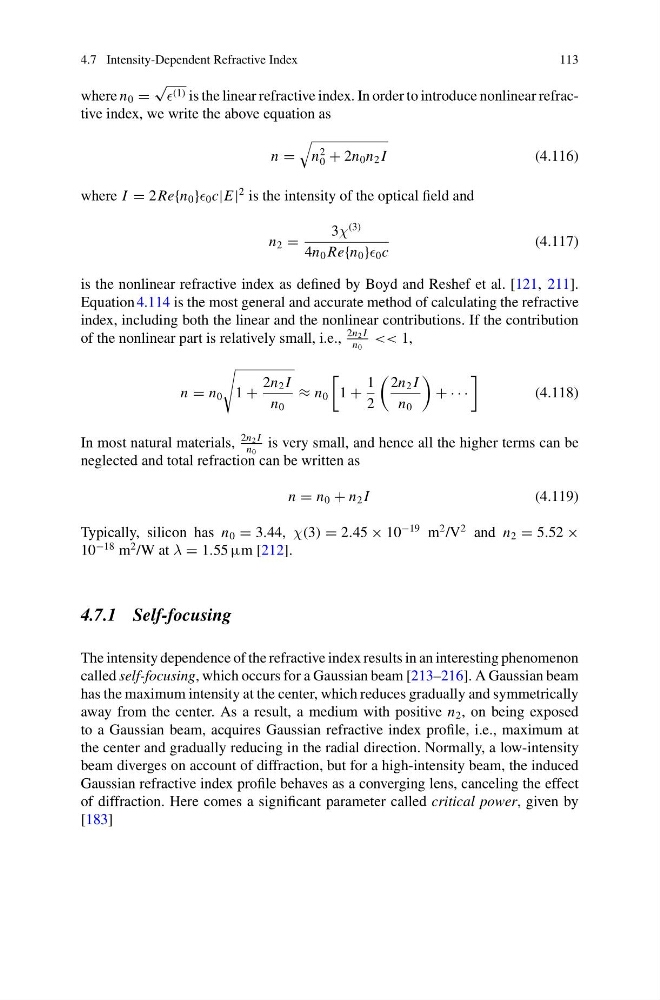
(1) is the linear refractive index. In order to introduce nonlinear refractive index, we write the above equation as
n =
n
2
0 + 2n 0 n 2 I
(4.116)
where I = 2Re{n 0 } 0 c|E|
2 is the intensity of the optical field and
n 2 =
3χ
(3)
4n 0 Re{n 0 } 0 c
(4.117)
is the nonlinear refractive index as defined by Boyd and Reshef et al. [121, 211].
Equation 4.114 is the most general and accurate method of calculating the refractive
index, including both the linear and the nonlinear contributions. If the contribution
of the nonlinear part is relatively small, i.e.,
2n 2 I
n 0
<< 1,
n = n 0
1 +
2n 2 I
n 0
≈ n 0
1 +
1
2
2n 2 I
n 0
+ · · ·
(4.118)
In most natural materials,
2n 2 I
n 0
is very small, and hence all the higher terms can be
neglected and total refraction can be written as
n = n 0 + n 2 I
(4.119)
Typically, silicon has n 0 = 3.44, χ(3) = 2.45 × 10
−19 m
2 /V
2 and n 2 = 5.52 ×
10
−18 m
2 /W at λ = 1.55 µm [212].
4.7.1 Self-focusing
The intensity dependence of the refractive index results in an interesting phenomenon
called self-focusing, which occurs for a Gaussian beam [213–216]. A Gaussian beam
has the maximum intensity at the center, which reduces gradually and symmetrically
away from the center. As a result, a medium with positive n 2 , on being exposed
to a Gaussian beam, acquires Gaussian refractive index profile, i.e., maximum at
the center and gradually reducing in the radial direction. Normally, a low-intensity
beam diverges on account of diffraction, but for a high-intensity beam, the induced
Gaussian refractive index profile behaves as a converging lens, canceling the effect
of diffraction. Here comes a significant parameter called critical power, given by
[183]
113
where n 0 =
√
(1) is the linear refractive index. In order to introduce nonlinear refractive index, we write the above equation as
n =
n
2
0 + 2n 0 n 2 I
(4.116)
where I = 2Re{n 0 } 0 c|E|
2 is the intensity of the optical field and
n 2 =
3χ
(3)
4n 0 Re{n 0 } 0 c
(4.117)
is the nonlinear refractive index as defined by Boyd and Reshef et al. [121, 211].
Equation 4.114 is the most general and accurate method of calculating the refractive
index, including both the linear and the nonlinear contributions. If the contribution
of the nonlinear part is relatively small, i.e.,
2n 2 I
n 0
<< 1,
n = n 0
1 +
2n 2 I
n 0
≈ n 0
1 +
1
2
2n 2 I
n 0
+ · · ·
(4.118)
In most natural materials,
2n 2 I
n 0
is very small, and hence all the higher terms can be
neglected and total refraction can be written as
n = n 0 + n 2 I
(4.119)
Typically, silicon has n 0 = 3.44, χ(3) = 2.45 × 10
−19 m
2 /V
2 and n 2 = 5.52 ×
10
−18 m
2 /W at λ = 1.55 µm [212].
4.7.1 Self-focusing
The intensity dependence of the refractive index results in an interesting phenomenon
called self-focusing, which occurs for a Gaussian beam [213–216]. A Gaussian beam
has the maximum intensity at the center, which reduces gradually and symmetrically
away from the center. As a result, a medium with positive n 2 , on being exposed
to a Gaussian beam, acquires Gaussian refractive index profile, i.e., maximum at
the center and gradually reducing in the radial direction. Normally, a low-intensity
beam diverges on account of diffraction, but for a high-intensity beam, the induced
Gaussian refractive index profile behaves as a converging lens, canceling the effect
of diffraction. Here comes a significant parameter called critical power, given by
[183]