

112
4 Nonlinear Optics with Zero-Index Metamaterials
index in improving the efficiency drastically. We believe that the above discussion
presents the significance of zero-index metamaterial in the SHG in a sufficiently
rigorous manner. Next, we tackle another important nonlinear phenomenon called
self-focusing and check if it can be enhanced with ZIM or not.
4.7 Intensity-Dependent Refractive Index
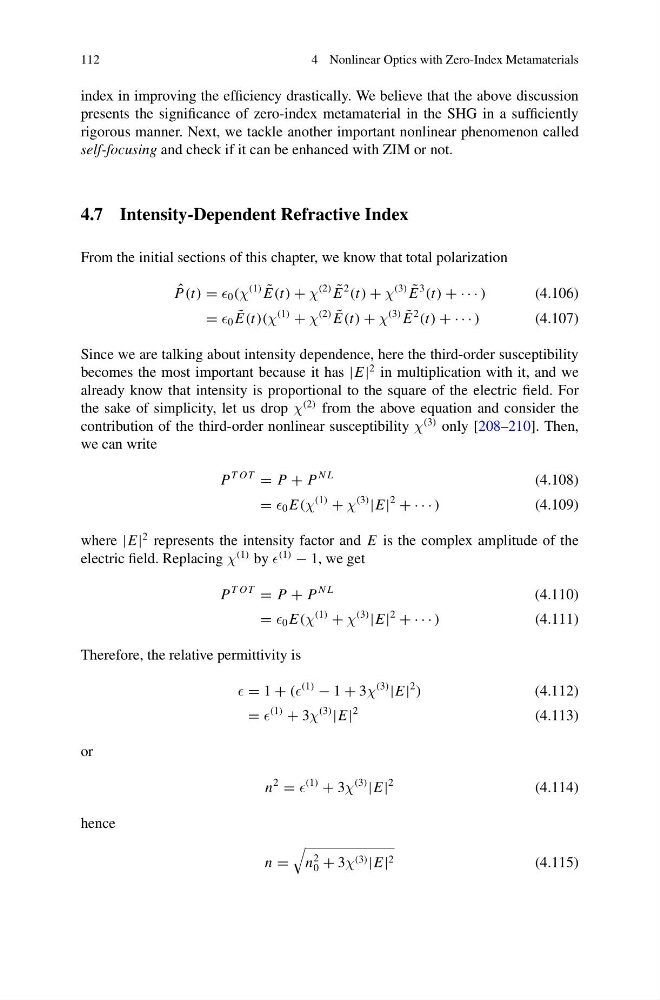
From the initial sections of this chapter, we know that total polarization
ˆ
P(t) = 0 (χ
(1) ˜
E(t) + χ
(2) ˜
E
2
(t) + χ
(3) ˜
E
3
(t) + · · · )
(4.106)
= 0 ˜
E(t)(χ
(1)
+ χ
(2) ˜
E(t) + χ
(3) ˜
E
2
(t) + · · · )
(4.107)
Since we are talking about intensity dependence, here the third-order susceptibility
becomes the most important because it has |E|
2 in multiplication with it, and we
already know that intensity is proportional to the square of the electric field. For
the sake of simplicity, let us drop χ
(2) from the above equation and consider the
contribution of the third-order nonlinear susceptibility χ
(3) only [208–210]. Then,
we can write
P
T OT
= P + P
N L
(4.108)
= 0 E(χ
(1)
+ χ
(3)
|E|
2
+ · · · )
(4.109)
where |E|
2 represents the intensity factor and E is the complex amplitude of the
electric field. Replacing χ
(1) by
(1)
− 1, we get
P
T OT
= P + P
N L
(4.110)
= 0 E(χ
(1)
+ χ
(3)
|E|
2
+ · · · )
(4.111)
Therefore, the relative permittivity is
= 1 + (
(1)
− 1 + 3χ
(3)
|E|
2
)
(4.112)
=
(1)
+ 3χ
(3)
|E|
2
(4.113)
or
n
2
=
(1)
+ 3χ
(3)
|E|
2
(4.114)
hence
n =
n
2
0 + 3χ (3) |E| 2
(4.115)
4 Nonlinear Optics with Zero-Index Metamaterials
index in improving the efficiency drastically. We believe that the above discussion
presents the significance of zero-index metamaterial in the SHG in a sufficiently
rigorous manner. Next, we tackle another important nonlinear phenomenon called
self-focusing and check if it can be enhanced with ZIM or not.
4.7 Intensity-Dependent Refractive Index
From the initial sections of this chapter, we know that total polarization
ˆ
P(t) = 0 (χ
(1) ˜
E(t) + χ
(2) ˜
E
2
(t) + χ
(3) ˜
E
3
(t) + · · · )
(4.106)
= 0 ˜
E(t)(χ
(1)
+ χ
(2) ˜
E(t) + χ
(3) ˜
E
2
(t) + · · · )
(4.107)
Since we are talking about intensity dependence, here the third-order susceptibility
becomes the most important because it has |E|
2 in multiplication with it, and we
already know that intensity is proportional to the square of the electric field. For
the sake of simplicity, let us drop χ
(2) from the above equation and consider the
contribution of the third-order nonlinear susceptibility χ
(3) only [208–210]. Then,
we can write
P
T OT
= P + P
N L
(4.108)
= 0 E(χ
(1)
+ χ
(3)
|E|
2
+ · · · )
(4.109)
where |E|
2 represents the intensity factor and E is the complex amplitude of the
electric field. Replacing χ
(1) by
(1)
− 1, we get
P
T OT
= P + P
N L
(4.110)
= 0 E(χ
(1)
+ χ
(3)
|E|
2
+ · · · )
(4.111)
Therefore, the relative permittivity is
= 1 + (
(1)
− 1 + 3χ
(3)
|E|
2
)
(4.112)
=
(1)
+ 3χ
(3)
|E|
2
(4.113)
or
n
2
=
(1)
+ 3χ
(3)
|E|
2
(4.114)
hence
n =
n
2
0 + 3χ (3) |E| 2
(4.115)