

76
5 Life Cycle Assessment of Chemical Products and Processes
• Calculate material balances for missing waste flows and emissions; calculations
can also be done to define missing degradation rates, transfer coefficients, etc. in
treatment technologies.
5.4.4 Calculation Methods
Once all of the necessary data have been collected for the processes being analyzed
(on the unit process level), the cumulative resource uses and emissions across the
entire life cycle of the product or process under review can be calculated. The
sequential method and the matrix inversion method are two common calculation
approaches used to do this. They are each introduced here following the same
example of chlorine production described previously in Fig. 5.4.
5.4.4.1 Sequential Method
The sequential method is a successive summation of the whole process chain
starting from the foreground processes (n = 1) toward the background processes
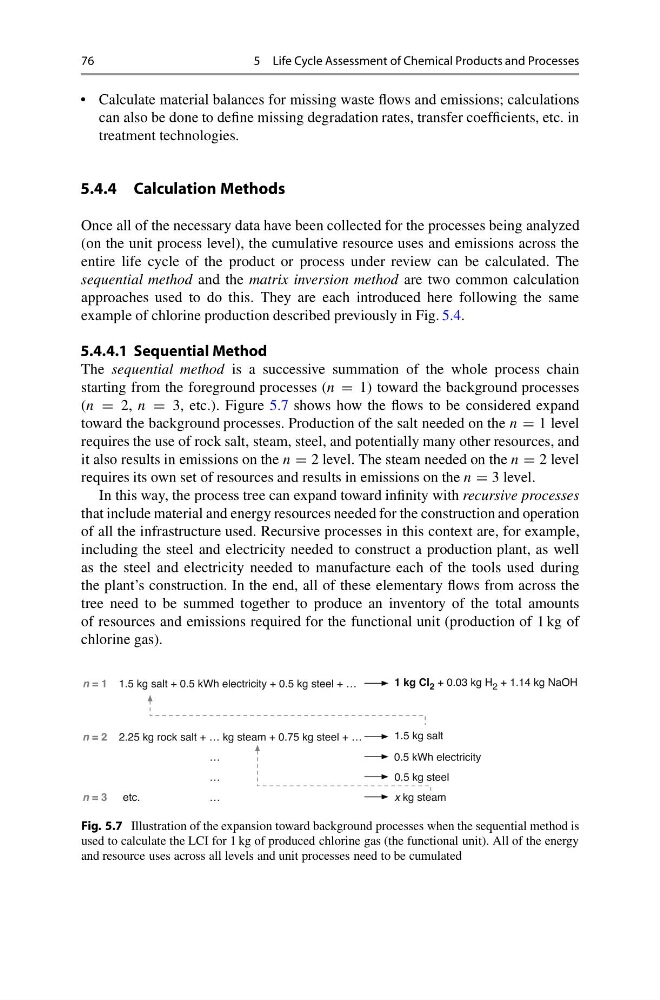
(n = 2, n = 3, etc.). Figure 5.7 shows how the flows to be considered expand
toward the background processes. Production of the salt needed on the n = 1 level
requires the use of rock salt, steam, steel, and potentially many other resources, and
it also results in emissions on the n = 2 level. The steam needed on the n = 2 level
requires its own set of resources and results in emissions on the n = 3 level.
In this way, the process tree can expand toward infinity with recursive processes
that include material and energy resources needed for the construction and operation
of all the infrastructure used. Recursive processes in this context are, for example,
including the steel and electricity needed to construct a production plant, as well
as the steel and electricity needed to manufacture each of the tools used during
the plant’s construction. In the end, all of these elementary flows from across the
tree need to be summed together to produce an inventory of the total amounts
of resources and emissions required for the functional unit (production of 1 kg of
chlorine gas).
Fig. 5.7 Illustration of the expansion toward background processes when the sequential method is
used to calculate the LCI for 1 kg of produced chlorine gas (the functional unit). All of the energy
and resource uses across all levels and unit processes need to be cumulated
5 Life Cycle Assessment of Chemical Products and Processes
• Calculate material balances for missing waste flows and emissions; calculations
can also be done to define missing degradation rates, transfer coefficients, etc. in
treatment technologies.
5.4.4 Calculation Methods
Once all of the necessary data have been collected for the processes being analyzed
(on the unit process level), the cumulative resource uses and emissions across the
entire life cycle of the product or process under review can be calculated. The
sequential method and the matrix inversion method are two common calculation
approaches used to do this. They are each introduced here following the same
example of chlorine production described previously in Fig. 5.4.
5.4.4.1 Sequential Method
The sequential method is a successive summation of the whole process chain
starting from the foreground processes (n = 1) toward the background processes
(n = 2, n = 3, etc.). Figure 5.7 shows how the flows to be considered expand
toward the background processes. Production of the salt needed on the n = 1 level
requires the use of rock salt, steam, steel, and potentially many other resources, and
it also results in emissions on the n = 2 level. The steam needed on the n = 2 level
requires its own set of resources and results in emissions on the n = 3 level.
In this way, the process tree can expand toward infinity with recursive processes
that include material and energy resources needed for the construction and operation
of all the infrastructure used. Recursive processes in this context are, for example,
including the steel and electricity needed to construct a production plant, as well
as the steel and electricity needed to manufacture each of the tools used during
the plant’s construction. In the end, all of these elementary flows from across the
tree need to be summed together to produce an inventory of the total amounts
of resources and emissions required for the functional unit (production of 1 kg of
chlorine gas).
Fig. 5.7 Illustration of the expansion toward background processes when the sequential method is
used to calculate the LCI for 1 kg of produced chlorine gas (the functional unit). All of the energy
and resource uses across all levels and unit processes need to be cumulated