

5.4 Inventory Analysis (Phase 2)
75
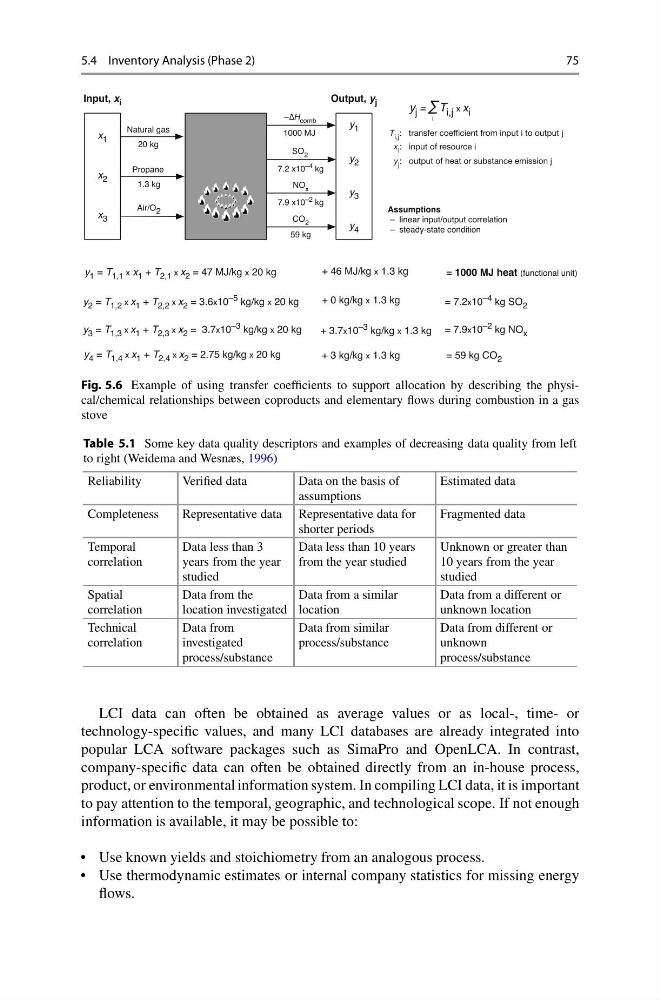
Fig. 5.6 Example of using transfer coefficients to support allocation by describing the physical/chemical relationships between coproducts and elementary flows during combustion in a gas
stove
Table 5.1 Some key data quality descriptors and examples of decreasing data quality from left
to right (Weidema and Wesnæs, 1996)
Reliability
Verified data
Data on the basis of
assumptions
Estimated data
Completeness
Representative data Representative data for
shorter periods
Fragmented data
Temporal
correlation
Data less than 3
years from the year
studied
Data less than 10 years
from the year studied
Unknown or greater than
10 years from the year
studied
Spatial
correlation
Data from the
location investigated
Data from a similar
location
Data from a different or
unknown location
Technical
correlation
Data from
investigated
process/substance
Data from similar
process/substance
Data from different or
unknown
process/substance
LCI data can often be obtained as average values or as local-, time- or
technology-specific values, and many LCI databases are already integrated into
popular LCA software packages such as SimaPro and OpenLCA. In contrast,
company-specific data can often be obtained directly from an in-house process,
product, or environmental information system. In compiling LCI data, it is important
to pay attention to the temporal, geographic, and technological scope. If not enough
information is available, it may be possible to:
• Use known yields and stoichiometry from an analogous process.
• Use thermodynamic estimates or internal company statistics for missing energy
flows.
75
Fig. 5.6 Example of using transfer coefficients to support allocation by describing the physical/chemical relationships between coproducts and elementary flows during combustion in a gas
stove
Table 5.1 Some key data quality descriptors and examples of decreasing data quality from left
to right (Weidema and Wesnæs, 1996)
Reliability
Verified data
Data on the basis of
assumptions
Estimated data
Completeness
Representative data Representative data for
shorter periods
Fragmented data
Temporal
correlation
Data less than 3
years from the year
studied
Data less than 10 years
from the year studied
Unknown or greater than
10 years from the year
studied
Spatial
correlation
Data from the
location investigated
Data from a similar
location
Data from a different or
unknown location
Technical
correlation
Data from
investigated
process/substance
Data from similar
process/substance
Data from different or
unknown
process/substance
LCI data can often be obtained as average values or as local-, time- or
technology-specific values, and many LCI databases are already integrated into
popular LCA software packages such as SimaPro and OpenLCA. In contrast,
company-specific data can often be obtained directly from an in-house process,
product, or environmental information system. In compiling LCI data, it is important
to pay attention to the temporal, geographic, and technological scope. If not enough
information is available, it may be possible to:
• Use known yields and stoichiometry from an analogous process.
• Use thermodynamic estimates or internal company statistics for missing energy
flows.