

5.4 Inventory Analysis (Phase 2)
73
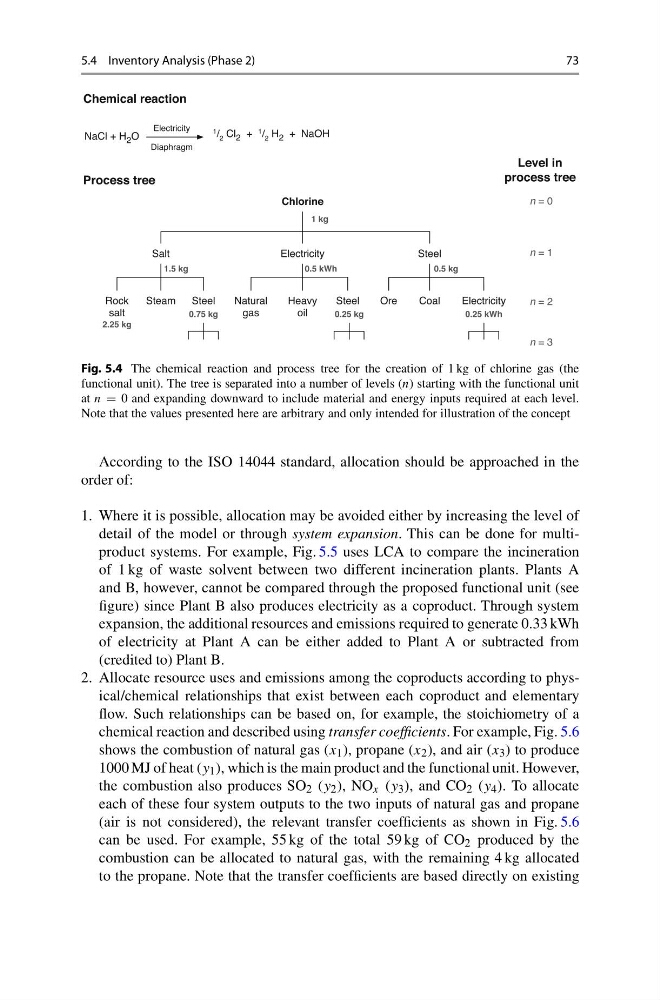
Fig. 5.4 The chemical reaction and process tree for the creation of 1 kg of chlorine gas (the
functional unit). The tree is separated into a number of levels (n) starting with the functional unit
at n = 0 and expanding downward to include material and energy inputs required at each level.
Note that the values presented here are arbitrary and only intended for illustration of the concept
According to the ISO 14044 standard, allocation should be approached in the
order of:
1. Where it is possible, allocation may be avoided either by increasing the level of
detail of the model or through system expansion. This can be done for multiproduct systems. For example, Fig. 5.5 uses LCA to compare the incineration
of 1 kg of waste solvent between two different incineration plants. Plants A
and B, however, cannot be compared through the proposed functional unit (see
figure) since Plant B also produces electricity as a coproduct. Through system
expansion, the additional resources and emissions required to generate 0.33 kWh
of electricity at Plant A can be either added to Plant A or subtracted from
(credited to) Plant B.
2. Allocate resource uses and emissions among the coproducts according to physical/chemical relationships that exist between each coproduct and elementary
flow. Such relationships can be based on, for example, the stoichiometry of a
chemical reaction and described using transfer coefficients. For example, Fig. 5.6
shows the combustion of natural gas (x 1 ), propane (x 2 ), and air (x 3 ) to produce
1000 MJ of heat (y 1 ), which is the main product and the functional unit. However,
the combustion also produces SO 2 (y 2 ), NO x (y 3 ), and CO 2 (y 4 ). To allocate
each of these four system outputs to the two inputs of natural gas and propane
(air is not considered), the relevant transfer coefficients as shown in Fig. 5.6
can be used. For example, 55 kg of the total 59 kg of CO 2 produced by the
combustion can be allocated to natural gas, with the remaining 4 kg allocated
to the propane. Note that the transfer coefficients are based directly on existing
73
Fig. 5.4 The chemical reaction and process tree for the creation of 1 kg of chlorine gas (the
functional unit). The tree is separated into a number of levels (n) starting with the functional unit
at n = 0 and expanding downward to include material and energy inputs required at each level.
Note that the values presented here are arbitrary and only intended for illustration of the concept
According to the ISO 14044 standard, allocation should be approached in the
order of:
1. Where it is possible, allocation may be avoided either by increasing the level of
detail of the model or through system expansion. This can be done for multiproduct systems. For example, Fig. 5.5 uses LCA to compare the incineration
of 1 kg of waste solvent between two different incineration plants. Plants A
and B, however, cannot be compared through the proposed functional unit (see
figure) since Plant B also produces electricity as a coproduct. Through system
expansion, the additional resources and emissions required to generate 0.33 kWh
of electricity at Plant A can be either added to Plant A or subtracted from
(credited to) Plant B.
2. Allocate resource uses and emissions among the coproducts according to physical/chemical relationships that exist between each coproduct and elementary
flow. Such relationships can be based on, for example, the stoichiometry of a
chemical reaction and described using transfer coefficients. For example, Fig. 5.6
shows the combustion of natural gas (x 1 ), propane (x 2 ), and air (x 3 ) to produce
1000 MJ of heat (y 1 ), which is the main product and the functional unit. However,
the combustion also produces SO 2 (y 2 ), NO x (y 3 ), and CO 2 (y 4 ). To allocate
each of these four system outputs to the two inputs of natural gas and propane
(air is not considered), the relevant transfer coefficients as shown in Fig. 5.6
can be used. For example, 55 kg of the total 59 kg of CO 2 produced by the
combustion can be allocated to natural gas, with the remaining 4 kg allocated
to the propane. Note that the transfer coefficients are based directly on existing