

316
G Case Study Solutions
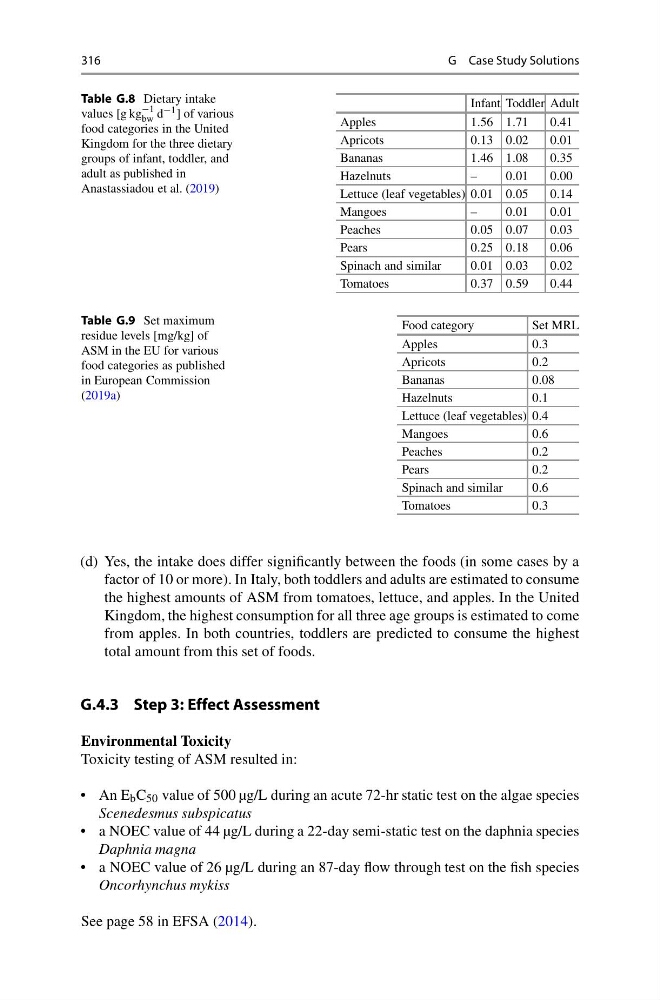
Table G.8 Dietary intake
values [g kg
−1
bw d −1 ] of various
food categories in the United
Kingdom for the three dietary
groups of infant, toddler, and
adult as published in
Anastassiadou et al. (2019)
Infant Toddler Adult
Apples
1.56 1.71
0.41
Apricots
0.13 0.02
0.01
Bananas
1.46 1.08
0.35
Hazelnuts
–
0.01
0.00
Lettuce (leaf vegetables) 0.01 0.05
0.14
Mangoes
–
0.01
0.01
Peaches
0.05 0.07
0.03
Pears
0.25 0.18
0.06
Spinach and similar
0.01 0.03
0.02
Tomatoes
0.37 0.59
0.44
Table G.9 Set maximum
residue levels [mg/kg] of
ASM in the EU for various
food categories as published
in European Commission
(2019a)
Food category
Set MRL
Apples
0.3
Apricots
0.2
Bananas
0.08
Hazelnuts
0.1
Lettuce (leaf vegetables) 0.4
Mangoes
0.6
Peaches
0.2
Pears
0.2
Spinach and similar
0.6
Tomatoes
0.3
(d) Yes, the intake does differ significantly between the foods (in some cases by a
factor of 10 or more). In Italy, both toddlers and adults are estimated to consume
the highest amounts of ASM from tomatoes, lettuce, and apples. In the United
Kingdom, the highest consumption for all three age groups is estimated to come
from apples. In both countries, toddlers are predicted to consume the highest
total amount from this set of foods.
G.4.3 Step 3: Effect Assessment
Environmental Toxicity
Toxicity testing of ASM resulted in:
• An E b C 50 value of 500 µg/L during an acute 72-hr static test on the algae species
Scenedesmus subspicatus
• a NOEC value of 44 µg/L during a 22-day semi-static test on the daphnia species
Daphnia magna
• a NOEC value of 26 µg/L during an 87-day flow through test on the fish species
Oncorhynchus mykiss
See page 58 in EFSA (2014).
G Case Study Solutions
Table G.8 Dietary intake
values [g kg
−1
bw d −1 ] of various
food categories in the United
Kingdom for the three dietary
groups of infant, toddler, and
adult as published in
Anastassiadou et al. (2019)
Infant Toddler Adult
Apples
1.56 1.71
0.41
Apricots
0.13 0.02
0.01
Bananas
1.46 1.08
0.35
Hazelnuts
–
0.01
0.00
Lettuce (leaf vegetables) 0.01 0.05
0.14
Mangoes
–
0.01
0.01
Peaches
0.05 0.07
0.03
Pears
0.25 0.18
0.06
Spinach and similar
0.01 0.03
0.02
Tomatoes
0.37 0.59
0.44
Table G.9 Set maximum
residue levels [mg/kg] of
ASM in the EU for various
food categories as published
in European Commission
(2019a)
Food category
Set MRL
Apples
0.3
Apricots
0.2
Bananas
0.08
Hazelnuts
0.1
Lettuce (leaf vegetables) 0.4
Mangoes
0.6
Peaches
0.2
Pears
0.2
Spinach and similar
0.6
Tomatoes
0.3
(d) Yes, the intake does differ significantly between the foods (in some cases by a
factor of 10 or more). In Italy, both toddlers and adults are estimated to consume
the highest amounts of ASM from tomatoes, lettuce, and apples. In the United
Kingdom, the highest consumption for all three age groups is estimated to come
from apples. In both countries, toddlers are predicted to consume the highest
total amount from this set of foods.
G.4.3 Step 3: Effect Assessment
Environmental Toxicity
Toxicity testing of ASM resulted in:
• An E b C 50 value of 500 µg/L during an acute 72-hr static test on the algae species
Scenedesmus subspicatus
• a NOEC value of 44 µg/L during a 22-day semi-static test on the daphnia species
Daphnia magna
• a NOEC value of 26 µg/L during an 87-day flow through test on the fish species
Oncorhynchus mykiss
See page 58 in EFSA (2014).