

G.4 Product Risk Assessment
315
Human Exposure: Occupational
(a) EFSA set the AOEL for ASM as 0.03 mg/kg body weight per day (EFSA,
2014). The maximum application rate of ASM is calculated to be 0.0375 kg/ha.
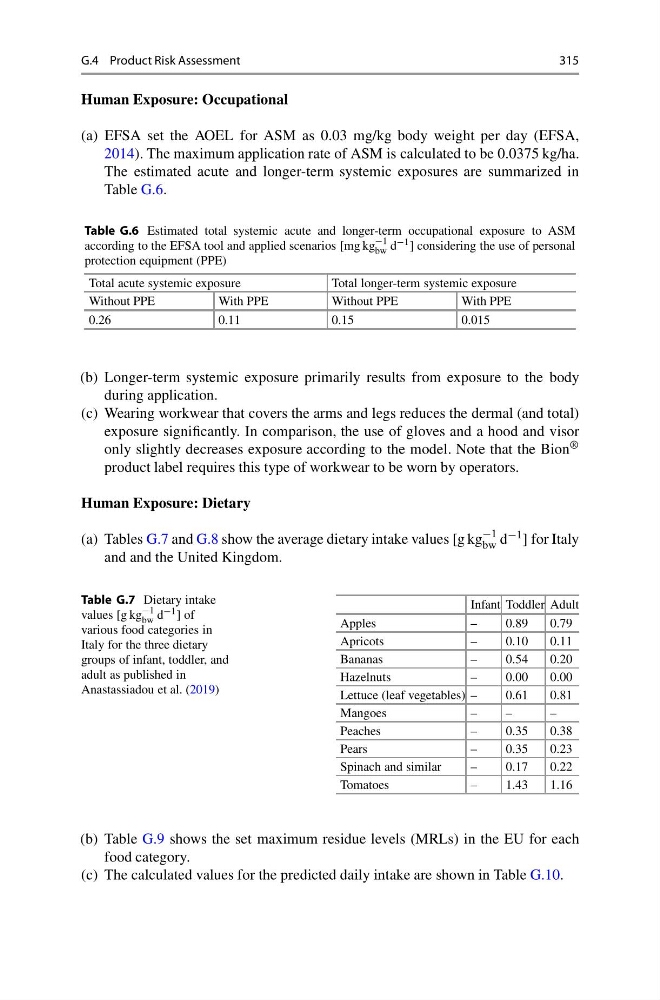
The estimated acute and longer-term systemic exposures are summarized in
Table G.6.
Table G.6 Estimated total systemic acute and longer-term occupational exposure to ASM
according to the EFSA tool and applied scenarios [mg kg
−1
bw d −1 ] considering the use of personal
protection equipment (PPE)
Total acute systemic exposure
Total longer-term systemic exposure
Without PPE
With PPE
Without PPE
With PPE
0.26
0.11
0.15
0.015
(b) Longer-term systemic exposure primarily results from exposure to the body
during application.
(c) Wearing workwear that covers the arms and legs reduces the dermal (and total)
exposure significantly. In comparison, the use of gloves and a hood and visor
only slightly decreases exposure according to the model. Note that the Bion ®
product label requires this type of workwear to be worn by operators.
Human Exposure: Dietary
(a) Tables G.7 and G.8 show the average dietary intake values [g kg
−1
bw d −1 ] for Italy
and and the United Kingdom.
Table G.7 Dietary intake
values [g kg
−1
bw d −1 ] of
various food categories in
Italy for the three dietary
groups of infant, toddler, and
adult as published in
Anastassiadou et al. (2019)
Infant Toddler Adult
Apples
–
0.89
0.79
Apricots
–
0.10
0.11
Bananas
–
0.54
0.20
Hazelnuts
–
0.00
0.00
Lettuce (leaf vegetables) –
0.61
0.81
Mangoes
–
–
–
Peaches
–
0.35
0.38
Pears
–
0.35
0.23
Spinach and similar
–
0.17
0.22
Tomatoes
–
1.43
1.16
(b) Table G.9 shows the set maximum residue levels (MRLs) in the EU for each
food category.
(c) The calculated values for the predicted daily intake are shown in Table G.10.
315
Human Exposure: Occupational
(a) EFSA set the AOEL for ASM as 0.03 mg/kg body weight per day (EFSA,
2014). The maximum application rate of ASM is calculated to be 0.0375 kg/ha.
The estimated acute and longer-term systemic exposures are summarized in
Table G.6.
Table G.6 Estimated total systemic acute and longer-term occupational exposure to ASM
according to the EFSA tool and applied scenarios [mg kg
−1
bw d −1 ] considering the use of personal
protection equipment (PPE)
Total acute systemic exposure
Total longer-term systemic exposure
Without PPE
With PPE
Without PPE
With PPE
0.26
0.11
0.15
0.015
(b) Longer-term systemic exposure primarily results from exposure to the body
during application.
(c) Wearing workwear that covers the arms and legs reduces the dermal (and total)
exposure significantly. In comparison, the use of gloves and a hood and visor
only slightly decreases exposure according to the model. Note that the Bion ®
product label requires this type of workwear to be worn by operators.
Human Exposure: Dietary
(a) Tables G.7 and G.8 show the average dietary intake values [g kg
−1
bw d −1 ] for Italy
and and the United Kingdom.
Table G.7 Dietary intake
values [g kg
−1
bw d −1 ] of
various food categories in
Italy for the three dietary
groups of infant, toddler, and
adult as published in
Anastassiadou et al. (2019)
Infant Toddler Adult
Apples
–
0.89
0.79
Apricots
–
0.10
0.11
Bananas
–
0.54
0.20
Hazelnuts
–
0.00
0.00
Lettuce (leaf vegetables) –
0.61
0.81
Mangoes
–
–
–
Peaches
–
0.35
0.38
Pears
–
0.35
0.23
Spinach and similar
–
0.17
0.22
Tomatoes
–
1.43
1.16
(b) Table G.9 shows the set maximum residue levels (MRLs) in the EU for each
food category.
(c) The calculated values for the predicted daily intake are shown in Table G.10.