

8.4 Example: Wet Grinding of Cyanuric Chloride
215
Mitigative measures:
• Implement a system that allows for a controlled depressurization of the reactor
at the early stages of a thermal runaway.
• Install an emergency pressure relief system that allows gases and vapor to
escape following a rapid increase in pressure.
• Implement an emergency containment system that keeps the contents from the
reactor in a controlled area after a thermal runaway.
8.4
Example: Wet Grinding of Cyanuric Chloride
In Chap. 7, the grinding process of cyanuric chloride was first introduced as an
example to illustrate the general procedure for the risk assessment of chemical
processes. As part of this example, the thermal hazards associated with the
decomposition reaction of cyanuric chloride also have to be assessed.
In this section, this will be done by estimating the impact and probability of a
thermal runaway from this decomposition reaction. For a description of the process
and the hydrolysis decomposition reaction itself, see Chap. 7.
8.4.1 Thermal Consequence Analysis
To assess the potential consequences of a thermal runaway from the decomposition
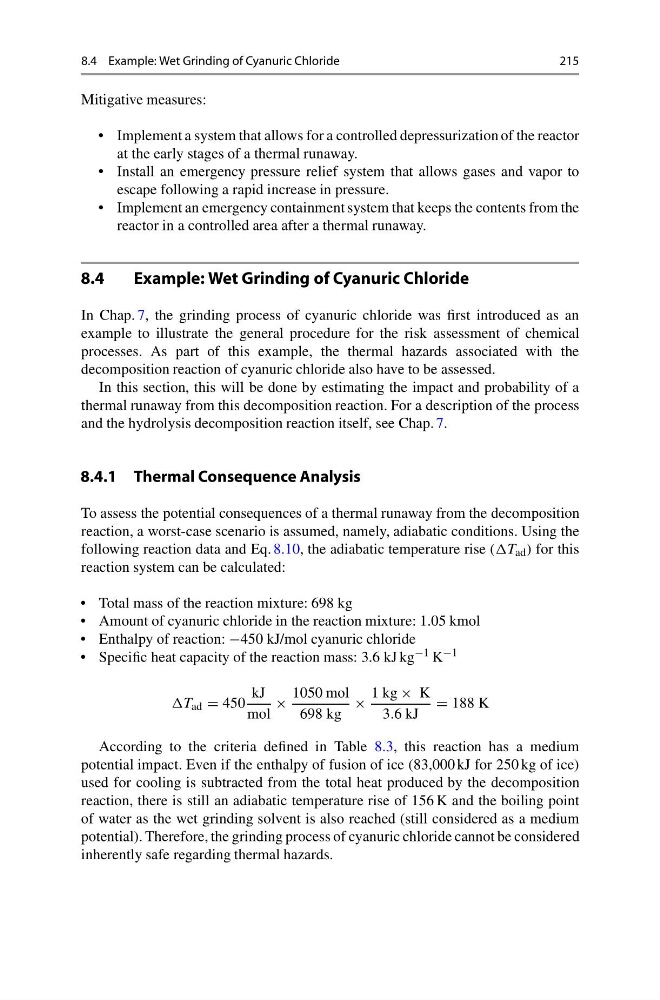
reaction, a worst-case scenario is assumed, namely, adiabatic conditions. Using the
following reaction data and Eq. 8.10, the adiabatic temperature rise (T ad ) for this
reaction system can be calculated:
• Total mass of the reaction mixture: 698 kg
• Amount of cyanuric chloride in the reaction mixture: 1.05 kmol
• Enthalpy of reaction: −450 kJ/mol cyanuric chloride
• Specific heat capacity of the reaction mass: 3.6 kJ kg −1 K −1
T ad = 450
kJ
mol
×
1050 mol
698 kg
×
1 kg × K
3.6 kJ
= 188 K
According to the criteria defined in Table 8.3, this reaction has a medium
potential impact. Even if the enthalpy of fusion of ice (83,000 kJ for 250 kg of ice)
used for cooling is subtracted from the total heat produced by the decomposition
reaction, there is still an adiabatic temperature rise of 156 K and the boiling point
of water as the wet grinding solvent is also reached (still considered as a medium
potential). Therefore, the grinding process of cyanuric chloride cannot be considered
inherently safe regarding thermal hazards.
215
Mitigative measures:
• Implement a system that allows for a controlled depressurization of the reactor
at the early stages of a thermal runaway.
• Install an emergency pressure relief system that allows gases and vapor to
escape following a rapid increase in pressure.
• Implement an emergency containment system that keeps the contents from the
reactor in a controlled area after a thermal runaway.
8.4
Example: Wet Grinding of Cyanuric Chloride
In Chap. 7, the grinding process of cyanuric chloride was first introduced as an
example to illustrate the general procedure for the risk assessment of chemical
processes. As part of this example, the thermal hazards associated with the
decomposition reaction of cyanuric chloride also have to be assessed.
In this section, this will be done by estimating the impact and probability of a
thermal runaway from this decomposition reaction. For a description of the process
and the hydrolysis decomposition reaction itself, see Chap. 7.
8.4.1 Thermal Consequence Analysis
To assess the potential consequences of a thermal runaway from the decomposition
reaction, a worst-case scenario is assumed, namely, adiabatic conditions. Using the
following reaction data and Eq. 8.10, the adiabatic temperature rise (T ad ) for this
reaction system can be calculated:
• Total mass of the reaction mixture: 698 kg
• Amount of cyanuric chloride in the reaction mixture: 1.05 kmol
• Enthalpy of reaction: −450 kJ/mol cyanuric chloride
• Specific heat capacity of the reaction mass: 3.6 kJ kg −1 K −1
T ad = 450
kJ
mol
×
1050 mol
698 kg
×
1 kg × K
3.6 kJ
= 188 K
According to the criteria defined in Table 8.3, this reaction has a medium
potential impact. Even if the enthalpy of fusion of ice (83,000 kJ for 250 kg of ice)
used for cooling is subtracted from the total heat produced by the decomposition
reaction, there is still an adiabatic temperature rise of 156 K and the boiling point
of water as the wet grinding solvent is also reached (still considered as a medium
potential). Therefore, the grinding process of cyanuric chloride cannot be considered
inherently safe regarding thermal hazards.