

216
8 Thermal Process Safety
8.4.2 Thermal Probability Analysis
Considering this heightened level of potential consequence, it is necessary to
estimate the probability of a runaway reaction occurring. To do this, the time
to maximum rate under adiabatic conditions (TMR ad ) can be calculated. For this
calculation, additional kinetic data is needed including the rate of heat release by
the hydrolysis reaction, activation energy, and pre-exponential factor (see Eq. 8.4).
For this specific example, this information is not available. However, from
experimental studies reported in the literature (Yan et al., 2008), it is known that
cyanuric chloride is stable (hydrolysis rate very slow) for approximately 12 hr
between 0 and 2 ◦ C and at pH 7.
Considering this and the classifications presented in Table 8.4, the probability of
a runaway reaction for the grinding process can be classified as medium.
8.4.3 Thermal Risk Evaluation
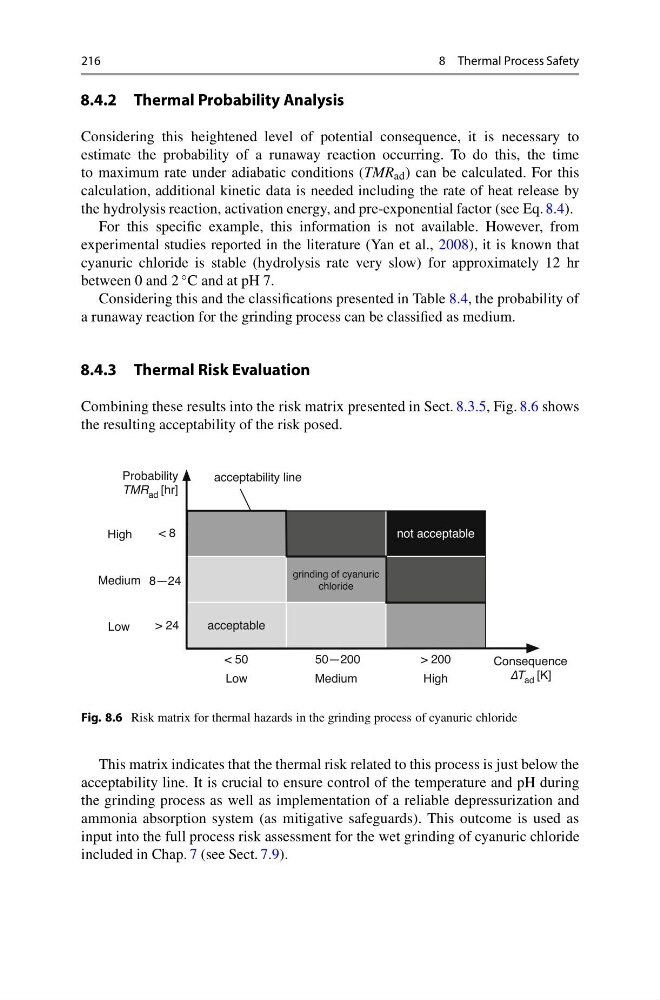
Combining these results into the risk matrix presented in Sect. 8.3.5, Fig. 8.6 shows
the resulting acceptability of the risk posed.
Fig. 8.6 Risk matrix for thermal hazards in the grinding process of cyanuric chloride
This matrix indicates that the thermal risk related to this process is just below the
acceptability line. It is crucial to ensure control of the temperature and pH during
the grinding process as well as implementation of a reliable depressurization and
ammonia absorption system (as mitigative safeguards). This outcome is used as
input into the full process risk assessment for the wet grinding of cyanuric chloride
included in Chap. 7 (see Sect. 7.9).
8 Thermal Process Safety
8.4.2 Thermal Probability Analysis
Considering this heightened level of potential consequence, it is necessary to
estimate the probability of a runaway reaction occurring. To do this, the time
to maximum rate under adiabatic conditions (TMR ad ) can be calculated. For this
calculation, additional kinetic data is needed including the rate of heat release by
the hydrolysis reaction, activation energy, and pre-exponential factor (see Eq. 8.4).
For this specific example, this information is not available. However, from
experimental studies reported in the literature (Yan et al., 2008), it is known that
cyanuric chloride is stable (hydrolysis rate very slow) for approximately 12 hr
between 0 and 2 ◦ C and at pH 7.
Considering this and the classifications presented in Table 8.4, the probability of
a runaway reaction for the grinding process can be classified as medium.
8.4.3 Thermal Risk Evaluation
Combining these results into the risk matrix presented in Sect. 8.3.5, Fig. 8.6 shows
the resulting acceptability of the risk posed.
Fig. 8.6 Risk matrix for thermal hazards in the grinding process of cyanuric chloride
This matrix indicates that the thermal risk related to this process is just below the
acceptability line. It is crucial to ensure control of the temperature and pH during
the grinding process as well as implementation of a reliable depressurization and
ammonia absorption system (as mitigative safeguards). This outcome is used as
input into the full process risk assessment for the wet grinding of cyanuric chloride
included in Chap. 7 (see Sect. 7.9).