

8.2 Heat Balance and Reactor Stability
203
Table 8.1 Standard values
of the enthalpy of reaction
(− R ) for common
synthesis and decomposition
reactions in the chemical
industry. Adopted from
Stoessel (1993) and Gygax
(1993)
Reaction
− R [kJ/mol]
Neutralization (HCl)
55
Diazotization
65
Amination
120
Nitration
130
Decomposition (diazo) 140
Sulfonation
150
Polymerization (vinyl) 50–200
Decomposition (nitro) 400
Hydrogenation (nitro) 560
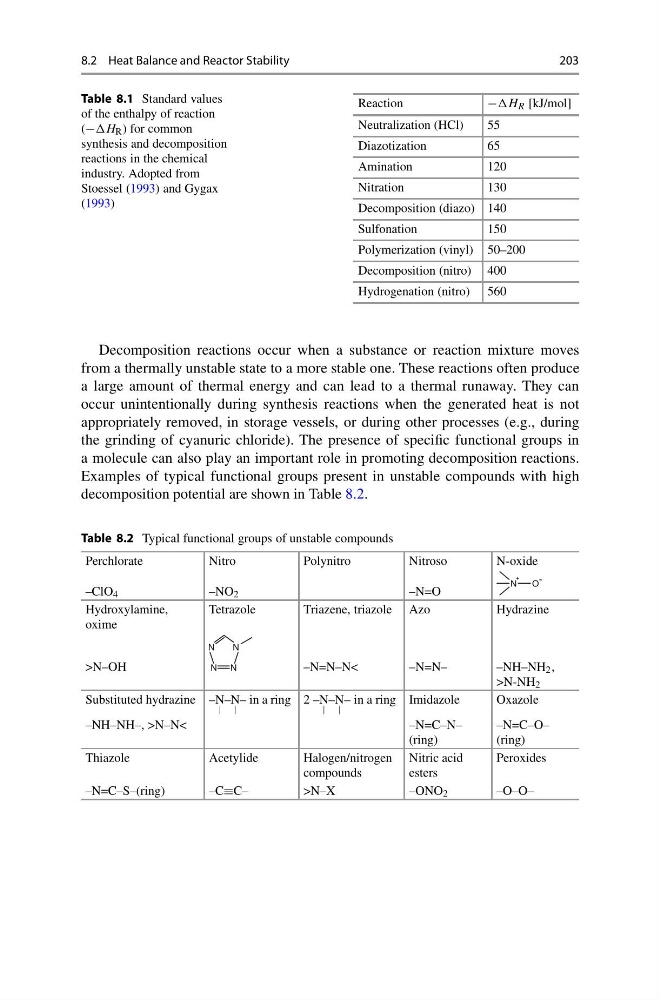
Decomposition reactions occur when a substance or reaction mixture moves
from a thermally unstable state to a more stable one. These reactions often produce
a large amount of thermal energy and can lead to a thermal runaway. They can
occur unintentionally during synthesis reactions when the generated heat is not
appropriately removed, in storage vessels, or during other processes (e.g., during
the grinding of cyanuric chloride). The presence of specific functional groups in
a molecule can also play an important role in promoting decomposition reactions.
Examples of typical functional groups present in unstable compounds with high
decomposition potential are shown in Table 8.2.
Table 8.2 Typical functional groups of unstable compounds
Perchlorate
Nitro
Polynitro
Nitroso
N-oxide
–ClO 4
–NO 2
–N=O
O
-
Hydroxylamine,
oxime
Tetrazole
Triazene, triazole Azo
Hydrazine
>N–OH
–N=N–N<
–N=N–
–NH–NH 2 ,
>N-NH 2
Substituted hydrazine –N
|
–N
|
– in a ring 2 –N
|
–N
|
– in a ring Imidazole
Oxazole
–NH–NH–, >N–N<
–N=C–N–
(ring)
–N=C–O–
(ring)
Thiazole
Acetylide
Halogen/nitrogen
compounds
Nitric acid
esters
Peroxides
–N=C–S–(ring)
–C≡C–
>N–X
–ONO 2
–O–O–
203
Table 8.1 Standard values
of the enthalpy of reaction
(− R ) for common
synthesis and decomposition
reactions in the chemical
industry. Adopted from
Stoessel (1993) and Gygax
(1993)
Reaction
− R [kJ/mol]
Neutralization (HCl)
55
Diazotization
65
Amination
120
Nitration
130
Decomposition (diazo) 140
Sulfonation
150
Polymerization (vinyl) 50–200
Decomposition (nitro) 400
Hydrogenation (nitro) 560
Decomposition reactions occur when a substance or reaction mixture moves
from a thermally unstable state to a more stable one. These reactions often produce
a large amount of thermal energy and can lead to a thermal runaway. They can
occur unintentionally during synthesis reactions when the generated heat is not
appropriately removed, in storage vessels, or during other processes (e.g., during
the grinding of cyanuric chloride). The presence of specific functional groups in
a molecule can also play an important role in promoting decomposition reactions.
Examples of typical functional groups present in unstable compounds with high
decomposition potential are shown in Table 8.2.
Table 8.2 Typical functional groups of unstable compounds
Perchlorate
Nitro
Polynitro
Nitroso
N-oxide
–ClO 4
–NO 2
–N=O
O
-
Hydroxylamine,
oxime
Tetrazole
Triazene, triazole Azo
Hydrazine
>N–OH
–N=N–N<
–N=N–
–NH–NH 2 ,
>N-NH 2
Substituted hydrazine –N
|
–N
|
– in a ring 2 –N
|
–N
|
– in a ring Imidazole
Oxazole
–NH–NH–, >N–N<
–N=C–N–
(ring)
–N=C–O–
(ring)
Thiazole
Acetylide
Halogen/nitrogen
compounds
Nitric acid
esters
Peroxides
–N=C–S–(ring)
–C≡C–
>N–X
–ONO 2
–O–O–