

204
8 Thermal Process Safety
8.2.3 Heat Removal
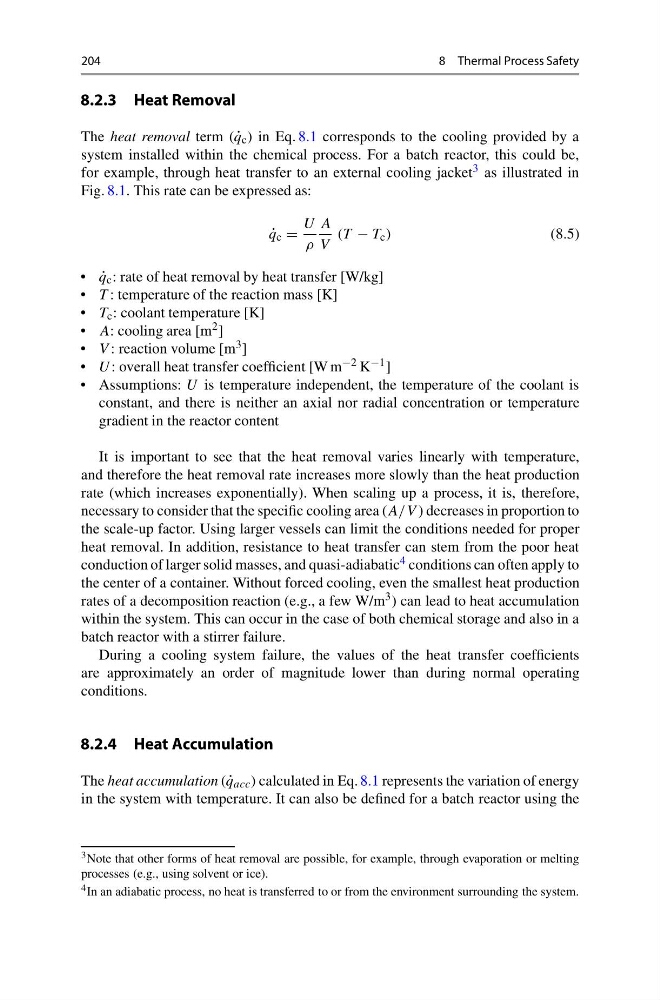
The heat removal term ( ˙
q c ) in Eq. 8.1 corresponds to the cooling provided by a
system installed within the chemical process. For a batch reactor, this could be,
for example, through heat transfer to an external cooling jacket 3 as illustrated in
Fig. 8.1. This rate can be expressed as:
˙
q c =
U
ρ
A
V
(T − T c )
(8.5)
• ˙
q c : rate of heat removal by heat transfer [W/kg]
• T : temperature of the reaction mass [K]
• T c : coolant temperature [K]
• A: cooling area [m 2 ]
• V : reaction volume [m 3 ]
• U : overall heat transfer coefficient [W m −2 K −1 ]
• Assumptions: U is temperature independent, the temperature of the coolant is
constant, and there is neither an axial nor radial concentration or temperature
gradient in the reactor content
It is important to see that the heat removal varies linearly with temperature,
and therefore the heat removal rate increases more slowly than the heat production
rate (which increases exponentially). When scaling up a process, it is, therefore,
necessary to consider that the specific cooling area (A/V ) decreases in proportion to
the scale-up factor. Using larger vessels can limit the conditions needed for proper
heat removal. In addition, resistance to heat transfer can stem from the poor heat
conduction of larger solid masses, and quasi-adiabatic 4 conditions can often apply to
the center of a container. Without forced cooling, even the smallest heat production
rates of a decomposition reaction (e.g., a few W/m 3 ) can lead to heat accumulation
within the system. This can occur in the case of both chemical storage and also in a
batch reactor with a stirrer failure.
During a cooling system failure, the values of the heat transfer coefficients
are approximately an order of magnitude lower than during normal operating
conditions.
8.2.4 Heat Accumulation
The heat accumulation ( ˙
q acc ) calculated in Eq. 8.1 represents the variation of energy
in the system with temperature. It can also be defined for a batch reactor using the
3 Note that other forms of heat removal are possible, for example, through evaporation or melting
processes (e.g., using solvent or ice).
4 In an adiabatic process, no heat is transferred to or from the environment surrounding the system.
8 Thermal Process Safety
8.2.3 Heat Removal
The heat removal term ( ˙
q c ) in Eq. 8.1 corresponds to the cooling provided by a
system installed within the chemical process. For a batch reactor, this could be,
for example, through heat transfer to an external cooling jacket 3 as illustrated in
Fig. 8.1. This rate can be expressed as:
˙
q c =
U
ρ
A
V
(T − T c )
(8.5)
• ˙
q c : rate of heat removal by heat transfer [W/kg]
• T : temperature of the reaction mass [K]
• T c : coolant temperature [K]
• A: cooling area [m 2 ]
• V : reaction volume [m 3 ]
• U : overall heat transfer coefficient [W m −2 K −1 ]
• Assumptions: U is temperature independent, the temperature of the coolant is
constant, and there is neither an axial nor radial concentration or temperature
gradient in the reactor content
It is important to see that the heat removal varies linearly with temperature,
and therefore the heat removal rate increases more slowly than the heat production
rate (which increases exponentially). When scaling up a process, it is, therefore,
necessary to consider that the specific cooling area (A/V ) decreases in proportion to
the scale-up factor. Using larger vessels can limit the conditions needed for proper
heat removal. In addition, resistance to heat transfer can stem from the poor heat
conduction of larger solid masses, and quasi-adiabatic 4 conditions can often apply to
the center of a container. Without forced cooling, even the smallest heat production
rates of a decomposition reaction (e.g., a few W/m 3 ) can lead to heat accumulation
within the system. This can occur in the case of both chemical storage and also in a
batch reactor with a stirrer failure.
During a cooling system failure, the values of the heat transfer coefficients
are approximately an order of magnitude lower than during normal operating
conditions.
8.2.4 Heat Accumulation
The heat accumulation ( ˙
q acc ) calculated in Eq. 8.1 represents the variation of energy
in the system with temperature. It can also be defined for a batch reactor using the
3 Note that other forms of heat removal are possible, for example, through evaporation or melting
processes (e.g., using solvent or ice).
4 In an adiabatic process, no heat is transferred to or from the environment surrounding the system.