

202
8 Thermal Process Safety
8.2.2 Heat Production
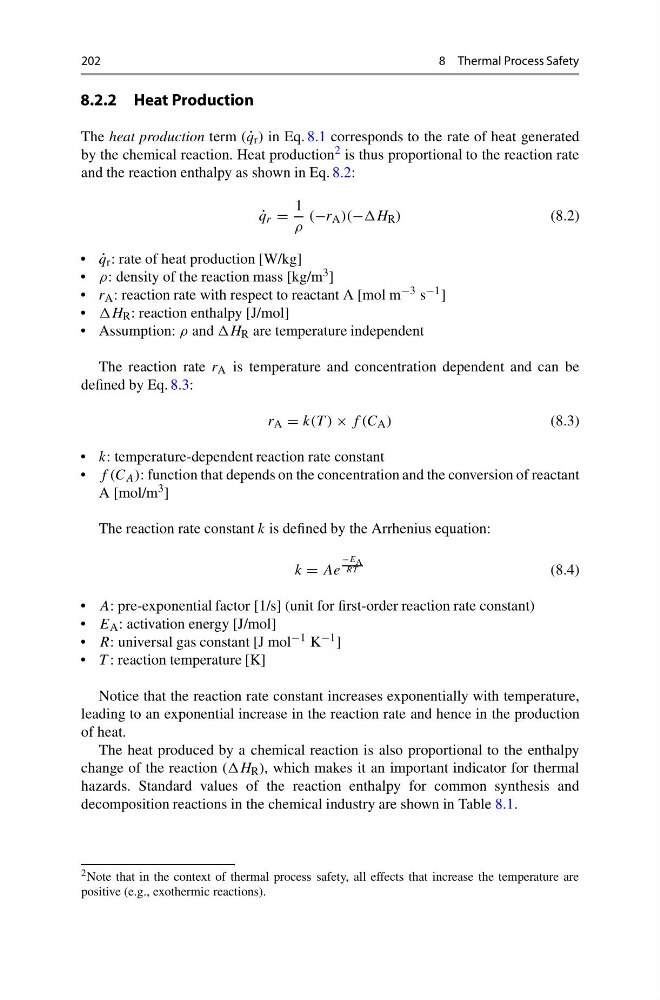
The heat production term ( ˙
q r ) in Eq. 8.1 corresponds to the rate of heat generated
by the chemical reaction. Heat production 2 is thus proportional to the reaction rate
and the reaction enthalpy as shown in Eq. 8.2:
˙
q r =
1
ρ
(−r A )(− R )
(8.2)
• ˙
q r : rate of heat production [W/kg]
• ρ: density of the reaction mass [kg/m 3 ]
• r A : reaction rate with respect to reactant A [mol m −3 s −1 ]
• R : reaction enthalpy [J/mol]
• Assumption: ρ and R are temperature independent
The reaction rate r A is temperature and concentration dependent and can be
defined by Eq. 8.3:
r A = k(T ) × f (C A )
(8.3)
• k: temperature-dependent reaction rate constant
• f (C A ): function that depends on the concentration and the conversion of reactant
A [mol/m 3 ]
The reaction rate constant k is defined by the Arrhenius equation:
k = Ae
−E A
RT
(8.4)
• A: pre-exponential factor [1/s] (unit for first-order reaction rate constant)
• E A : activation energy [J/mol]
• R: universal gas constant [J mol −1 K −1 ]
• T : reaction temperature [K]
Notice that the reaction rate constant increases exponentially with temperature,
leading to an exponential increase in the reaction rate and hence in the production
of heat.
The heat produced by a chemical reaction is also proportional to the enthalpy
change of the reaction ( R ), which makes it an important indicator for thermal
hazards. Standard values of the reaction enthalpy for common synthesis and
decomposition reactions in the chemical industry are shown in Table 8.1.
2 Note that in the context of thermal process safety, all effects that increase the temperature are
positive (e.g., exothermic reactions).
8 Thermal Process Safety
8.2.2 Heat Production
The heat production term ( ˙
q r ) in Eq. 8.1 corresponds to the rate of heat generated
by the chemical reaction. Heat production 2 is thus proportional to the reaction rate
and the reaction enthalpy as shown in Eq. 8.2:
˙
q r =
1
ρ
(−r A )(− R )
(8.2)
• ˙
q r : rate of heat production [W/kg]
• ρ: density of the reaction mass [kg/m 3 ]
• r A : reaction rate with respect to reactant A [mol m −3 s −1 ]
• R : reaction enthalpy [J/mol]
• Assumption: ρ and R are temperature independent
The reaction rate r A is temperature and concentration dependent and can be
defined by Eq. 8.3:
r A = k(T ) × f (C A )
(8.3)
• k: temperature-dependent reaction rate constant
• f (C A ): function that depends on the concentration and the conversion of reactant
A [mol/m 3 ]
The reaction rate constant k is defined by the Arrhenius equation:
k = Ae
−E A
RT
(8.4)
• A: pre-exponential factor [1/s] (unit for first-order reaction rate constant)
• E A : activation energy [J/mol]
• R: universal gas constant [J mol −1 K −1 ]
• T : reaction temperature [K]
Notice that the reaction rate constant increases exponentially with temperature,
leading to an exponential increase in the reaction rate and hence in the production
of heat.
The heat produced by a chemical reaction is also proportional to the enthalpy
change of the reaction ( R ), which makes it an important indicator for thermal
hazards. Standard values of the reaction enthalpy for common synthesis and
decomposition reactions in the chemical industry are shown in Table 8.1.
2 Note that in the context of thermal process safety, all effects that increase the temperature are
positive (e.g., exothermic reactions).