

8.2 Heat Balance and Reactor Stability
201
In this chapter, a main focus will be placed on introducing and understanding heat
balances within batch reactor processes. Compared to other types of ideal reactors
(e.g., semi-batch reactors, ideally stirred tank reactors, plug flow reactors, etc.),
batch reactors can result in some of the most critical impacts. Nevertheless, most
of the concepts illustrated here can be applied to other types of chemical reactors
and storage systems.
8.2.1 The Batch Reactor
In a batch reaction process, all reactants are fed into the reactor vessel at once, and
the start of the reaction is carried out by increasing the temperature, making use of
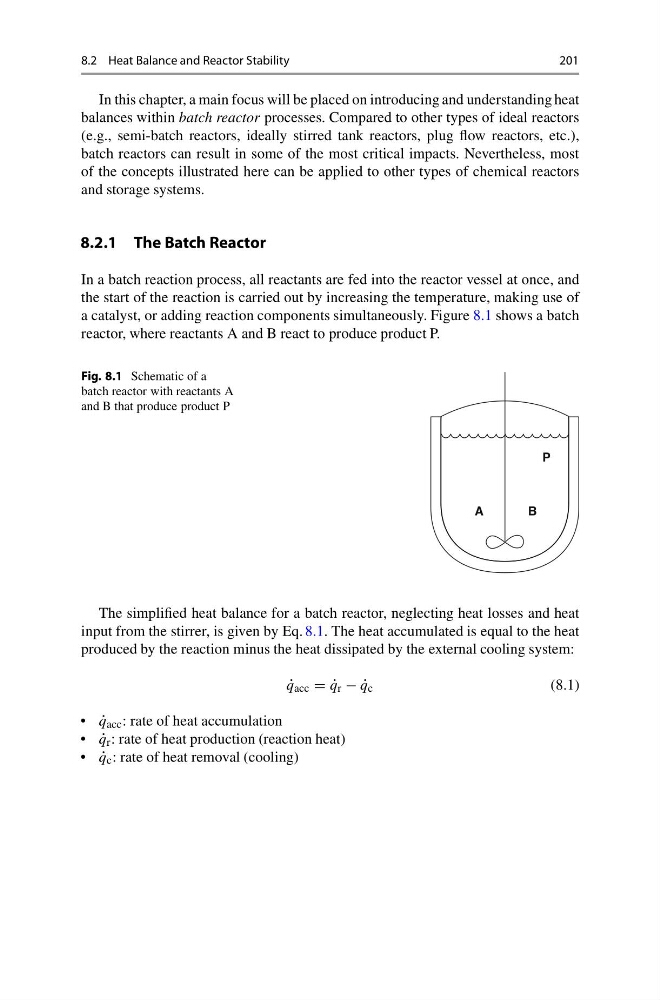
a catalyst, or adding reaction components simultaneously. Figure 8.1 shows a batch
reactor, where reactants A and B react to produce product P.
Fig. 8.1 Schematic of a
batch reactor with reactants A
and B that produce product P
The simplified heat balance for a batch reactor, neglecting heat losses and heat
input from the stirrer, is given by Eq. 8.1. The heat accumulated is equal to the heat
produced by the reaction minus the heat dissipated by the external cooling system:
˙
q acc = ˙
q r − ˙
q c
(8.1)
• ˙
q acc : rate of heat accumulation
• ˙
q r : rate of heat production (reaction heat)
• ˙
q c : rate of heat removal (cooling)
201
In this chapter, a main focus will be placed on introducing and understanding heat
balances within batch reactor processes. Compared to other types of ideal reactors
(e.g., semi-batch reactors, ideally stirred tank reactors, plug flow reactors, etc.),
batch reactors can result in some of the most critical impacts. Nevertheless, most
of the concepts illustrated here can be applied to other types of chemical reactors
and storage systems.
8.2.1 The Batch Reactor
In a batch reaction process, all reactants are fed into the reactor vessel at once, and
the start of the reaction is carried out by increasing the temperature, making use of
a catalyst, or adding reaction components simultaneously. Figure 8.1 shows a batch
reactor, where reactants A and B react to produce product P.
Fig. 8.1 Schematic of a
batch reactor with reactants A
and B that produce product P
The simplified heat balance for a batch reactor, neglecting heat losses and heat
input from the stirrer, is given by Eq. 8.1. The heat accumulated is equal to the heat
produced by the reaction minus the heat dissipated by the external cooling system:
˙
q acc = ˙
q r − ˙
q c
(8.1)
• ˙
q acc : rate of heat accumulation
• ˙
q r : rate of heat production (reaction heat)
• ˙
q c : rate of heat removal (cooling)