

188
7 Risk Assessment and Management of Chemical Processes
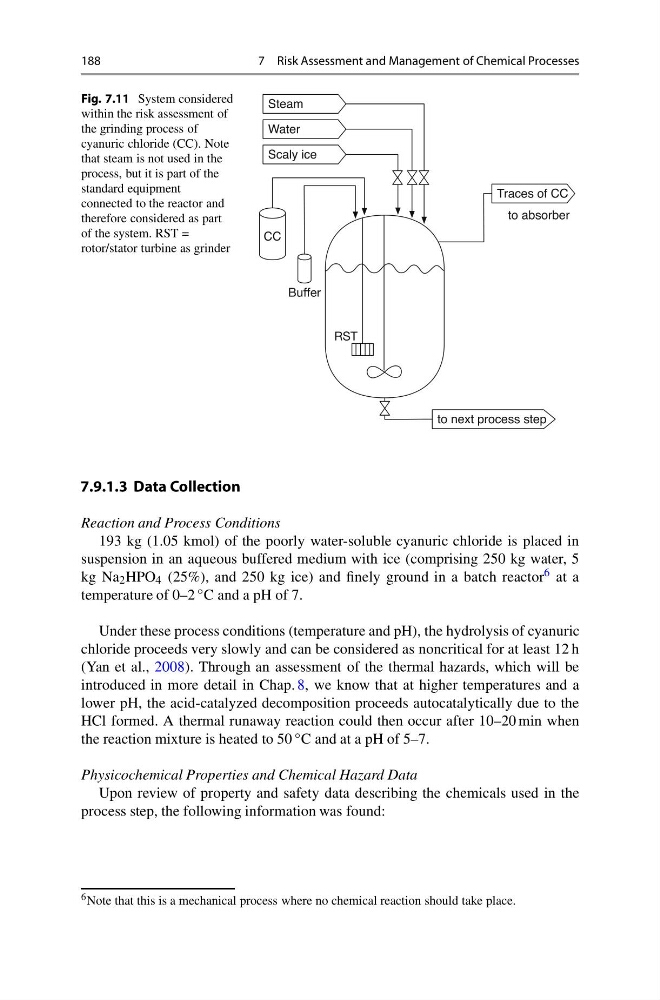
Fig. 7.11 System considered
within the risk assessment of
the grinding process of
cyanuric chloride (CC). Note
that steam is not used in the
process, but it is part of the
standard equipment
connected to the reactor and
therefore considered as part
of the system. RST =
rotor/stator turbine as grinder
7.9.1.3 Data Collection
Reaction and Process Conditions
193 kg (1.05 kmol) of the poorly water-soluble cyanuric chloride is placed in
suspension in an aqueous buffered medium with ice (comprising 250 kg water, 5
kg Na 2 HPO 4 (25%), and 250 kg ice) and finely ground in a batch reactor 6 at a
temperature of 0–2 ◦ C and a pH of 7.
Under these process conditions (temperature and pH), the hydrolysis of cyanuric
chloride proceeds very slowly and can be considered as noncritical for at least 12 h
(Yan et al., 2008). Through an assessment of the thermal hazards, which will be
introduced in more detail in Chap. 8, we know that at higher temperatures and a
lower pH, the acid-catalyzed decomposition proceeds autocatalytically due to the
HCl formed. A thermal runaway reaction could then occur after 10–20 min when
the reaction mixture is heated to 50 ◦ C and at a pH of 5–7.
Physicochemical Properties and Chemical Hazard Data
Upon review of property and safety data describing the chemicals used in the
process step, the following information was found:
6 Note that this is a mechanical process where no chemical reaction should take place.
7 Risk Assessment and Management of Chemical Processes
Fig. 7.11 System considered
within the risk assessment of
the grinding process of
cyanuric chloride (CC). Note
that steam is not used in the
process, but it is part of the
standard equipment
connected to the reactor and
therefore considered as part
of the system. RST =
rotor/stator turbine as grinder
7.9.1.3 Data Collection
Reaction and Process Conditions
193 kg (1.05 kmol) of the poorly water-soluble cyanuric chloride is placed in
suspension in an aqueous buffered medium with ice (comprising 250 kg water, 5
kg Na 2 HPO 4 (25%), and 250 kg ice) and finely ground in a batch reactor 6 at a
temperature of 0–2 ◦ C and a pH of 7.
Under these process conditions (temperature and pH), the hydrolysis of cyanuric
chloride proceeds very slowly and can be considered as noncritical for at least 12 h
(Yan et al., 2008). Through an assessment of the thermal hazards, which will be
introduced in more detail in Chap. 8, we know that at higher temperatures and a
lower pH, the acid-catalyzed decomposition proceeds autocatalytically due to the
HCl formed. A thermal runaway reaction could then occur after 10–20 min when
the reaction mixture is heated to 50 ◦ C and at a pH of 5–7.
Physicochemical Properties and Chemical Hazard Data
Upon review of property and safety data describing the chemicals used in the
process step, the following information was found:
6 Note that this is a mechanical process where no chemical reaction should take place.