

7.9 Example: Wet Grinding of Cyanuric Chloride
187
– are compliant with the protection goals of the company and society
– have been rigorously implemented and are regularly inspected
7.9
Example: Wet Grinding of Cyanuric Chloride
In this section, the procedure of process risk assessment is illustrated through a
simplified application to a process step within the production of a reactive dye. This
particular process step involves the grinding of cyanuric chloride in an aqueous
medium to bring it into a reactive form necessary for the subsequent reaction steps.
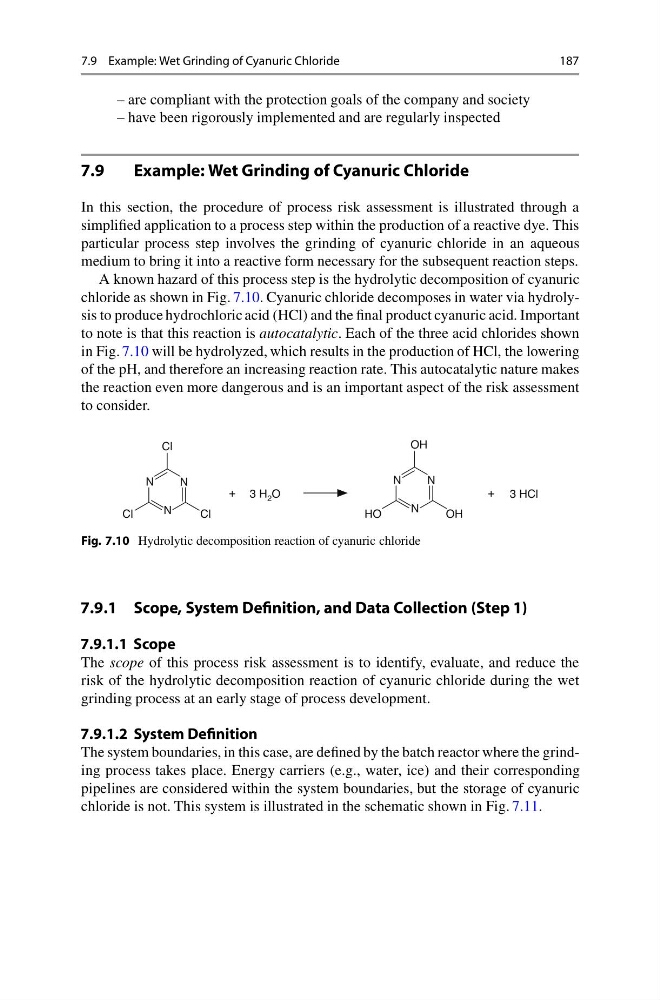
A known hazard of this process step is the hydrolytic decomposition of cyanuric
chloride as shown in Fig. 7.10. Cyanuric chloride decomposes in water via hydrolysis to produce hydrochloric acid (HCl) and the final product cyanuric acid. Important
to note is that this reaction is autocatalytic. Each of the three acid chlorides shown
in Fig. 7.10 will be hydrolyzed, which results in the production of HCl, the lowering
of the pH, and therefore an increasing reaction rate. This autocatalytic nature makes
the reaction even more dangerous and is an important aspect of the risk assessment
to consider.
Fig. 7.10 Hydrolytic decomposition reaction of cyanuric chloride
7.9.1 Scope, System Definition, and Data Collection (Step 1)
7.9.1.1 Scope
The scope of this process risk assessment is to identify, evaluate, and reduce the
risk of the hydrolytic decomposition reaction of cyanuric chloride during the wet
grinding process at an early stage of process development.
7.9.1.2 System Definition
The system boundaries, in this case, are defined by the batch reactor where the grinding process takes place. Energy carriers (e.g., water, ice) and their corresponding
pipelines are considered within the system boundaries, but the storage of cyanuric
chloride is not. This system is illustrated in the schematic shown in Fig. 7.11.
187
– are compliant with the protection goals of the company and society
– have been rigorously implemented and are regularly inspected
7.9
Example: Wet Grinding of Cyanuric Chloride
In this section, the procedure of process risk assessment is illustrated through a
simplified application to a process step within the production of a reactive dye. This
particular process step involves the grinding of cyanuric chloride in an aqueous
medium to bring it into a reactive form necessary for the subsequent reaction steps.
A known hazard of this process step is the hydrolytic decomposition of cyanuric
chloride as shown in Fig. 7.10. Cyanuric chloride decomposes in water via hydrolysis to produce hydrochloric acid (HCl) and the final product cyanuric acid. Important
to note is that this reaction is autocatalytic. Each of the three acid chlorides shown
in Fig. 7.10 will be hydrolyzed, which results in the production of HCl, the lowering
of the pH, and therefore an increasing reaction rate. This autocatalytic nature makes
the reaction even more dangerous and is an important aspect of the risk assessment
to consider.
Fig. 7.10 Hydrolytic decomposition reaction of cyanuric chloride
7.9.1 Scope, System Definition, and Data Collection (Step 1)
7.9.1.1 Scope
The scope of this process risk assessment is to identify, evaluate, and reduce the
risk of the hydrolytic decomposition reaction of cyanuric chloride during the wet
grinding process at an early stage of process development.
7.9.1.2 System Definition
The system boundaries, in this case, are defined by the batch reactor where the grinding process takes place. Energy carriers (e.g., water, ice) and their corresponding
pipelines are considered within the system boundaries, but the storage of cyanuric
chloride is not. This system is illustrated in the schematic shown in Fig. 7.11.