

186
7 Risk Assessment and Management of Chemical Processes
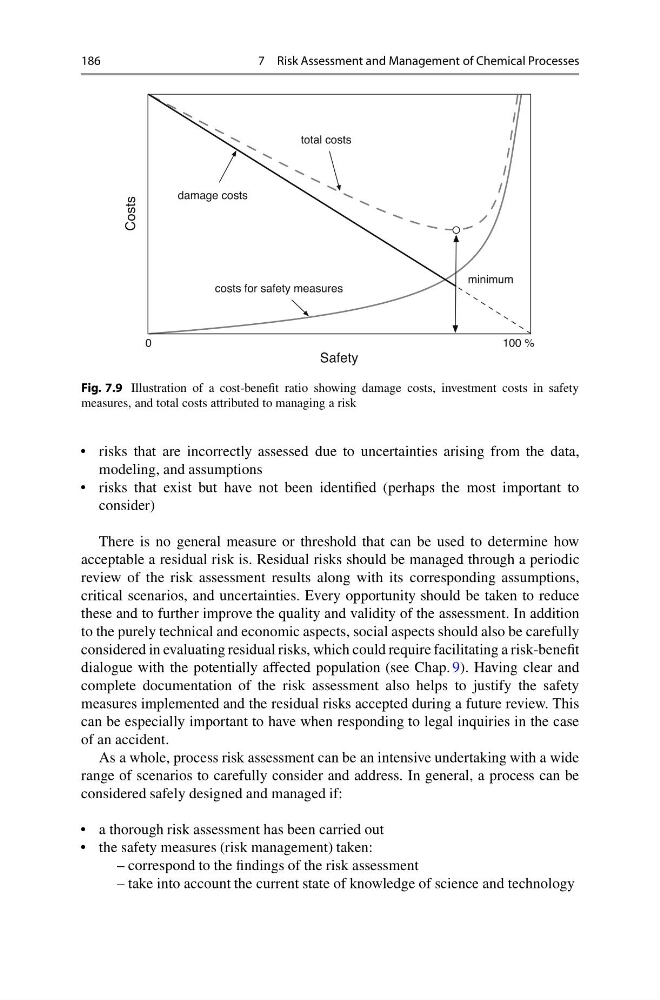
Fig. 7.9 Illustration of a cost-benefit ratio showing damage costs, investment costs in safety
measures, and total costs attributed to managing a risk
• risks that are incorrectly assessed due to uncertainties arising from the data,
modeling, and assumptions
• risks that exist but have not been identified (perhaps the most important to
consider)
There is no general measure or threshold that can be used to determine how
acceptable a residual risk is. Residual risks should be managed through a periodic
review of the risk assessment results along with its corresponding assumptions,
critical scenarios, and uncertainties. Every opportunity should be taken to reduce
these and to further improve the quality and validity of the assessment. In addition
to the purely technical and economic aspects, social aspects should also be carefully
considered in evaluating residual risks, which could require facilitating a risk-benefit
dialogue with the potentially affected population (see Chap. 9). Having clear and
complete documentation of the risk assessment also helps to justify the safety
measures implemented and the residual risks accepted during a future review. This
can be especially important to have when responding to legal inquiries in the case
of an accident.
As a whole, process risk assessment can be an intensive undertaking with a wide
range of scenarios to carefully consider and address. In general, a process can be
considered safely designed and managed if:
• a thorough risk assessment has been carried out
• the safety measures (risk management) taken:
– correspond to the findings of the risk assessment
– take into account the current state of knowledge of science and technology
7 Risk Assessment and Management of Chemical Processes
Fig. 7.9 Illustration of a cost-benefit ratio showing damage costs, investment costs in safety
measures, and total costs attributed to managing a risk
• risks that are incorrectly assessed due to uncertainties arising from the data,
modeling, and assumptions
• risks that exist but have not been identified (perhaps the most important to
consider)
There is no general measure or threshold that can be used to determine how
acceptable a residual risk is. Residual risks should be managed through a periodic
review of the risk assessment results along with its corresponding assumptions,
critical scenarios, and uncertainties. Every opportunity should be taken to reduce
these and to further improve the quality and validity of the assessment. In addition
to the purely technical and economic aspects, social aspects should also be carefully
considered in evaluating residual risks, which could require facilitating a risk-benefit
dialogue with the potentially affected population (see Chap. 9). Having clear and
complete documentation of the risk assessment also helps to justify the safety
measures implemented and the residual risks accepted during a future review. This
can be especially important to have when responding to legal inquiries in the case
of an accident.
As a whole, process risk assessment can be an intensive undertaking with a wide
range of scenarios to carefully consider and address. In general, a process can be
considered safely designed and managed if:
• a thorough risk assessment has been carried out
• the safety measures (risk management) taken:
– correspond to the findings of the risk assessment
– take into account the current state of knowledge of science and technology