

7.6 Risk Analysis (Step 4)
179
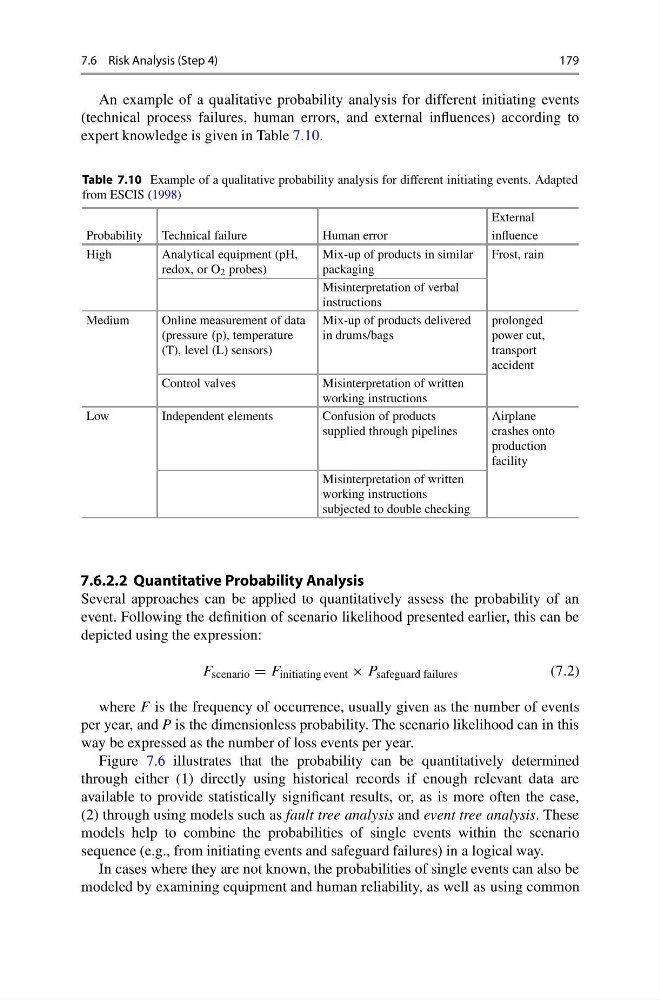
An example of a qualitative probability analysis for different initiating events
(technical process failures, human errors, and external influences) according to
expert knowledge is given in Table 7.10.
Table 7.10 Example of a qualitative probability analysis for different initiating events. Adapted
from ESCIS (1998)
External
Probability Technical failure
Human error
influence
High
Analytical equipment (pH,
redox, or O 2 probes)
Mix-up of products in similar
packaging
Frost, rain
Misinterpretation of verbal
instructions
Medium
Online measurement of data
(pressure (p), temperature
(T), level (L) sensors)
Mix-up of products delivered
in drums/bags
prolonged
power cut,
transport
accident
Control valves
Misinterpretation of written
working instructions
Low
Independent elements
Confusion of products
supplied through pipelines
Airplane
crashes onto
production
facility
Misinterpretation of written
working instructions
subjected to double checking
7.6.2.2 Quantitative Probability Analysis
Several approaches can be applied to quantitatively assess the probability of an
event. Following the definition of scenario likelihood presented earlier, this can be
depicted using the expression:
F scenario = F initiating event × P safeguard failures
(7.2)
where F is the frequency of occurrence, usually given as the number of events
per year, and P is the dimensionless probability. The scenario likelihood can in this
way be expressed as the number of loss events per year.
Figure 7.6 illustrates that the probability can be quantitatively determined
through either (1) directly using historical records if enough relevant data are
available to provide statistically significant results, or, as is more often the case,
(2) through using models such as fault tree analysis and event tree analysis. These
models help to combine the probabilities of single events within the scenario
sequence (e.g., from initiating events and safeguard failures) in a logical way.
In cases where they are not known, the probabilities of single events can also be
modeled by examining equipment and human reliability, as well as using common
179
An example of a qualitative probability analysis for different initiating events
(technical process failures, human errors, and external influences) according to
expert knowledge is given in Table 7.10.
Table 7.10 Example of a qualitative probability analysis for different initiating events. Adapted
from ESCIS (1998)
External
Probability Technical failure
Human error
influence
High
Analytical equipment (pH,
redox, or O 2 probes)
Mix-up of products in similar
packaging
Frost, rain
Misinterpretation of verbal
instructions
Medium
Online measurement of data
(pressure (p), temperature
(T), level (L) sensors)
Mix-up of products delivered
in drums/bags
prolonged
power cut,
transport
accident
Control valves
Misinterpretation of written
working instructions
Low
Independent elements
Confusion of products
supplied through pipelines
Airplane
crashes onto
production
facility
Misinterpretation of written
working instructions
subjected to double checking
7.6.2.2 Quantitative Probability Analysis
Several approaches can be applied to quantitatively assess the probability of an
event. Following the definition of scenario likelihood presented earlier, this can be
depicted using the expression:
F scenario = F initiating event × P safeguard failures
(7.2)
where F is the frequency of occurrence, usually given as the number of events
per year, and P is the dimensionless probability. The scenario likelihood can in this
way be expressed as the number of loss events per year.
Figure 7.6 illustrates that the probability can be quantitatively determined
through either (1) directly using historical records if enough relevant data are
available to provide statistically significant results, or, as is more often the case,
(2) through using models such as fault tree analysis and event tree analysis. These
models help to combine the probabilities of single events within the scenario
sequence (e.g., from initiating events and safeguard failures) in a logical way.
In cases where they are not known, the probabilities of single events can also be
modeled by examining equipment and human reliability, as well as using common