

178
7 Risk Assessment and Management of Chemical Processes
More information regarding effect modeling on people can be found in CCPS
(1999). Section 6.3.2 also provides additional information on effect modeling for
humans and the environment.
7.6.2 Probability Analysis
With the consequences of an accident scenario estimated, the second piece of
information needed to define the risk is the likelihood of the accident occurring.
This is estimated through probability analysis. In this step, the likelihood of an
accident scenario is determined using the frequency of the initiating event and the
probability of any preventive safeguards present within the process system failing.
As already mentioned, an initiating event can be the result of one or a combination of several process failures, human errors, or external influences. At very
early stages of process development where no preventive safeguards are present, the
scenario likelihood is equal to the frequency of the initiating event.
The probability of an accident can be reduced through the use of multiple
safeguards. However, this will depend on whether there could be an independent
failure of each safeguard, or if a single event could cause the failure of multiple
safeguards simultaneously (known as a dependent failure event). An example of
such a dependency could be the reliance on common support systems such as
utilities, e.g., different equipment relying simultaneously on the same supply of
electricity. If this single energy source fails, then multiple processes and their
safeguards could all be compromised. If the potential for such dependent failure
events is overlooked, the risk reduction measures implemented will be significantly
overestimated. It is therefore extremely important to consider dependent failure
events during probability analysis, and more detail specifically on this is provided
in Appendix E.3.
The following sections present some general approaches for qualitative and
quantitative probability analysis.
7.6.2.1 Qualitative Probability Analysis
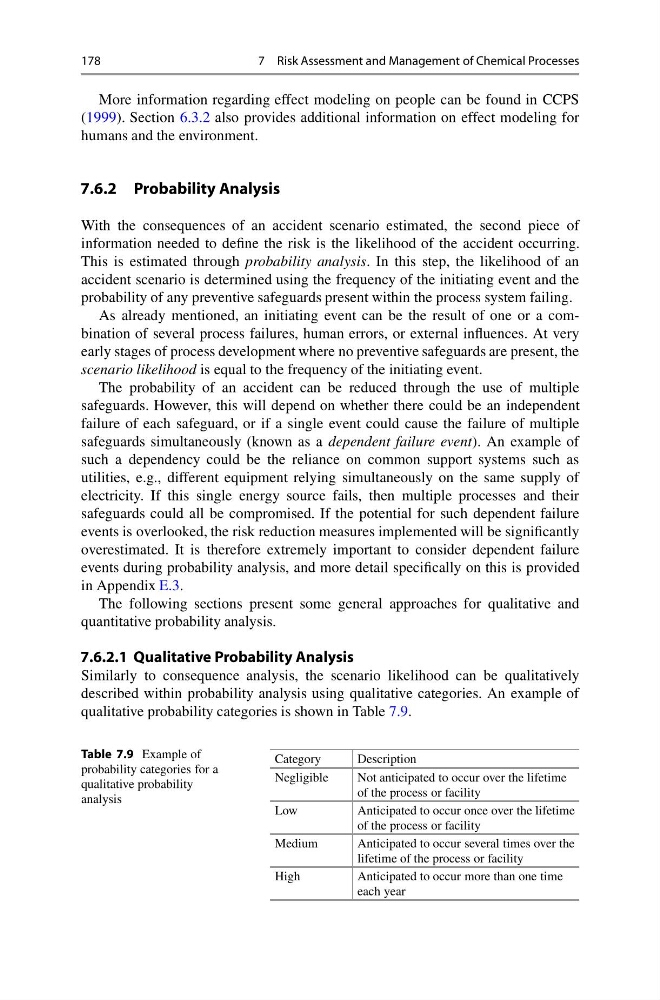
Similarly to consequence analysis, the scenario likelihood can be qualitatively
described within probability analysis using qualitative categories. An example of
qualitative probability categories is shown in Table 7.9.
Table 7.9 Example of
probability categories for a
qualitative probability
analysis
Category
Description
Negligible
Not anticipated to occur over the lifetime
of the process or facility
Low
Anticipated to occur once over the lifetime
of the process or facility
Medium
Anticipated to occur several times over the
lifetime of the process or facility
High
Anticipated to occur more than one time
each year
7 Risk Assessment and Management of Chemical Processes
More information regarding effect modeling on people can be found in CCPS
(1999). Section 6.3.2 also provides additional information on effect modeling for
humans and the environment.
7.6.2 Probability Analysis
With the consequences of an accident scenario estimated, the second piece of
information needed to define the risk is the likelihood of the accident occurring.
This is estimated through probability analysis. In this step, the likelihood of an
accident scenario is determined using the frequency of the initiating event and the
probability of any preventive safeguards present within the process system failing.
As already mentioned, an initiating event can be the result of one or a combination of several process failures, human errors, or external influences. At very
early stages of process development where no preventive safeguards are present, the
scenario likelihood is equal to the frequency of the initiating event.
The probability of an accident can be reduced through the use of multiple
safeguards. However, this will depend on whether there could be an independent
failure of each safeguard, or if a single event could cause the failure of multiple
safeguards simultaneously (known as a dependent failure event). An example of
such a dependency could be the reliance on common support systems such as
utilities, e.g., different equipment relying simultaneously on the same supply of
electricity. If this single energy source fails, then multiple processes and their
safeguards could all be compromised. If the potential for such dependent failure
events is overlooked, the risk reduction measures implemented will be significantly
overestimated. It is therefore extremely important to consider dependent failure
events during probability analysis, and more detail specifically on this is provided
in Appendix E.3.
The following sections present some general approaches for qualitative and
quantitative probability analysis.
7.6.2.1 Qualitative Probability Analysis
Similarly to consequence analysis, the scenario likelihood can be qualitatively
described within probability analysis using qualitative categories. An example of
qualitative probability categories is shown in Table 7.9.
Table 7.9 Example of
probability categories for a
qualitative probability
analysis
Category
Description
Negligible
Not anticipated to occur over the lifetime
of the process or facility
Low
Anticipated to occur once over the lifetime
of the process or facility
Medium
Anticipated to occur several times over the
lifetime of the process or facility
High
Anticipated to occur more than one time
each year