

174
7 Risk Assessment and Management of Chemical Processes
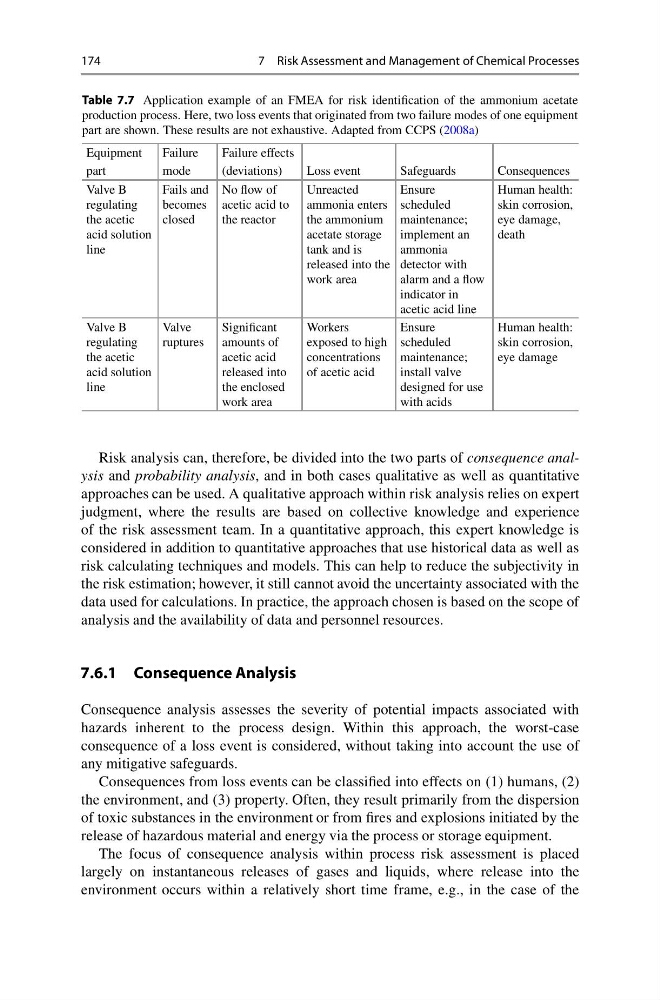
Table 7.7 Application example of an FMEA for risk identification of the ammonium acetate
production process. Here, two loss events that originated from two failure modes of one equipment
part are shown. These results are not exhaustive. Adapted from CCPS (2008a)
Equipment
Failure
Failure effects
part
mode
(deviations)
Loss event
Safeguards
Consequences
Valve B
regulating
the acetic
acid solution
line
Fails and
becomes
closed
No flow of
acetic acid to
the reactor
Unreacted
ammonia enters
the ammonium
acetate storage
tank and is
released into the
work area
Ensure
scheduled
maintenance;
implement an
ammonia
detector with
alarm and a flow
indicator in
acetic acid line
Human health:
skin corrosion,
eye damage,
death
Valve B
regulating
the acetic
acid solution
line
Valve
ruptures
Significant
amounts of
acetic acid
released into
the enclosed
work area
Workers
exposed to high
concentrations
of acetic acid
Ensure
scheduled
maintenance;
install valve
designed for use
with acids
Human health:
skin corrosion,
eye damage
Risk analysis can, therefore, be divided into the two parts of consequence analysis and probability analysis, and in both cases qualitative as well as quantitative
approaches can be used. A qualitative approach within risk analysis relies on expert
judgment, where the results are based on collective knowledge and experience
of the risk assessment team. In a quantitative approach, this expert knowledge is
considered in addition to quantitative approaches that use historical data as well as
risk calculating techniques and models. This can help to reduce the subjectivity in
the risk estimation; however, it still cannot avoid the uncertainty associated with the
data used for calculations. In practice, the approach chosen is based on the scope of
analysis and the availability of data and personnel resources.
7.6.1 Consequence Analysis
Consequence analysis assesses the severity of potential impacts associated with
hazards inherent to the process design. Within this approach, the worst-case
consequence of a loss event is considered, without taking into account the use of
any mitigative safeguards.
Consequences from loss events can be classified into effects on (1) humans, (2)
the environment, and (3) property. Often, they result primarily from the dispersion
of toxic substances in the environment or from fires and explosions initiated by the
release of hazardous material and energy via the process or storage equipment.
The focus of consequence analysis within process risk assessment is placed
largely on instantaneous releases of gases and liquids, where release into the
environment occurs within a relatively short time frame, e.g., in the case of the
7 Risk Assessment and Management of Chemical Processes
Table 7.7 Application example of an FMEA for risk identification of the ammonium acetate
production process. Here, two loss events that originated from two failure modes of one equipment
part are shown. These results are not exhaustive. Adapted from CCPS (2008a)
Equipment
Failure
Failure effects
part
mode
(deviations)
Loss event
Safeguards
Consequences
Valve B
regulating
the acetic
acid solution
line
Fails and
becomes
closed
No flow of
acetic acid to
the reactor
Unreacted
ammonia enters
the ammonium
acetate storage
tank and is
released into the
work area
Ensure
scheduled
maintenance;
implement an
ammonia
detector with
alarm and a flow
indicator in
acetic acid line
Human health:
skin corrosion,
eye damage,
death
Valve B
regulating
the acetic
acid solution
line
Valve
ruptures
Significant
amounts of
acetic acid
released into
the enclosed
work area
Workers
exposed to high
concentrations
of acetic acid
Ensure
scheduled
maintenance;
install valve
designed for use
with acids
Human health:
skin corrosion,
eye damage
Risk analysis can, therefore, be divided into the two parts of consequence analysis and probability analysis, and in both cases qualitative as well as quantitative
approaches can be used. A qualitative approach within risk analysis relies on expert
judgment, where the results are based on collective knowledge and experience
of the risk assessment team. In a quantitative approach, this expert knowledge is
considered in addition to quantitative approaches that use historical data as well as
risk calculating techniques and models. This can help to reduce the subjectivity in
the risk estimation; however, it still cannot avoid the uncertainty associated with the
data used for calculations. In practice, the approach chosen is based on the scope of
analysis and the availability of data and personnel resources.
7.6.1 Consequence Analysis
Consequence analysis assesses the severity of potential impacts associated with
hazards inherent to the process design. Within this approach, the worst-case
consequence of a loss event is considered, without taking into account the use of
any mitigative safeguards.
Consequences from loss events can be classified into effects on (1) humans, (2)
the environment, and (3) property. Often, they result primarily from the dispersion
of toxic substances in the environment or from fires and explosions initiated by the
release of hazardous material and energy via the process or storage equipment.
The focus of consequence analysis within process risk assessment is placed
largely on instantaneous releases of gases and liquids, where release into the
environment occurs within a relatively short time frame, e.g., in the case of the