

7.6 Risk Analysis (Step 4)
173
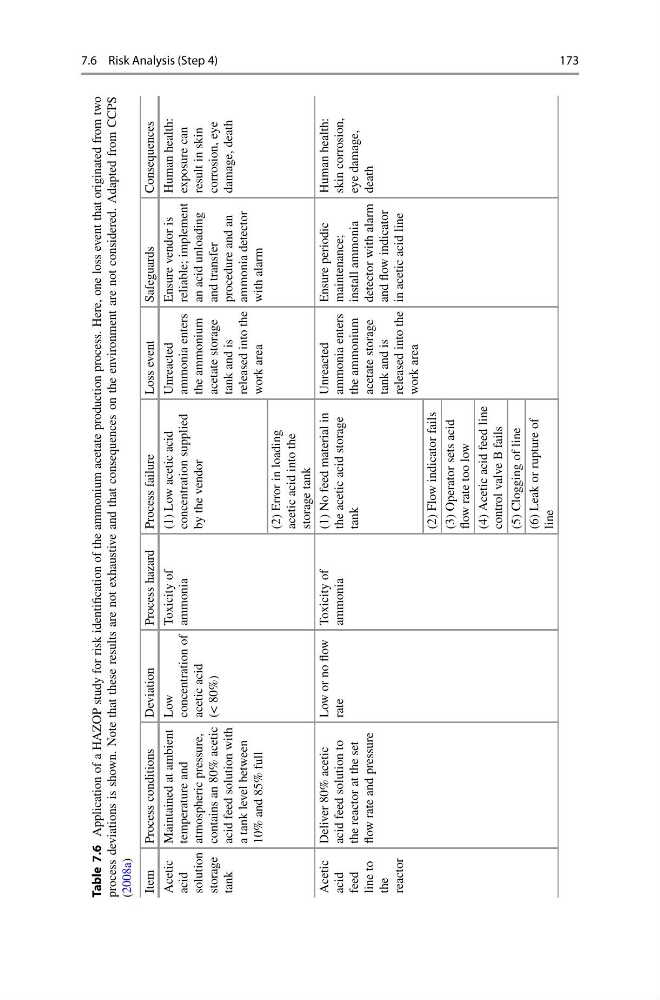
Table 7.6
Application of a HAZOP study for risk identification of the ammonium acetate production process. Here, one loss event that originated from two
process deviations is shown. Note that these results are not exhaustive and that consequences on the environment are not considered. Adapted from CCPS
(2008a)
Item
Process conditions
Deviation
Process hazard
Process failure
Loss event
Safeguards
Consequences
Acetic
acid
solution
storage
tank
Maintained at ambient
temperature and
atmospheric pressure,
contains an 80% acetic
acid feed solution with
a tank level between
10% and 85% full
Low
concentration of
acetic acid
(< 80%)
Toxicity of
ammonia
(1) Low acetic acid
concentration supplied
by the vendor
Unreacted
ammonia enters
the ammonium
acetate storage
tank and is
released into the
work area
Ensure vendor is
reliable; implement
an acid unloading
and transfer
procedure and an
ammonia detector
with alarm
Human health:
exposure can
result in skin
corrosion, eye
damage, death
(2) Error in loading
acetic acid into the
storage tank
Acetic
acid
feed
line to
the
reactor
Deliver 80% acetic
acid feed solution to
the reactor at the set
flow rate and pressure
Low or no flow
rate
Toxicity of
ammonia
(1) No feed material in
the acetic acid storage
tank
Unreacted
ammonia enters
the ammonium
acetate storage
tank and is
released into the
work area
Ensure periodic
maintenance;
install ammonia
detector with alarm
and flow indicator
in acetic acid line
Human health:
skin corrosion,
eye damage,
death
(2) Flow indicator fails
(3) Operator sets acid
flow rate too low
(4) Acetic acid feed line
control valve B fails
(5) Clogging of line
(6) Leak or rupture of
line
173
Table 7.6
Application of a HAZOP study for risk identification of the ammonium acetate production process. Here, one loss event that originated from two
process deviations is shown. Note that these results are not exhaustive and that consequences on the environment are not considered. Adapted from CCPS
(2008a)
Item
Process conditions
Deviation
Process hazard
Process failure
Loss event
Safeguards
Consequences
Acetic
acid
solution
storage
tank
Maintained at ambient
temperature and
atmospheric pressure,
contains an 80% acetic
acid feed solution with
a tank level between
10% and 85% full
Low
concentration of
acetic acid
(< 80%)
Toxicity of
ammonia
(1) Low acetic acid
concentration supplied
by the vendor
Unreacted
ammonia enters
the ammonium
acetate storage
tank and is
released into the
work area
Ensure vendor is
reliable; implement
an acid unloading
and transfer
procedure and an
ammonia detector
with alarm
Human health:
exposure can
result in skin
corrosion, eye
damage, death
(2) Error in loading
acetic acid into the
storage tank
Acetic
acid
feed
line to
the
reactor
Deliver 80% acetic
acid feed solution to
the reactor at the set
flow rate and pressure
Low or no flow
rate
Toxicity of
ammonia
(1) No feed material in
the acetic acid storage
tank
Unreacted
ammonia enters
the ammonium
acetate storage
tank and is
released into the
work area
Ensure periodic
maintenance;
install ammonia
detector with alarm
and flow indicator
in acetic acid line
Human health:
skin corrosion,
eye damage,
death
(2) Flow indicator fails
(3) Operator sets acid
flow rate too low
(4) Acetic acid feed line
control valve B fails
(5) Clogging of line
(6) Leak or rupture of
line