

172
7 Risk Assessment and Management of Chemical Processes
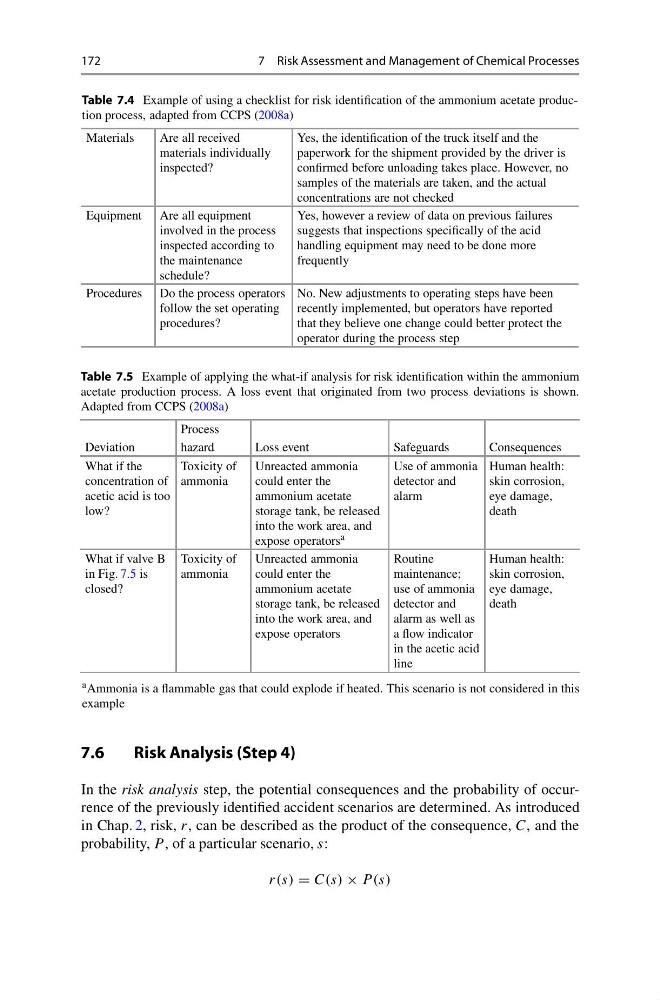
Table 7.4 Example of using a checklist for risk identification of the ammonium acetate production process, adapted from CCPS (2008a)
Materials
Are all received
materials individually
inspected?
Yes, the identification of the truck itself and the
paperwork for the shipment provided by the driver is
confirmed before unloading takes place. However, no
samples of the materials are taken, and the actual
concentrations are not checked
Equipment Are all equipment
involved in the process
inspected according to
the maintenance
schedule?
Yes, however a review of data on previous failures
suggests that inspections specifically of the acid
handling equipment may need to be done more
frequently
Procedures Do the process operators
follow the set operating
procedures?
No. New adjustments to operating steps have been
recently implemented, but operators have reported
that they believe one change could better protect the
operator during the process step
Table 7.5 Example of applying the what-if analysis for risk identification within the ammonium
acetate production process. A loss event that originated from two process deviations is shown.
Adapted from CCPS (2008a)
Process
Deviation
hazard
Loss event
Safeguards
Consequences
What if the
concentration of
acetic acid is too
low?
Toxicity of
ammonia
Unreacted ammonia
could enter the
ammonium acetate
storage tank, be released
into the work area, and
expose operators a
Use of ammonia
detector and
alarm
Human health:
skin corrosion,
eye damage,
death
What if valve B
in Fig. 7.5 is
closed?
Toxicity of
ammonia
Unreacted ammonia
could enter the
ammonium acetate
storage tank, be released
into the work area, and
expose operators
Routine
maintenance;
use of ammonia
detector and
alarm as well as
a flow indicator
in the acetic acid
line
Human health:
skin corrosion,
eye damage,
death
a Ammonia is a flammable gas that could explode if heated. This scenario is not considered in this
example
7.6
Risk Analysis (Step 4)
In the risk analysis step, the potential consequences and the probability of occurrence of the previously identified accident scenarios are determined. As introduced
in Chap. 2, risk, r, can be described as the product of the consequence, C, and the
probability, P , of a particular scenario, s:
r(s) = C(s) × P (s)
7 Risk Assessment and Management of Chemical Processes
Table 7.4 Example of using a checklist for risk identification of the ammonium acetate production process, adapted from CCPS (2008a)
Materials
Are all received
materials individually
inspected?
Yes, the identification of the truck itself and the
paperwork for the shipment provided by the driver is
confirmed before unloading takes place. However, no
samples of the materials are taken, and the actual
concentrations are not checked
Equipment Are all equipment
involved in the process
inspected according to
the maintenance
schedule?
Yes, however a review of data on previous failures
suggests that inspections specifically of the acid
handling equipment may need to be done more
frequently
Procedures Do the process operators
follow the set operating
procedures?
No. New adjustments to operating steps have been
recently implemented, but operators have reported
that they believe one change could better protect the
operator during the process step
Table 7.5 Example of applying the what-if analysis for risk identification within the ammonium
acetate production process. A loss event that originated from two process deviations is shown.
Adapted from CCPS (2008a)
Process
Deviation
hazard
Loss event
Safeguards
Consequences
What if the
concentration of
acetic acid is too
low?
Toxicity of
ammonia
Unreacted ammonia
could enter the
ammonium acetate
storage tank, be released
into the work area, and
expose operators a
Use of ammonia
detector and
alarm
Human health:
skin corrosion,
eye damage,
death
What if valve B
in Fig. 7.5 is
closed?
Toxicity of
ammonia
Unreacted ammonia
could enter the
ammonium acetate
storage tank, be released
into the work area, and
expose operators
Routine
maintenance;
use of ammonia
detector and
alarm as well as
a flow indicator
in the acetic acid
line
Human health:
skin corrosion,
eye damage,
death
a Ammonia is a flammable gas that could explode if heated. This scenario is not considered in this
example
7.6
Risk Analysis (Step 4)
In the risk analysis step, the potential consequences and the probability of occurrence of the previously identified accident scenarios are determined. As introduced
in Chap. 2, risk, r, can be described as the product of the consequence, C, and the
probability, P , of a particular scenario, s:
r(s) = C(s) × P (s)